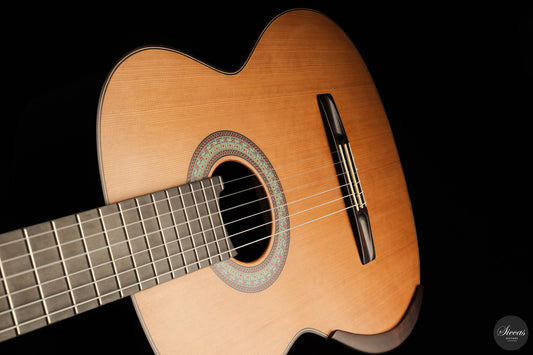
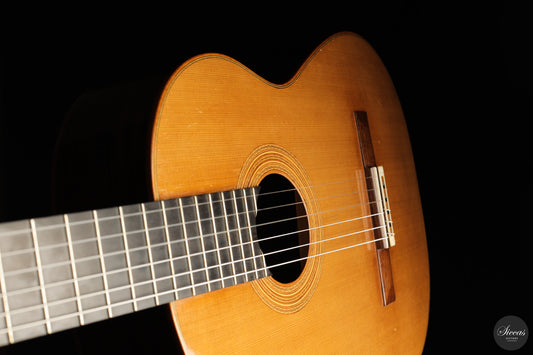
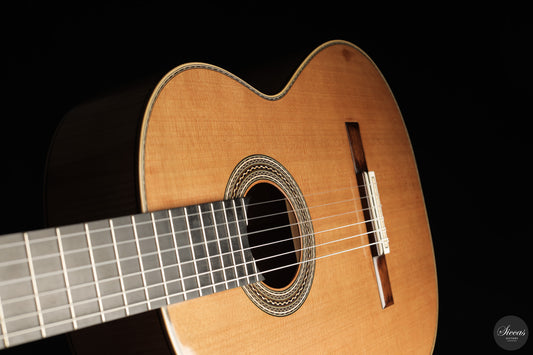
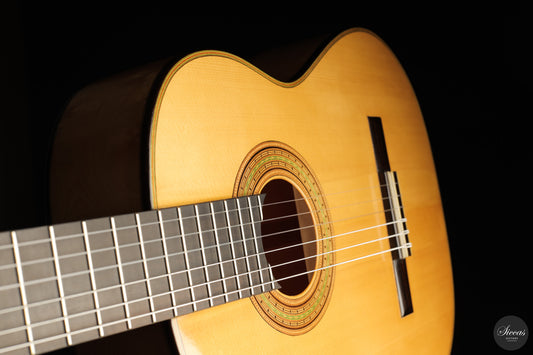
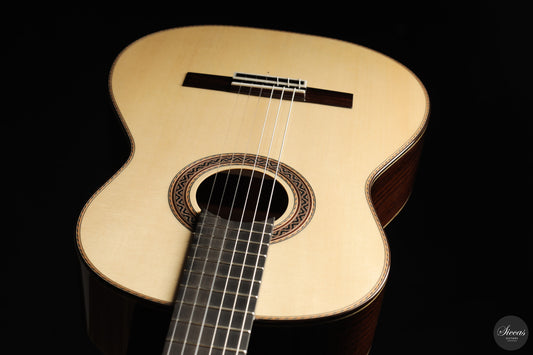
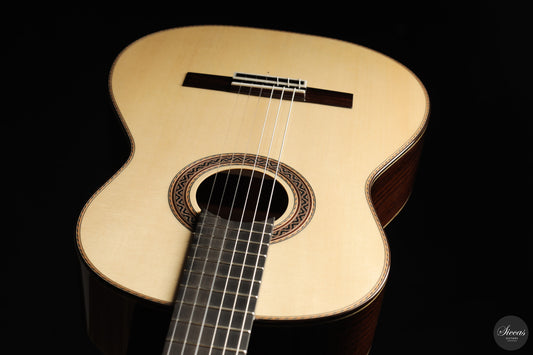
Raimundo Guitars – Handmade in Spain Since 1880
Raimundo is one of Spain's most enduring guitar manufacturers, rooted in the rich lutherie tradition of Valencia. Founded in 1880, the workshop has spent well over a century producing classical, flamenco, and acoustic guitars that carry the unmistakable character of Spanish craftsmanship. For students, advancing players, and professionals alike, Raimundo instruments represent a direct connection to the geographical and cultural heart of guitar making.
Valencia has long served as a centre of Spanish lutherie — a city where workshop skills were passed down through generations, and where climate, the timber trade, and a deep musical culture combined to create ideal conditions for guitar production. Raimundo emerged from this tradition and has maintained its presence there for more than 140 years.
The History of Raimundo Guitars
The origins of Raimundo Guitars reach back to 1880, placing the workshop among the oldest active guitar manufacturers in Spain. The company grew out of the Valencian lutherie tradition, a school of guitar making that developed alongside — and in dialogue with — the Andalusian workshops of Granada and Seville. While those southern cities are often cited for the genealogy of the modern classical guitar, Valencia developed its own distinct manufacturing culture, particularly well suited to producing instruments in larger series without sacrificing construction quality.
Throughout the twentieth century, Raimundo established itself as a trusted name for consistent, well-built guitars across a wide range of price points. The workshop became known for reliable cedar and spruce tops, properly braced bodies, and necks shaped to suit the demands of serious study. These qualities made Raimundo instruments a natural choice for conservatories, music schools, and individual students beginning their journey with the classical guitar.
The Tatyana Ryzhkova signature model represents one of the more prominent collaborations in the workshop's recent history. Ryzhkova, an internationally active classical guitarist, worked with Raimundo on a model designed to meet the demands of professional performance — a collaboration that signals the company's continued ambition beyond the student market.
Construction and Materials
Raimundo guitars are built using materials and methods consistent with Spanish lutherie practice. Classical models typically feature solid cedar or solid spruce soundboards, with cypress, rosewood, or mahogany used for the back and sides depending on the model tier. The choice of top wood has a direct bearing on the character of the instrument: cedar tends to produce a warmer, more immediately responsive sound, while spruce rewards a more developed right-hand technique with a brighter, more projecting tone.
The internal bracing follows the traditional fan-bracing system associated with Spanish classical guitar construction. This system distributes the vibration of the top across a series of radiating struts, shaping the instrument's tonal response. Higher-tier Raimundo models use more carefully selected tonewoods and more refined finishing, resulting in instruments with greater tonal complexity and longer sustain.
Flamenco models in the Raimundo range are built with the characteristics specific to that tradition: lighter construction, lower action, and cypress back and sides, which contribute the sharp, percussive attack that flamenco technique demands. Golpeadores — the transparent tap plates fitted to the top — protect the soundboard during the rhythmic strumming and percussive playing central to flamenco.
Acoustic guitar models in the range extend the Raimundo offer to players whose needs go beyond the classical or flamenco idiom. These instruments use steel strings and internal bracing adapted accordingly, typically with X-bracing or variants suited to the greater string tension of steel.
The Raimundo Model Range
Raimundo organises its classical guitar range around a numbered system. Entry-level and student models occupy the lower numbers, while higher numbers indicate increased specification, more carefully selected tonewoods, and more refined workmanship. Among the most referenced models are the 104, 118, and 155.
Model 104
The 104 is a widely recommended beginner model. It typically features a solid cedar top with laminated back and sides, producing a warm and accessible tone suited to the early stages of study. The action and neck profile are set up to encourage good left-hand technique without excessive difficulty for the developing student. For anyone beginning to explore the path of learning classical guitar, an instrument at this level offers reliable intonation and consistent playability without the investment required for a higher-tier guitar.
Model 118
The 118 occupies the intermediate tier. With improved tonewoods and more refined construction details compared to the entry-level instruments, it suits students who have progressed past the earliest stages and are beginning to work on more demanding repertoire. The tonal palette becomes more expressive at this level, with better separation between bass and treble registers and stronger overall projection.
Model 155
The 155 moves into the upper-intermediate range. Solid tops combined with solid or higher-grade back and sides produce an instrument whose tonal qualities approach those of a professional instrument. Players working on concert-level repertoire — the sonatas, variations, and studies that form the core of the classical guitar canon — will find at this level an instrument that responds to the nuances of a developed technique.
The Valencian Lutherie Tradition
To understand Raimundo guitars, it helps to understand the city in which they are made. Valencia sits on Spain's Mediterranean coast, and its guitar-making tradition has roots in the nineteenth century. The city became a centre of instrument production in part because of its position as a trading hub, and in part because of craftsmen who settled there and established workshops over successive generations. The combination of local timber supplies, a tradition of fine woodworking, and a strong regional musical culture created the conditions for a sustained lutherie industry.
Valencian guitars are sometimes distinguished from their Andalusian counterparts by a slightly different approach to construction — one that lends itself more readily to workshop production while maintaining the essential qualities of Spanish guitar making: the Spanish-heel neck joint, traditional fan bracing, and finishing methods developed over many decades. Raimundo has operated within this tradition throughout its existence, and its instruments carry that heritage in their construction details.
The great nineteenth-century repertoire of the classical guitar — the works of Francisco Tárrega, who himself was born in the Valencian region, and the concert pieces that followed in his wake — was written in an environment where the Spanish guitar was being actively refined and developed. Raimundo's long presence in that city places the workshop at the centre of that history.
Raimundo at Siccas Guitars
Siccas Guitars carries Raimundo instruments as part of a broader selection of classical guitars suited to players at different stages of development. The Raimundo range fits naturally into a guitar programme that spans student instruments through to professional-grade handmade guitars.
The following video, recorded at Siccas Guitars, demonstrates the tonal character and playability of a Raimundo instrument in a performance context.
Hearing the guitar played by an experienced musician gives a clearer sense of what a Raimundo instrument can do than any written description. The warmth, clarity, and evenness across the range that Raimundo has cultivated over more than a century of production comes through in the recorded sound.
Raimundo and the Flamenco Tradition
Alongside classical guitars, Raimundo has a long history of producing flamenco instruments. The flamenco guitar is a distinct instrument from the classical guitar — not merely a classical guitar played in a different style, but an instrument built with different priorities: lightness, immediacy of response, a cutting percussive attack, and a bright, dry tonal character well suited to ensemble playing with cante (voice) and baile (dance).
Traditional flamenco guitars use cypress for the back and sides — a wood choice that contributes to the characteristic brightness and dryness of the flamenco sound. The tops are typically thinner than on a classical guitar, and the bracing is lighter, producing a faster, more sensitive response to the attacking strokes of flamenco technique. The action is set lower, enabling the rapid, close-to-the-body playing position characteristic of flamenco performance.
Raimundo flamenco models carry these construction principles. For players who want to explore the rhythmic complexity and emotional intensity of flamenco guitar, a Raimundo instrument provides a properly built starting point — one suited to the demands of the style rather than merely a repurposed classical guitar.
Choosing a Raimundo Guitar
The decision about which Raimundo model suits you depends primarily on where you are in your development and what kind of music you intend to play.
For students beginning their first serious engagement with the classical guitar, the entry-level models offer a solid foundation. The most important qualities at this stage are reliable intonation, comfortable playability, and a consistent tone that does not obstruct learning. A poorly set-up instrument can make the early stages of study unnecessarily difficult; a well-made student guitar removes that obstacle.
For players who have been studying for some time and are beginning to work on more substantial repertoire — Baroque transcriptions, the etudes of Fernando Sor and Mauro Giuliani, early twentieth-century concert pieces — an intermediate-tier instrument offers the tonal range and dynamic response that more advanced playing requires. At this level, the difference between a good instrument and a mediocre one becomes audible in performance.
Players approaching professional-level work, or those who have developed a strong technique and wish to invest in an instrument that will serve them for many years, should consider the upper-tier models. These instruments also pair well with the demands of repertoire such as Recuerdos de la Alhambra — a piece that requires both sensitivity in the treble register and a solid, resonant bass.
The Importance of Spanish Lutherie
The classical guitar as we know it today was shaped in nineteenth-century Spain — by the workshops of Seville, Granada, and Valencia, and by the musicians who worked with those workshops to develop an instrument capable of meeting the demands of the concert stage. The fan-braced body, the Spanish-heel neck joint, the choice of tonewoods, the scale length — all of these elements were established through a process of development that took place over many decades in Spanish workshops.
Raimundo is part of this tradition in a direct, unbroken way. The workshop has been active since 1880, which means it predates many of the most celebrated twentieth-century developments in Spanish lutherie. When a player picks up a Raimundo guitar for the first time, they are holding an instrument whose construction methods derive from a tradition that is both ancient and living — one that connects the modern concert stage to the workshops of nineteenth-century Valencia.
For players who value that connection — who want an instrument genuinely rooted in the historical and geographical centre of the classical guitar — Raimundo's long presence in Valencia gives its instruments a particular kind of authenticity.
Care and Maintenance
Classical guitars, including Raimundo instruments, require consistent care to maintain their playability and tonal quality. The most important factor is humidity control: solid wood tops, backs, and sides are sensitive to changes in ambient humidity. Sustained exposure to very low humidity — common in centrally heated environments during winter — can cause cracking or structural damage. A case humidifier and a consistent storage environment are the most effective preventive measures.
String choice is a further consideration. Classical guitars use nylon strings, and the tension, material, and construction of the strings all affect both tone and playability. Different players and different instruments respond differently to various string types; finding the right combination is part of the process of developing a relationship with a particular guitar.
Regular attention to the nut and saddle, fret condition, and neck relief ensures that the instrument remains correctly set up as it ages. A well-maintained Raimundo guitar will play reliably for many years.
Summary
Raimundo Guitars brings together more than 140 years of Valencian lutherie tradition, a comprehensive range of classical, flamenco, and acoustic instruments, and a reputation for consistent quality across student, intermediate, and professional tiers. For players looking to explore the classical guitar — whether beginning their study or deepening an established practice — a Raimundo instrument offers a genuine connection to the Spanish tradition that shaped the instrument.
Siccas Guitars offers the Raimundo range alongside a wider selection of instruments for players at every level. Explore our full range of classical guitars or learn more about the players and repertoire that have shaped the instrument through our profiles of great classical guitarists.