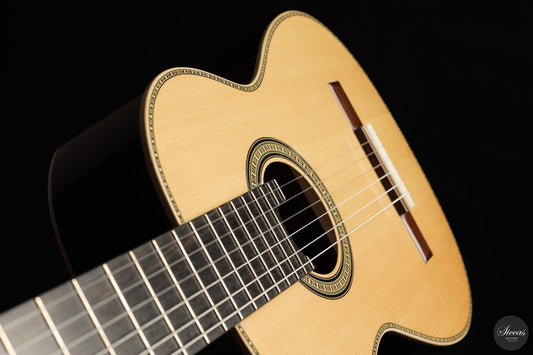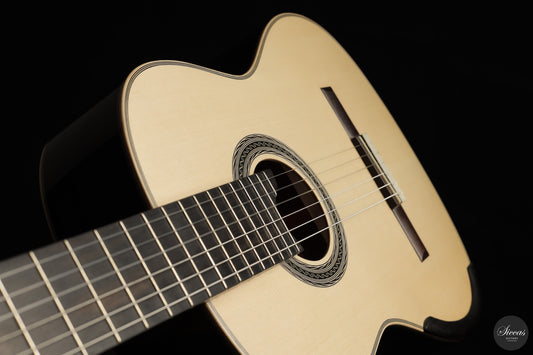

Robert Bouchet – The Painter Who Founded the French Guitar School
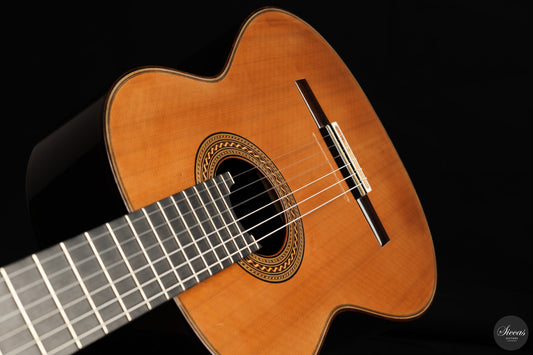
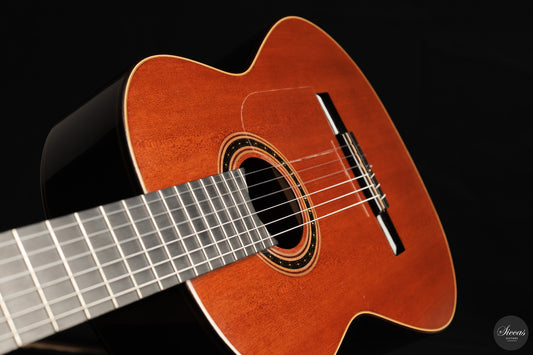
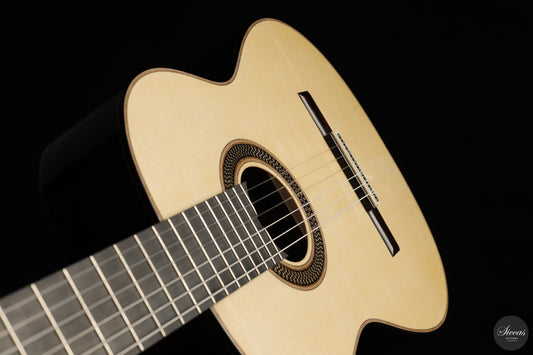
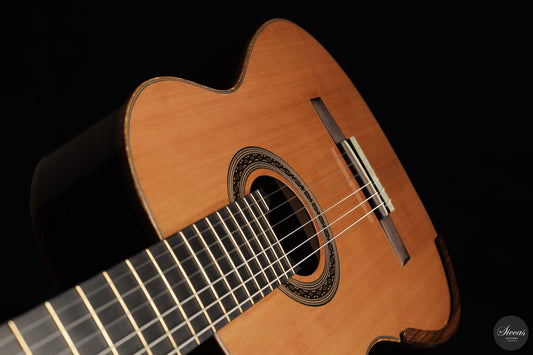
Robert Bouchet (1898–1986) stands as one of the most consequential luthiers of the twentieth century. A Paris-based painter who came to guitar making entirely on his own terms, he produced approximately 180 instruments across four decades — each one hand-crafted, each one the result of a mind trained to see rather than to copy. The guitarists who played his instruments — Ida Presti, Alexandre Lagoya, and Julian Bream among them — considered Bouchet's guitars to be in a class of their own. Today, surviving examples are among the most valuable and sought-after 20th-century classical guitars in the world.
What makes Bouchet's story unusual in the history of lutherie is precisely that he had no formal training as an instrument maker. He learned to build guitars the way a painter learns to paint: by looking carefully, by experimenting, by rejecting whatever did not work. That independence of method gave him a perspective no apprentice-trained craftsman could have reached, and it left a permanent mark on the French tradition of classical guitar making.
From the Canvas to the Workshop
Bouchet was born in Paris in 1898 and spent most of his professional life as a painter and drawing teacher. His entry into lutherie came relatively late: he built his first guitar in the 1940s, motivated not by a desire to become a professional craftsman but by a deep personal interest in the instrument and its acoustics. He had no workshop lineage to fall back on — no established French tradition of guitar making to apprentice within — so he developed his methods by studying the physics of resonance, experimenting with woods, and listening to the results.
This approach placed him outside the mainstream from the start. While most luthiers of the mid-20th century worked within inherited systems, Bouchet questioned those systems at a fundamental level. He was particularly interested in the bracing of the soundboard — the internal architecture that determines how a guitar's top vibrates, and therefore how it projects and responds. His most significant structural innovation was a modified fan-bracing system that included what became known as the Bouchet bar: a transverse brace placed in a specific relationship to the fan struts, designed to control the bass register and improve the instrument's tonal balance across the strings.
This was not a cosmetic adjustment. The Bouchet bar changed the physics of how the soundboard moved, and the sonic result was unmistakable: a tone that combined warmth in the bass with clarity in the treble, and a sustain that players described as singing rather than fading. The instruments responded easily under the fingers and projected with an authority that belied their delicacy. For concert guitarists performing in halls rather than salons, that combination was exactly what they needed.
The Guitarists Who Chose Bouchet
Ida Presti and Alexandre Lagoya were the defining guitar duo of the mid-20th century — the two players most responsible for establishing the guitar duet as a serious concert form. Both played Bouchet guitars, and their choice was not incidental. Presti in particular was one of the most technically gifted guitarists of her generation, and she required instruments that could sustain under the physical demands of performance at the highest level. A Bouchet guitar in her hands carried a particular authority: the sound was full-bodied, the response immediate, the tone distinctive.
Julian Bream, the British guitarist who did more than almost anyone else to expand the classical guitar repertoire in the second half of the 20th century, also performed on Bouchet instruments. Bream was known for his exacting standards and his willingness to be specific about what he needed from a guitar. That he chose Bouchet's work is a strong endorsement of both the quality and the character of those instruments. For great classical guitarists of this period, a Bouchet guitar was not merely a tool — it was a statement about the level of playing they aspired to.
The music these players performed on Bouchet guitars ranged across the entire classical repertoire. The works of Francisco Tárrega — whose own luthiers had helped define the Spanish tradition Bouchet was now answering from a French perspective — were central to the concert programs of the era. So were the suites and transcriptions of Johann Sebastian Bach, whose counterpoint demands exceptional clarity from the instrument. And the South American repertoire — above all the music of Agustín Barrios Mangoré — placed its own demands on sustain and tonal depth. A Bouchet guitar met all of these challenges.
Robert Bouchet at Siccas Guitars
The following video, recorded at Siccas Guitars, offers a rare opportunity to hear a historic instrument in a contemporary context. The sound speaks for itself.
Founding a French Tradition
Before Bouchet, France had no significant tradition of classical guitar making. The instrument's great 19th-century makers had been predominantly Spanish — Torres above all — and the tradition of serious lutherie had remained centred on Andalusia and Madrid. Bouchet changed that. By building instruments of international concert quality from his Paris workshop, he established that France could produce guitars that belonged at the highest level of the art.
More than that, he attracted the attention of other French craftsmen and passed on what he had learned. His influence on Daniel Friederich — who became one of the most important French luthiers of the late 20th century — is well documented. Friederich, who went on to build guitars for players including Narciso Yepes and John Williams, described Bouchet as a formative influence on his own approach to soundboard construction and tonal design. This transmission of knowledge, from Bouchet to Friederich and through Friederich to subsequent makers, is what allows historians to speak of a French school of guitar making. Bouchet was its founding figure.
The irony is that Bouchet himself never sought this role. He remained a painter throughout his life, and guitar making was always, in some sense, his second vocation. He did not operate a large workshop or take on many apprentices. He built carefully and slowly, and the approximately 180 instruments he completed over the course of his career reflect that deliberateness. Each one was a project in itself, not a production unit.
Design Principles and Tonal Philosophy
Bouchet's approach to instrument design was driven by a consistent set of priorities: evenness of response across the strings, clarity in the upper register, depth in the bass, and a sustain that supported rather than cluttered the musical line. He achieved these goals through a combination of careful wood selection, precise graduation of the soundboard, and his distinctive bracing system.
The choice of woods was critical. Bouchet was meticulous about the spruce he used for soundboards, selecting for stiffness-to-weight ratio and for the regularity of the grain. He was equally careful with the back and sides — typically rosewood — and paid close attention to how the different parts of the instrument interacted acoustically. This systems-level thinking, unusual for a self-taught craftsman, was one consequence of his training as a visual artist: he saw the instrument as a whole rather than as a collection of parts.
The Bouchet bar was not a fixed formula but a tool he adjusted from instrument to instrument depending on the specific properties of each soundboard. He was empirical in his approach: he tested, listened, and modified. This willingness to treat each guitar as an individual problem rather than a standardised production task is part of what makes surviving Bouchet instruments so varied in character and so valued by players today.
Legacy and Market Value
Bouchet died in 1986, having spent roughly four decades as a luthier while remaining, to the end, a working painter. The approximately 180 guitars he made are scattered across collections and concert stages worldwide. Instruments in good condition regularly change hands at figures that place them among the most expensive 20th-century classical guitars ever sold — a reflection both of their scarcity and of the sustained demand from serious players who know what they are.
The legacy extends beyond the instruments themselves. Bouchet's career demonstrated that a self-taught craftsman working outside the established centres of lutherie could produce instruments of the highest quality, and that the rigour of one discipline — in his case, painting — could be applied productively to another. For anyone interested in famous classical guitar pieces and the instruments on which they were first brought to concert audiences, Bouchet's guitars form an essential part of the story.
His influence on French lutherie was not exercised through institutional succession — there was no Bouchet atelier with a line of trained apprentices. It was, rather, an influence transmitted through the example of the instruments themselves and through the conversations he had with the craftsmen who came after him. That influence proved durable. The French school of classical guitar making that exists today — characterised by rigorous attention to acoustics, seriousness of purpose, and independence from convention — owes its formation to him.
Bouchet Guitars at Siccas Guitars
Siccas Guitars has a long history of handling instruments from the great mid-20th century makers. If you are looking for an instrument of the highest calibre — whether a historic piece or a contemporary master-built classical guitar — our team is available to help you find the right match for your playing and your ambitions.
The tradition Bouchet established continues to inform how the finest instruments are built and chosen today. His guitars remain in active use by concert players, and each performance on one of them is a continuation of the conversation between maker and musician that Bouchet began in his Paris workshop in the 1940s.