Spruce vs Cedar Classical Guitar: Which Top Is Right for You?
Walk into any serious classical guitar workshop and you will face this question almost immediately: spruce or cedar? The choice of tonewood for the soundboard — the large, book-matched panel that forms the top of the instrument — is arguably the single most influential decision in a guitar's construction. It shapes the instrument's tonal character, its dynamic range, its responsiveness, and how the sound will evolve over decades of playing. Yet despite its importance, the spruce versus cedar debate is one that confuses beginners and experienced players alike.
This guide cuts through the confusion. We look at the physical properties of both woods, explain precisely how those properties translate into sound, and help you decide which top suits your playing style, repertoire, and experience level — with concrete recommendations from our own collection.

The Soundboard: Why the Top Wood Matters Most
The soundboard of a classical guitar is responsible for converting the vibration of the strings — transmitted through the bridge and saddle — into audible sound. Unlike the back and sides, which primarily reflect and shape the internal air column, the top actively radiates sound into the room. Luthiers therefore regard the top wood as the primary voice of the instrument.
Both spruce and cedar are softwoods with excellent stiffness-to-weight ratios, meaning they are light enough to vibrate freely yet rigid enough to resist deformation under string tension. Beyond that shared suitability, however, the two species diverge considerably in their cellular structure, density, and working properties — and those differences are audible from the first note you play.
Spruce: The Traditional Choice
Physical Properties
The species most commonly used for classical guitar tops is European spruce (Picea abies), though Engelmann spruce and Sitka spruce also appear on quality instruments. European spruce grows slowly in the Alps and Carpathian mountains, producing wood with very tight, even annual rings — typically 12 to 20 rings per centimetre on a premium blank. This tight grain translates directly into high stiffness and low mass: exactly what a luthier needs for a responsive, powerful soundboard.
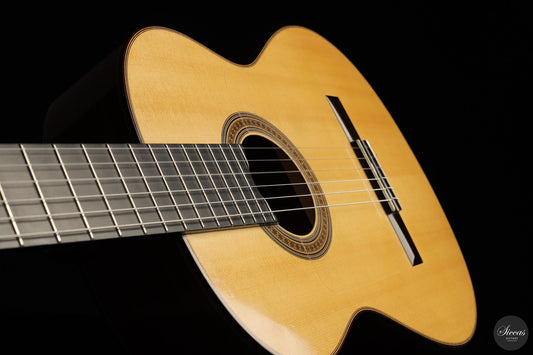
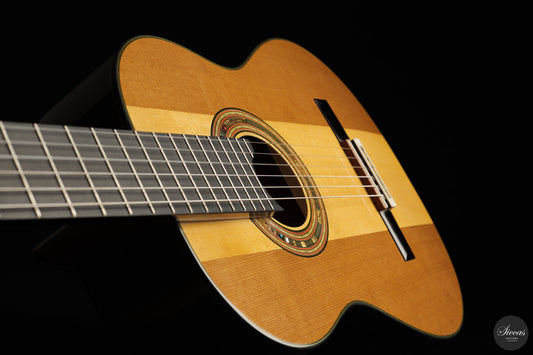
Visually, spruce tops range from creamy white to pale gold. They often display a subtle silk figure called "bear claw" when the light catches them at an angle, a feature highly prized by collectors. The wood is harder to work than cedar — it requires sharp tools and careful bracing — but it rewards skilled craftsmanship with exceptional longevity and tonal development.
How Spruce Sounds
Spruce produces a sound that players typically describe as bright, clear, and projecting. The attack — the moment the string is plucked and the note begins — is crisp and well-defined. Each note separates cleanly from its neighbours, giving polyphonic music exceptional clarity. The high frequencies are present without being harsh, and the midrange is focused rather than lush.
Crucially, spruce tops are known for their dynamic range. They respond differently at low volumes versus high volumes: at a gentle touch, the sound is intimate and controlled; pushed hard, the instrument opens up and fills a concert hall. This elasticity — what guitarists sometimes call "headroom" — makes spruce the preferred choice for professional concert performance, where the ability to shape phrasing with subtle variations in right-hand pressure is essential.
The one caveat with spruce is that a new instrument can feel slightly stiff and restrained. Spruce needs time and playing to reach its full potential. As the cellular walls gradually realign through vibration, the wood becomes more resonant and the tone warmer and richer — a process that can take anywhere from two to ten years of regular playing. An old, well-played spruce-top guitar is one of the most compelling sounds in all of acoustic music.
Who Should Choose Spruce?
Spruce is the natural home of the classical repertoire from the Baroque era through to the early twentieth century — Bach, Sor, Giuliani, Tárrega, and early Segovia all played or favoured instruments with spruce tops. If your repertoire is centred on this tradition, or if you play transcriptions of Baroque lute music, a spruce top will deliver the articulation and clarity those pieces demand. Spruce also suits players who value long-term investment: the instrument you buy today will sound noticeably better in five years and still better in twenty.
Concert players and advanced students almost universally gravitate toward spruce for its dynamic headroom. If you perform on stage regularly, the ability to project over a distance and to shape your sound with precision is difficult to replicate on any other top wood.
Browse our selection of spruce top classical guitars to hear this character for yourself.
Cedar: The Responsive Alternative
Physical Properties
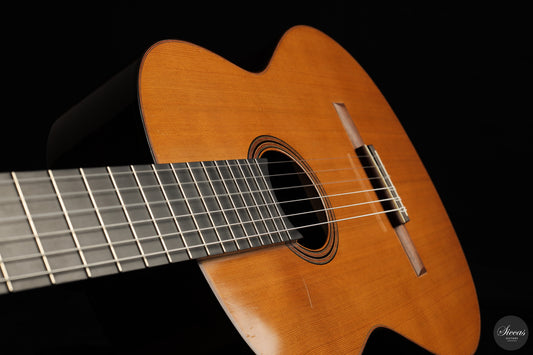
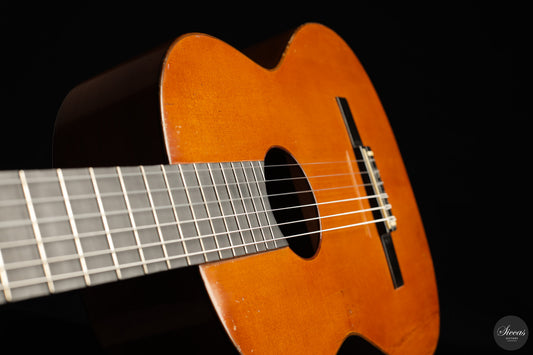
Western red cedar (Thuja plicata) became widely used on classical guitars from the 1960s onwards, when luthiers began experimenting with alternatives to the increasingly scarce supplies of fine European spruce. Cedar grows primarily along the Pacific coast of North America and is lighter, softer, and more porous than spruce. Its annual rings are typically wider and less uniform, and the wood has a distinctive reddish-brown colour with a warm, almost oily appearance.
Because cedar is softer and less stiff than spruce, luthiers must adjust their bracing patterns when working with it — using lighter, more flexible braces to compensate for the wood's natural compliance. A well-made cedar-top guitar is not a compromise; it is simply a different engineering solution, one that opens up a distinct tonal world.
How Cedar Sounds
Cedar sounds warm, rich, and immediate. Where spruce presents a bright, focused attack, cedar offers a rounder, more enveloping tone with a prominent midrange and a softer, more blended attack. The fundamental note is full and resonant from the very first day you play the instrument — cedar does not require the long "opening up" period that spruce demands. Many players describe a new cedar guitar as sounding like a mature instrument straight out of the box.
The warmth of cedar can be extraordinarily beautiful in slower, more lyrical music. Romantic and contemporary repertoire — Barrios, Villa-Lobos, Rodrigo, Brouwer — often sounds more naturally idiomatic on cedar because the wood's natural warmth and sustain support the singing, expressive lines these composers favoured. Fingerpicking at moderate volumes is particularly flattering: cedar responds to a lighter touch with a lush, velvety tone that spruce at the same dynamic level simply does not deliver.
Cedar's limitation is essentially the inverse of spruce's strength: its dynamic range is narrower. When pushed to high volumes, the tone can become slightly compressed or even harsh compared to the open, clean sound a spruce top produces under the same conditions. For intimate performances in smaller venues, or for recording in a studio context, this is rarely a problem. For projecting in a large concert hall without amplification, it can be a real constraint.
Cedar is also more sensitive to humidity changes than spruce and, being softer, is slightly more prone to surface dents and scratches. These are minor considerations with proper instrument care, but worth knowing.
Who Should Choose Cedar?
Cedar is an excellent choice for beginners and intermediate players. Because it responds to a lighter touch, it is more forgiving during the years when right-hand technique is still developing. You hear results immediately, which is motivating — the guitar sounds rich and musical even before your tone production is fully refined. Cedar also tends to be slightly less expensive at the entry and mid-range level, making it accessible for students.
Players who focus on Romantic or contemporary repertoire — from Agustín Barrios to Heitor Villa-Lobos — will often find cedar a natural match. The warm, singing tone suits these composers' expressive language beautifully. Guitarists who play primarily in smaller venues, in recordings, or at home will also find cedar's immediate response and tonal richness deeply satisfying.
Explore our range of cedar top classical guitars to find the instrument that speaks to your style.
Spruce vs Cedar: A Direct Comparison
The following summary maps the key differences side by side. Neither wood is objectively superior — both have produced some of the greatest concert instruments in history. The right choice depends entirely on you.
Tone Character
Spruce: Bright, clear, focused, excellent note separation. Strong attack, crystalline highs, defined midrange.
Cedar: Warm, round, lush, blended. Softer attack, prominent mids, rich fundamental.
Dynamic Range
Spruce: Wide — performs beautifully at both soft and loud dynamics; excels under hard playing.
Cedar: Narrower — best at low to medium volumes; can compress at full projection.
Break-In Period
Spruce: Significant — may sound slightly tight when new; improves dramatically over years.
Cedar: Minimal — sounds rich and open almost immediately from new.
Touch Sensitivity
Spruce: Rewards a confident, developed right-hand technique.
Cedar: Responds well to a lighter touch; forgiving for developing players.
Repertoire Fit
Spruce: Baroque, Classical period, early Romantic; contrapuntal and polyphonic music.
Cedar: Late Romantic, 20th-century, contemporary; lyrical and expressive music.
Best For
Spruce: Concert performers, advanced students, long-term investment players.
Cedar: Beginners and intermediate players, home and studio players, warm-tone seekers.
What the Luthiers Say: Hauser, Ramírez, and the Great Makers
The historical divide between spruce and cedar broadly mirrors a geographic and stylistic split in classical guitar making. The great German luthiers — the Hauser dynasty in particular — worked almost exclusively with European spruce, favouring its clarity and projection for the concert hall. José Ramírez III in Madrid, by contrast, was one of the first major Spanish builders to embrace cedar on a large scale in the 1960s, producing instruments with a warm, voluminous tone that became widely associated with the sound of classical guitar in the late twentieth century.
Today, most leading luthiers offer both options, and many players own instruments with each top wood to suit different repertoire and contexts. The debate is not one of right and wrong — it is a question of choosing the right voice for the music you want to make.
Video: Cedar vs Spruce — Hear the Difference
The best way to understand this tonal difference is to hear it. In this video from the Siccas Guitars workshop, you can listen to the two top woods played on comparable instruments under identical conditions:
Practical Buying Advice
If you are choosing your first or second classical guitar, start by thinking honestly about your playing context and goals. Here are four questions that will guide your decision:
1. How long have you been playing? If you are in your first three years of study, cedar's immediate responsiveness will reward you faster and help you stay motivated. Spruce's full potential may take longer to unlock without a well-developed technique.
2. What repertoire do you love most? Bach counterpoint and Tárrega etudes sound crisp and luminous on spruce. Barrios's La Catedral and the lush landscapes of Villa-Lobos feel most natural on cedar.
3. Where will you play most often? Stage concerts and large rooms favour spruce's projection. Home practice, small recitals, and recording sessions are ideal for cedar.
4. Are you buying for the long term? Spruce is the more durable long-term investment in terms of tonal development. A quality spruce guitar purchased today will still be improving twenty years from now.
If you are still undecided, the safest advice is to play both in person. Visit a specialist retailer and ask to compare spruce and cedar guitars of equivalent quality. The difference will be immediately apparent — and one of them will almost certainly feel like home.
You can browse our full range of classical guitars, filtered by top wood, on the Siccas Guitars website. Our team is happy to advise on any instrument in the collection.