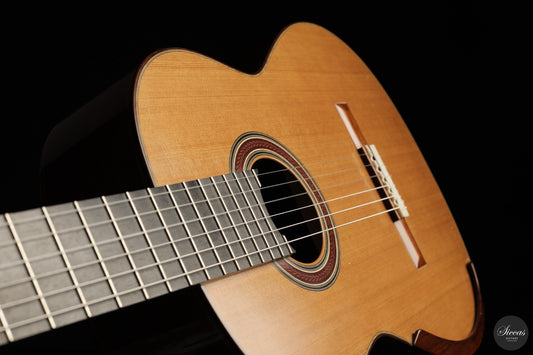

The Last of Us Guitar – Gustavo Santaolalla's Nylon-String Masterpiece
Few instruments have defined a piece of entertainment as completely as Gustavo Santaolalla's nylon-string guitar defined The Last of Us. The sparse, intimate sound of a single guitar — fragile, resonant, and utterly human — became the emotional backbone of one of the most celebrated video games of the 21st century, and later of one of the most acclaimed television adaptations in recent memory. Behind that sound is a composer and musician who spent decades perfecting a language of restraint, earning two Academy Awards along the way and reshaping what audiences expect from a film or game score.
Gustavo Santaolalla was born in 1951 in El Palomar, Buenos Aires, Argentina. He grew up surrounded by music and began playing guitar as a child, developing an instinct for texture and atmosphere long before he became a celebrated film composer. His early career took him through rock and experimental music in Argentina, where he co-founded the pioneering band Arco Iris in the late 1960s, a group that fused Argentine folk, rock, and psychedelia in ways that had no precedent in the country's musical landscape. That willingness to dissolve boundaries between genres and traditions would remain the defining feature of his work for the next half century.
In the 1990s, Santaolalla relocated to Los Angeles and began building a parallel career as a record producer and collaborator, working with artists across Latin America and establishing himself as a central figure in the Latin alternative scene. His production work gave him an international platform, but it was his film scoring that brought him to the broadest possible audience. The guitar — specifically the nylon-string guitar and the ruan, a Chinese plucked lute — became his preferred vehicle for emotional storytelling in cinematic contexts.
Two Academy Awards and a Language of Silence
Santaolalla's film scoring career reached its highest public recognition with back-to-back Academy Awards for Best Original Score. He won first for Ang Lee's Brokeback Mountain (2005), a film about forbidden love set against the Wyoming landscape, in which his guitar lines carried the weight of unspoken longing with extraordinary economy. The following year, he won again for Alejandro González Iñárritu's Babel (2006), a film spanning four continents whose emotional coherence depended largely on Santaolalla's score to find its common thread.
What united those scores — and what connects them to his video game work — is the principle of restraint. Santaolalla has described his compositional approach as finding the single note, the single phrase, that says everything without saying too much. In an era when film and game scores often reach for orchestral grandeur as a default, his preference for solo or near-solo guitar, for silence as a structural element, was a deliberate and radical choice. It was also, as audiences responded, exactly the right one.
His other notable scoring credits include Walter Salles's The Motorcycle Diaries (2004), Iñárritu's 21 Grams (2003), and Amores Perros (2000). Each of these films shares an emotional seriousness and a concern with characters under extreme pressure — precisely the conditions in which Santaolalla's spare guitar language proves most powerful.
The Last of Us: A Guitar That Carries the Weight of the World
The Last of Us was released by Naughty Dog and Sony Computer Entertainment in 2013 for the PlayStation 3. Set in a post-apocalyptic United States twenty years after a fungal pandemic has destroyed civilization, the game follows Joel, a smuggler hardened by personal loss, and Ellie, a teenager who may hold the key to a cure. The story is built around their evolving relationship — wary, painful, ultimately profound — and it asks the player to sit with moral ambiguity and emotional weight in ways that few games had attempted before.
Santaolalla's score was commissioned from the outset to serve that emotional ambition. Rather than composing a conventional action or horror soundtrack, he approached the project as he would a film: finding the emotional truth of the relationship between Joel and Ellie and building the music outward from that center. The main theme, played on nylon-string guitar with a fingerpicking pattern of striking simplicity, established immediately that this was not going to be a score about spectacle. It was a score about grief, love, and the stubborn persistence of human connection in impossible circumstances.
The guitar sound Santaolalla chose was not accidental. The nylon string — warmer, softer, more vulnerable than a steel-string acoustic — carries overtones of folk tradition, of the intimate and the handmade, that perfectly counterpoint the industrial ruin of the game's world. In a landscape of collapsed cities and overgrown highways, a single guitar playing something quietly beautiful is an act of resistance. It insists on interiority, on the life of the mind and heart, at exactly the moment when the exterior world is at its most brutal.
The theme's harmonic language is deceptively simple. Moving through a small number of chords with a patience that refuses urgency, it creates a kind of suspended time — the emotional space in which Joel and Ellie's bond develops across the game's long journey. That suspension, that quality of time held still, is one of Santaolalla's most characteristic compositional signatures, and it is nowhere more effective than here.
The Score in Detail: How Santaolalla Built the Sound
The production of the Last of Us score involved a deliberately constrained palette. Santaolalla worked with a small number of instruments, allowing silence and space to function as structural elements rather than filling the sonic landscape. The guitar was always at the center, but it was surrounded by carefully chosen textures — ambient drones, subtle percussion, occasional string arrangements — that expanded the emotional range without disturbing the intimacy of the guitar's voice.
The recording itself was done in a way that captured the natural resonance of the instrument. Close microphone placement, minimal processing, and a room sound that preserved the acoustic character of the guitar rather than situating it in a large artificial reverb — these choices meant that the listener could hear the instrument's physicality: the slight sound of fingers on strings, the breath of the attack, the natural decay of each note. In a game about physical survival and physical endurance, this audible physicality was exactly right.
The thematic material itself was built around a small number of motifs that could be developed, fragmented, and recombined across the length of the game. This motivic approach — common in orchestral film music, but here applied to a solo or near-solo instrument — gave the score a structural coherence that meant the music functioned as a memory system as well as an emotional amplifier. Hearing the main theme in the game's final sequences carried the accumulated weight of everything that had come before.
The HBO Series and a New Generation of Listeners
When HBO adapted The Last of Us as a television series, premiering in January 2023, Santaolalla returned to score the adaptation. The series, created by Craig Mazin and Neil Druckmann — the game's original creative director — received immediate and sustained critical acclaim, winning numerous Emmy Awards and introducing the story, and the music, to an audience of millions who had never played the game.
For many viewers encountering the score for the first time, Santaolalla's guitar theme was a revelation: proof that a nylon-string instrument, played with intelligence and feeling, could carry an entire epic narrative. The main theme became one of the most recognized pieces of music associated with any television series in recent memory, circulating widely on streaming platforms and inspiring an enormous wave of guitar cover versions and arrangements worldwide.
The series's success also raised the broader cultural profile of the nylon-string guitar as a serious instrument for contemporary storytelling. Audiences who had never thought consciously about the difference between steel-string and nylon-string guitars found themselves responding to qualities — warmth, intimacy, a particular kind of quiet authority — that are specific to the classical guitar family. In that sense, Santaolalla's work on The Last of Us functioned as a kind of large-scale public introduction to the expressive range of the instrument.
The television adaptation also gave Santaolalla the opportunity to extend and develop his musical language in new directions. Working with a different medium — one that operates at a different pace than a video game, that structures its emotional beats differently, that allows for different relationships between music and image — meant that the score for the series is not simply a version of the game's music but a related and developed body of work. Both scores reward close listening, and together they represent a substantial creative achievement.
Playing Style and Instrument
Santaolalla's guitar technique is rooted in his background as a rock and folk musician rather than in the conservatory tradition of classical guitar. He plays primarily with fingerstyle technique, allowing the natural resonance of the nylon string to shape the sound rather than imposing a more formal tone production. This gives his playing an immediacy and a slight roughness of texture that connect it to folk and roots traditions across Latin America and beyond.
He has spoken in interviews about his preference for instruments with character — guitars that have been played and carry a history — over technically perfect but emotionally neutral instruments. That preference aligns with the values his music embodies: the handmade, the personal, the worn and beautiful. The instrument in his hands is never a demonstration of technical mastery; it is a means of direct emotional communication.
For listeners who have been moved by the sound of Santaolalla's guitar in The Last of Us and want to understand it more deeply, the natural next step is exploring the classical guitar tradition from which that sound, however obliquely, derives. The qualities that make his playing so affecting — the warmth of nylon strings, the intimacy of fingerstyle technique, the capacity for silence and space — are at the heart of the classical guitar as it has been developed over centuries by builders, composers, and performers across the world.
The Classical Guitar Tradition Behind the Sound
The nylon-string guitar that Santaolalla plays belongs to a family of instruments with deep roots in European and Latin American music. The development of the modern classical guitar is inseparable from the work of Spanish luthier Antonio de Torres in the 19th century, who established the proportions and fan-bracing system that remain the foundation of the instrument today. His innovations gave the guitar the projection, sustain, and tonal complexity that allowed it to stand alone as a concert instrument — no longer an accompaniment, but a voice in its own right.
Composers who shaped the guitar's repertoire — Francisco Tárrega, who systematized modern right-hand technique and wrote some of the most beloved pieces in the guitar's canon, and later Agustín Barrios Mangoré, whose compositions fused European Romanticism with South American folk idioms in ways that parallel Santaolalla's own cultural syntheses — established the expressive vocabulary that later composers and performers continue to draw on.
The guitar's capacity for intimate, personal expression — its ability to speak quietly and still be heard across a room — was recognized by Francisco Tárrega and has been central to the instrument's identity ever since. When Santaolalla reaches for a nylon-string guitar to score a scene of quiet devastation or fragile hope, he is drawing on that tradition, whether consciously or not. The instrument carries its history in its sound.
The broader classical guitar repertoire encompasses an extraordinary range of emotional and technical possibilities, from the intricate polyphony of J.S. Bach's lute works as arranged for guitar to the virtuosic demands of the 20th-century concert repertoire. What unites them is the quality of attention the instrument demands and rewards — the same quality that makes Santaolalla's Last of Us theme so quietly powerful.
Video Game Music and the Legitimization of a Genre
The success of Santaolalla's score for The Last of Us is inseparable from a broader development in the cultural status of video game music. For much of the medium's history, game scores were regarded as functional rather than artistic — background noise rather than composition. That has changed dramatically over the past two decades, as games have grown in scale and ambition and as composers of serious stature have been drawn to the medium.
Santaolalla's involvement with The Last of Us was significant precisely because he brought to it the same seriousness of purpose that he brought to his Academy Award-winning film work. He treated the game's emotional narrative with the respect that had previously been reserved for cinema, and the result helped shift the cultural conversation about what game music could be and do.
Since The Last of Us, other high-profile game scores have continued this trajectory, but few have achieved the same degree of public recognition or cultural penetration. The main theme remains, more than a decade after the game's original release and following the HBO series's success, one of the most widely recognized pieces of composed music from any game — a status it shares with a very small handful of scores that crossed over from enthusiast culture into general cultural awareness.
Part of what makes the score so effective in that crossing-over is its accessibility. Unlike the technically demanding concert works of the classical guitar repertoire, Santaolalla's theme is built from simple materials: a few chords, a patient rhythm, a melody that stays within a narrow range. Its emotional power comes not from complexity but from its absolute clarity of feeling. It says one thing, and it says it completely.
Why the Nylon-String Guitar Matters
The specific choice of the nylon-string guitar for The Last of Us was not merely a stylistic preference. It was a statement about what kind of story was being told and what kind of emotional register it would occupy.
The nylon string is warmer and more sustain-rich than the steel string, with a decay that lingers and resonates in a way that suggests interiority and reflection rather than action and forward momentum. It is associated, across a wide range of musical traditions, with intimacy — with music made in small rooms for small audiences, with the personal and the confessional. In the context of a game that asks its player to inhabit a character's inner life as well as control their actions, this association was precisely right.
The guitar also occupies a paradoxical cultural position: it is both ubiquitous and capable of great refinement. Everyone recognizes a guitar. Not everyone recognizes the difference between a mass-produced instrument and one built by a master luthier with decades of experience. But that difference is audible, and it is part of what makes Santaolalla's sound distinctive: the resonance, the complexity of the tone, the way the instrument responds to the slightest variation in touch.
For players and listeners who have been moved by that sound and want to explore it further, the world of classical guitars offers an extraordinary range of instruments at every level, from those suitable for a player just beginning to explore fingerstyle technique to instruments built for the concert stage by luthiers who have spent their careers in pursuit of the perfect nylon-string sound. The tradition of great classical guitarists who have shaped what the instrument can do provides a rich context for understanding what Santaolalla draws on, even as he brings it into entirely new sonic territory.
Santaolalla and Latin American Music: Roots of a Sound
To fully understand what Santaolalla brought to The Last of Us, it helps to trace the path that led him there. Argentine folk music — the music of the pampas, of the peñas, of the milonga and the zamba — occupies a particular place in the world's musical imagination: deeply serious, concerned with landscape and loss, built around the voice and the guitar in a relationship of unusual intimacy. Santaolalla grew up within earshot of this tradition, even as he moved toward rock and experimental music in his early career.
The band Arco Iris represented one of the more ambitious attempts in Argentine popular music to synthesize indigenous, folk, and psychedelic rock influences into something entirely new. The group released albums in the early 1970s that were adventurous by any standard and controversial by Argentine standards, drawing on mystical and spiritual themes at a moment of intense political tension in the country. This context — music made under pressure, music that sought to transcend its immediate circumstances — left marks on Santaolalla's sensibility that are visible in everything he has done since.
When he moved to Los Angeles in the 1990s and began working with artists across the Latin alternative scene, he was practicing exactly the kind of cultural synthesis he had been developing since adolescence. His production style emphasized emotional directness over technical complexity, texture over polish, the human over the mechanical. These are also the values that define his scoring work.
The nylon-string guitar, in this context, is not simply an instrument but a cultural emblem. In much of Latin America, the guitar is the instrument of the common person, of the singer-songwriter, of the person who picks it up to express something that cannot be said otherwise. That democratic, personal quality — the sense that the guitar belongs to whoever needs it — is audible in Santaolalla's playing in a way that distinguishes it from the classical tradition proper, where the instrument can carry a more formal, studied character.
The Emotional Architecture of the Score
One of the less discussed but most significant aspects of Santaolalla's Last of Us score is its structural intelligence. The emotional impact of the music is not merely a matter of the individual themes being well-written — though they are — but of how those themes are deployed across the full arc of the game and series.
The main theme is introduced early and associated immediately with the game's central relationship. But it is not played constantly or loudly. It appears, disappears, returns in fragments, is withheld at moments when it would be expected, and arrives at moments when it is most needed. This strategic management of the material — knowing when to play and when to remain silent — is one of the hallmarks of a mature musical storyteller.
The game's structure also supports this approach. The Last of Us unfolds over seasons — literally, as Joel and Ellie travel across a year's worth of seasons — and the score reflects these changes. The music of the opening act, set in autumn, has a different character from the winter sections, which are among the most musically austere in the score. Santaolalla worked closely with the game's creative team to ensure that the music served not just the immediate dramatic needs of each scene but the longer narrative arc of the game as a whole. For listeners accustomed to classical guitar music, this kind of structural thinking across an extended work will be familiar: themes that develop and transform, tension that builds and releases, silence that functions as a structural element as much as any note.
The Nylon String: Physics and Feeling
There is a physical explanation for why the nylon string produces the emotional effect it produces, and it is worth understanding briefly. Nylon — polyamide, a synthetic material — has lower density and stiffness than steel. A nylon string tuned to a given pitch vibrates with a different pattern of overtones than a steel string tuned to the same pitch. The nylon string is relatively poor in its higher overtones and relatively rich in its lower and middle overtones. This is the physical basis for what listeners describe as its warmth and round tone.
The way a nylon string responds to the attack is also different. The contact — the moment when the finger touches and releases the string — is softer and slower, with a less sharp transient than a steel string. This means that each note begins with a slight softness before opening into its full tone. That softer attack is what gives Santaolalla's playing its almost vocal quality — the feeling that the notes breathe and begin like a voice speaking rather than like a percussive strike.
The decay curve of the nylon string — how quickly the tone loses volume after the attack — is also characteristic. Nylon strings sustain longer than steel strings in the midrange but lose their high overtones more quickly. The result is a tone that sounds warm and round until shortly before the end of its decay, rather than becoming increasingly metallic and thin, as steel strings can. For music that is about memory and the disappearance of things, this decay characteristic is metaphorically as well as musically right.
Contemporary Guitar Music and the Nylon String's New Audience
Santaolalla's success with a nylon-string guitar as the primary expressive vehicle for a mass audience has had a broader cultural effect on how contemporary composers and producers think about the instrument. In the years since The Last of Us, the nylon-string guitar has appeared in a range of high-profile productions — not as a reference to the classical tradition or as a folk gesture, but as an independent emotional voice that is fully plausible in modern contexts.
This is a cultural shift to which Santaolalla has contributed more than any other single artist over the past two decades. The nylon-string guitar has always had a large and expressive tradition — in the classical repertoire, in the flamenco tradition, in Latin American folk music, in bossa nova and samba. But for many listeners outside these traditions, the instrument was primarily associated with those specific contexts. Santaolalla has shown his listeners that the sound of the nylon string is universal — that it can express a post-apocalyptic American landscape as convincingly as it can a Spanish garden or a Brazilian café.
For the world of the classical guitar, this is an unambiguously positive development. Every new listener introduced to the instrument through Santaolalla's work is a potential student, a potential concert-goer, a potential buyer of an instrument built by one of the skilled luthiers who continue the centuries-old tradition of classical guitar making. The tradition lives on because each generation finds new entrances into it, and Santaolalla has opened one of those entrances for millions of people in the 21st century.
The cover versions and arrangements of the Last of Us theme that have appeared in such numbers since the game's release are themselves evidence of this. When a piece of composed music inspires thousands of people to learn an instrument in order to play it themselves, that is as clear a demonstration as any of the music's power and of the instrument's accessibility. Those players, having started with the theme, will find their way to other music — perhaps to the Romantic pieces of the 19th-century guitar repertoire, perhaps to the works of 20th-century masters, perhaps to the compositions written for today's concert performers. The nylon string, once heard, is hard to leave behind.
The classical guitar's long history of absorbing and inspiring other musical traditions — from the Baroque lute works of Bach transcribed for six strings, to the Spanish folk idioms that run through so much 19th-century repertoire, to the South American rhythms that Barrios Mangoré wove into concert works of the highest sophistication — is part of what makes it so resilient as an instrument and so rewarding as a subject of study. Santaolalla's contribution to this history is real, even if it arrives from an unexpected direction. He did not write for the instrument's existing audience. He wrote for his own emotional truth, and an audience found its way to the instrument through him.
A Legacy Still Being Written
Gustavo Santaolalla continues to work as a composer and producer. The HBO series has generated renewed interest in both the games and the scores, and a second season was confirmed, ensuring that his themes will continue to reach new audiences in the years ahead. His influence on how audiences hear and think about the nylon-string guitar in contemporary contexts is difficult to overstate.
He has taken an instrument associated in many minds primarily with classical recitals or folk music and demonstrated, to a global audience numbering in the hundreds of millions, that it remains one of the most emotionally powerful tools in a composer's arsenal. The intimacy that is the nylon-string guitar's defining characteristic — its inability to hide behind volume or spectacle — is, in Santaolalla's hands, not a limitation but a strength. It forces composer and listener alike to be present, to attend to the quiet, to find in simplicity the full weight of what it means to be human.
That demonstration matters beyond the immediate context of a single game or series. It is a reminder that the classical guitar's expressive range has not been exhausted — that there are still new contexts, new listeners, and new ways of hearing the instrument waiting to be discovered. Every generation finds its own way into the guitar's world, and for many listeners who came of age with The Last of Us, Santaolalla's spare, aching theme was the door.
For those who want to walk through it, the tradition is waiting: centuries of music, hundreds of builders, and the quiet, insistent sound of nylon strings speaking about things that cannot be said any other way.
Entering the Repertoire
The pieces that make the most natural entry points from the Last of Us aesthetic into the classical guitar repertoire share certain qualities: emotional directness, a strong melodic voice, and a sense of inner stillness that rewards patient listening. The nocturnes of Francisco Tárrega — pieces like Recuerdos de la Alhambra, with its famous tremolo — occupy an emotional world not entirely unlike Santaolalla's: intimate, melancholy, built from a small number of gestures repeated and varied until they carry extraordinary weight. The Preludes of Heitor Villa-Lobos offer a different but related experience: rooted in Brazilian folk music, rich in modal harmony, lyrical and personal in a way that connects them to the folk-influenced world Santaolalla inhabits.
Further along the same path lie the works of Agustín Barrios Mangoré — a composer whose life story reads almost like a work of romantic fiction, and whose music combines technical virtuosity with an emotional openness that is rare in the concert repertoire. La Catedral, his three-movement suite, builds from a meditative prelude into a solemn Andante Religioso and finally an exhilarating Allegro Solemne: a journey through moods that is structurally ambitious and emotionally immediate at the same time. It is music that asks no particular prior knowledge to respond to. It simply requires that the listener be present, which is exactly what Santaolalla's Last of Us music demands.
This is the gift that Santaolalla has given to the classical guitar world, arriving from a direction it did not expect: a demonstration, on the largest possible stage, that the qualities which make the instrument extraordinary — its intimacy, its directness, its capacity for silence — are not specialized tastes accessible only to the already-initiated, but human responses available to anyone willing to listen.