The Adagio from Concierto de Aranjuez – Deep Dive & Guitar Arrangements
Of all the movements ever written for classical guitar and orchestra, none has reached further into the human heart than the Adagio of the Concierto de Aranjuez. It is not simply a beautiful piece of music — it is an experience that has moved listeners to tears in concert halls, jazz clubs, and living rooms for over eighty years. This article goes deep into the music itself: what happens structurally and emotionally in this extraordinary movement, why it works so powerfully, how the greatest guitarists have approached it, and what it means to play or arrange the Adagio for solo guitar.
For the full story of the concerto — its composition in Paris, its premiere in Barcelona in 1940, and Rodrigo's remarkable life — see Concierto de Aranjuez – Complete History & Guide →
The Emotional Architecture of the Adagio
The Adagio sits at the centre of a three-movement concerto — flanked by the bright, dance-like Allegro con spirito and the spritely Allegro gentile — and it changes everything. Where the outer movements are extrovert and folk-inflected, the Adagio turns inward. Its tempo marking is not simply slow: it asks for something suspended, almost motionless, as though time itself has consented to pause.
The movement is in B minor, a key historically associated with introspection and mourning. Composers across centuries have reached for B minor when they needed a key that holds grief without collapsing under it — and Rodrigo, whether consciously or instinctively, chose it here with devastating effect. The modal colouring he adds — moments where the harmony drifts toward D major, toward Phrygian inflections drawn from Andalusian folk music — keeps the movement from becoming simply sad. Instead it achieves something more complex: a sorrow that also contains beauty, longing that also contains acceptance.
The Cor Anglais Theme: Where It All Begins
The Adagio opens not with the guitar but with the orchestra alone. The cor anglais — an instrument whose sound sits between the oboe and the bassoon, reedy and slightly nasal but with a warmth that neither possesses on its own — states the principal theme without introduction. There are no chords beneath it at first, no cushion of strings. Just the melody, bare and exposed.
This is a deliberate compositional choice of great psychological intelligence. The cor anglais has a quality of distance, as though it is calling from somewhere far away. Its timbre is not comfortable; it is yearning. By giving the theme to this instrument before the guitar has entered, Rodrigo establishes a world of longing before the soloist arrives. The guitar, when it enters, does not announce itself triumphantly. It responds — quietly, intimately — as though answering a question that has just been posed.
That call-and-response architecture governs the entire movement. The orchestra speaks; the guitar reflects. The guitar reaches toward something; the orchestra draws back. It is a dialogue rather than a monologue, and this is part of why the movement feels so deeply human. We recognise the structure from conversation, from grief, from the way two people try to comfort each other when there are no adequate words.
The Guitar's Voice: Entry, Cadenza, and Ascent
When the guitar enters with the theme, it is playing in a register that is immediately intimate. Rodrigo did not write for the guitar as a percussive or rhythmic instrument here — he wrote for it as a singing voice. The right-hand phrasing demands a tone production that is warm, sustained, slightly veiled at the edges. The notes must connect as a singer's breath connects syllables.
The movement builds through a series of intensifications. Rodrigo increases the orchestral density gradually, layering strings and woodwinds beneath the guitar in ways that push the soloist higher in register and more emotionally exposed. At the peak of this intensification — one of the most dramatic moments in the entire concerto literature — the orchestra erupts in a passage of considerable orchestral weight, and the guitar must somehow respond.
The guitar cadenza that follows this climax is technically and musically extraordinary. The soloist is alone, unaccompanied, required to distil everything that has happened in the movement into a single unbroken line. The demands on the right hand — sustaining a singing melody while the left hand navigates wide-interval shifts across the fingerboard — are considerable. But the technical challenge is secondary to the expressive one: the cadenza must sound inevitable, not effortful. It is the movement's emotional resolution, the point at which grief stops fighting itself and simply flows.
After the cadenza, the orchestra returns and the movement finds its close — not in triumph, not in reconciliation exactly, but in something like stillness. The final bars let go rather than conclude. The music simply stops resisting.
The Miscarriage Story: Contested but Widely Cited
One of the most frequently repeated stories about the Adagio is that Rodrigo wrote it as a private expression of grief following a miscarriage suffered by his wife Victoria Kamhi in 1939. The couple had been married since 1933; Victoria was deeply involved in Rodrigo's creative life and served as his collaborator, copyist, and musical confidante throughout his career. The miscarriage — which Victoria described in her own memoirs — was a devastating loss for both of them.
The story holds that the Adagio's anguish is not abstract but personal: that the climbing intensity and the cry at the movement's peak represent specific human pain, not a generalised evocation of melancholy. This reading has been endorsed by a number of performers and commentators over the decades and gives the movement an additional layer of biographical weight.
It should be noted that Rodrigo himself was not always consistent in confirming this interpretation. He spoke of Aranjuez — the royal palace and gardens south of Madrid, now a UNESCO World Heritage Site — as his primary inspiration: the sounds of carriages, fountains, and formal gardens of the Spanish court. The biographical and the landscape readings are not mutually exclusive. Grief and beauty can inhabit the same music simultaneously. Whatever its precise origin, the Adagio achieves something that purely programmatic music rarely manages: it is specific enough to feel true and open enough to absorb whatever the listener brings to it.
Miles Davis and the Jazz Transformation
In 1960, Miles Davis and arranger Gil Evans released Sketches of Spain, an album that opened with an extended reimagining of the Adagio's principal theme. Davis played flugelhorn — an instrument with a tone colour not entirely unlike the cor anglais — and Evans's orchestration preserved the meditative quality of the original while placing it in an entirely different harmonic and rhythmic context.
The recording introduced the Adagio to an enormous audience that had no prior connection to classical guitar or Spanish orchestral music. It also demonstrated something important about the melody itself: it does not belong to any single genre or tradition. The theme's modal quality, its pentatonic elements, its reliance on shape rather than harmonic complexity, make it universally accessible. Davis could inhabit it without it sounding like pastiche, because the melody itself has no nationalist possessiveness. It is, at its core, a human cry.
Sketches of Spain remains one of the most successful crossover recordings ever made — a jazz album built on classical material that fully satisfies listeners from both traditions. Its existence has, over six decades, pointed countless listeners back toward the original concerto and specifically back toward the Adagio.
Iconic Recordings: The Orchestral Versions
The first recording of the complete Concierto de Aranjuez was made in 1949 by Regino Sainz de la Maza, who had premiered the work in 1940 in Barcelona. Sainz de la Maza's approach to the Adagio was shaped by his direct relationship with Rodrigo and the music: he understood it as landscape as much as emotion, spacious and unhurried.
Narciso Yepes's multiple recordings across the 1950s and 1960s brought the Adagio to international attention on a new scale. Yepes's right-hand technique allowed for an unusually sustained tone in the upper registers, which suited the singing quality the Adagio demands. His recordings with various Spanish orchestras became the reference point for a generation of listeners.
John Williams recorded the concerto several times and brought to the Adagio a precision that never sacrificed warmth. His articulation in the cadenza passages set a technical standard that has influenced guitarists working in the following decades. Pepe Romero brought a different quality — more overtly emotional, more willing to push the tempo fluctuations that give the movement its sense of breathing — and his recordings remain among the most passionately felt.
Among more recent interpretations, Vera Danilina's performance has been noted for its combination of tonal refinement and genuine expressive depth. The Siccas Guitars recording (embedded above) captures the Adagio in the context of live performance, where the interaction between soloist and orchestra has an immediacy that studio recordings sometimes smooth away.
The Adagio for Solo Guitar: Arrangements and Technical Challenges
The Adagio was written for guitar and orchestra — and the orchestral context is not incidental decoration. The cor anglais theme, the string textures, the woodwind responses: these are structural elements, not ornaments. Arranging the Adagio for solo guitar therefore poses a genuine problem: how do you translate a dialogue into a monologue without losing what makes it a dialogue?
The answer, in the best arrangements, is that you do not translate literally. You suggest. The right hand becomes responsible not just for the melodic line but for implying an accompaniment texture — a bass note here, an inner voice there — while never letting the melody lose its singing quality. The best solo arrangements preserve the call-and-response structure by treating different registers of the guitar as different voices.
Several published arrangements have become standard. The most widely performed essentially retain the original melodic structure while adapting the supporting material for idiomatic guitar writing. The technical demands are substantial:
Right-hand legato and sustain: The melody must sing without interruption across position shifts. This requires a highly controlled right-hand approach where each note is given enough duration before the next, without the breathy gaps that characterise some students' attempts at slow, lyrical playing.
Left-hand reach and stretch: Several passages require wide stretches in the left hand — intervals of a ninth or tenth played simultaneously — that demand either a large hand or careful preparatory technique. These are moments where the arrangement reveals its orchestral origin most clearly.
Dynamic control: The Adagio's climax requires a genuine fortissimo from a solo guitar — a request that can sound impossible given the instrument's natural limitations. The most effective performances achieve this through right-hand placement (playing closer to the bridge for brightness and projection) and through a slight increase in tempo that creates a sense of forward pressure even without added volume.
The cadenza: In solo arrangements, the cadenza no longer functions as a passage of orchestral rest around a single voice. Instead it must be self-contained, implying both the melody and its accompaniment simultaneously. Tremolo technique is sometimes employed here to sustain a melody over a moving bass — a technically demanding passage that rewards years of patient practice.
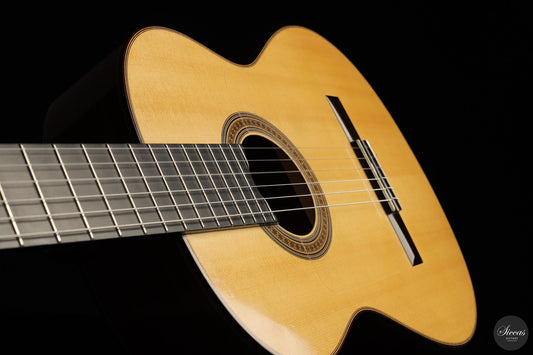
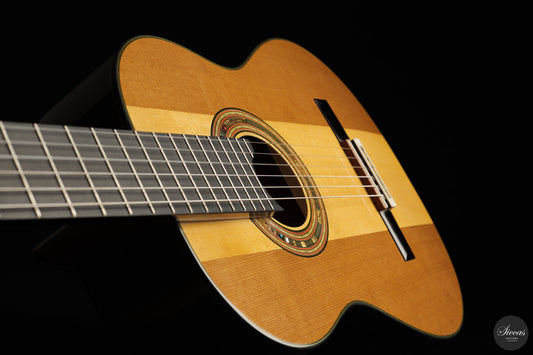
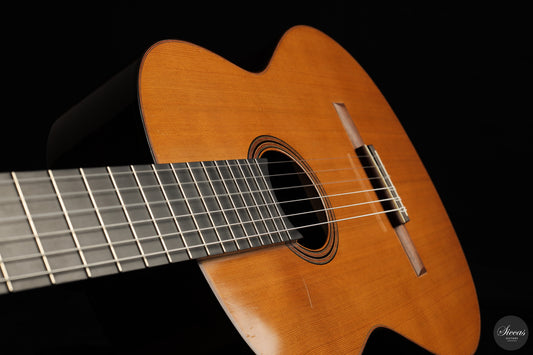
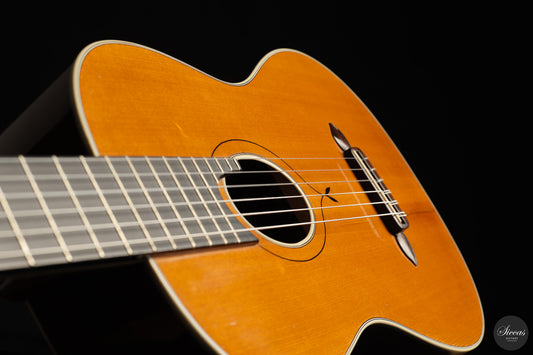
For guitarists seeking an instrument capable of projecting the Adagio's dynamic range and tonal variety, the choice of guitar matters considerably. Explore our range of classical guitars — including instruments with the tonal depth and sustain that slow, singing passages demand.
Why It Moves Everyone: The Universality of the Adagio
Music scholars have spent considerable energy attempting to explain why the Adagio works as powerfully on people who know nothing about classical music as on people who have spent their lives studying it. Several factors seem to be at work.
The melody is built on intervals and shapes that appear across many musical traditions worldwide. Its rise and fall follow patterns that seem to map onto human emotional contour in a way that transcends cultural specificity. The opening phrase of the cor anglais theme — a rising minor third followed by a descending line — is a shape that appears in folk music across Europe, North Africa, and the Middle East. It is not borrowed from any of them; it simply shares a common human logic.
The tempo of the Adagio, when performed correctly, synchronises with a resting human heartbeat. This is not a coincidence. Music that sits at or near resting heart rate has been shown to modulate emotional response in ways that faster or slower music does not. The listener's body is drawn into the music's pulse without conscious effort.
The movement's structure also mirrors the arc of grief itself. It builds from quietness to unbearable intensity and then, after the climax, gradually releases. This arc is not comfortable — the listener is not let off the hook, not offered easy resolution — but it is cathartic. Audiences leave the Adagio not drained but, paradoxically, restored.
There is also the matter of the guitar's specific timbre. The classical guitar, played with the right-hand fingernails in the correct position and with appropriate nail shape, produces a tone that is simultaneously bright and warm, sustained and percussive. It is unlike any other orchestral instrument in this combination of qualities, and the combination maps onto the Adagio's emotional palette with unusual precision. Read more about how tonal characteristics of different guitars shape this kind of music in our guide to spruce vs cedar classical guitars.
The Adagio in Context: What Came Before and After
When Rodrigo composed the concerto in 1939, the guitar had almost no orchestral repertoire of comparable scale or seriousness. The instrument was considered, in much of the European classical establishment, as a salon curiosity — capable of charm and intimacy but not of sustaining an extended orchestral argument. The Adagio disproved this in its first performance.
The movement showed that the guitar could carry an emotional weight previously associated only with the violin or the piano in the soloist's role. It did so not by pretending to be louder than it is, but by exploiting the quality that distinguishes it from all other instruments: the sense of the human hand in direct contact with the vibrating string, with nothing mechanical between them. You can hear the guitarist breathing in the Adagio. That proximity is part of what makes it so moving.
Since 1940, the Adagio has influenced composers writing for guitar in ways that are sometimes acknowledged and often not. Toru Takemitsu's late guitar works owe something to the harmonic and timbral world Rodrigo established. Leo Brouwer's concertos inherit the Adagio's willingness to treat the guitar as a vehicle for extended lyrical expression. Even composers working in idioms far from Spanish Romanticism have had to reckon with the standard the Adagio set.
For a broader view of the musical tradition the Adagio inhabits, see our overview of famous classical guitar pieces, and for the instrument's historical journey, the history of the classical guitar and its evolution.
Performing the Adagio: What It Asks of the Guitarist
Every serious classical guitarist must eventually confront the Adagio. Whether in its orchestral form or in solo arrangement, it is a benchmark — not for technical display but for musical maturity. The movement does not reward showing off. It rewards listening, restraint, and the ability to mean every note.
Guitarists who have worked through the piece report that it changes over time. What seems, at first practice, like a beautiful but manageable melody reveals, on closer acquaintance, an almost impossible series of decisions: how much to slow down here, how much to push there; where to add vibrato and where to let the note decay naturally; how to shape the cadenza so that it sounds discovered rather than rehearsed.
Andrés Segovia, who did not perform the concerto (he preferred solo repertoire and found the balance between guitar and orchestra difficult to achieve in the acoustic conditions of his era), nevertheless wrote about the Adagio with admiration. He understood, even from the outside, that it occupied a singular place in the repertoire — neither a display piece nor a character piece, but something closer to a confession.
Performers like Ana Vidovic have brought the Adagio to new audiences in the twenty-first century, demonstrating that the movement continues to grow with each new interpretation. The Adagio is not a museum piece. It is alive in the hands of every guitarist who approaches it with genuine commitment.
Conclusion: Why the Adagio Endures
The Adagio from the Concierto de Aranjuez has outlasted every trend, every shift in musical fashion, every decade of changing taste. It has been arranged for jazz ensemble, performed by symphony orchestras on every continent, recorded hundreds of times, used in films and advertisements and memorial services. None of this has diminished it. If anything, each new context reveals something that was already there.
At its core, the Adagio is about the gap between what we feel and what we can say. Rodrigo was blind from the age of three — he composed by dictating to Victoria, by working entirely in his imagination, by developing an inner ear of extraordinary precision. The Adagio speaks from that interior space. It knows something about loss and about beauty that cannot be expressed in any other way.
That is why, when the cor anglais begins its opening phrase and the guitar answers, audiences who have heard the piece a hundred times still go quiet. They are not remembering a melody. They are, for a few minutes, inside the feeling itself.
On the concerto's extraordinary cultural reach: Concierto de Aranjuez – Cultural Impact & World Legacy →