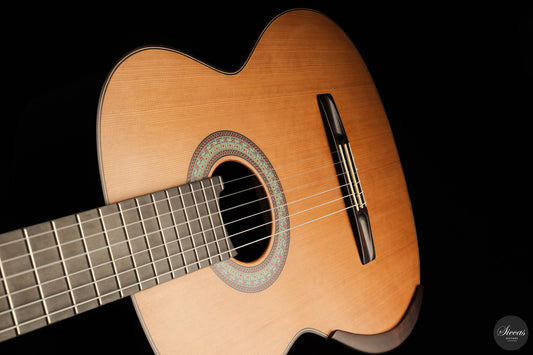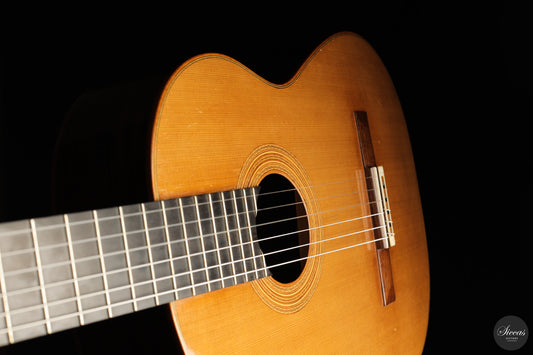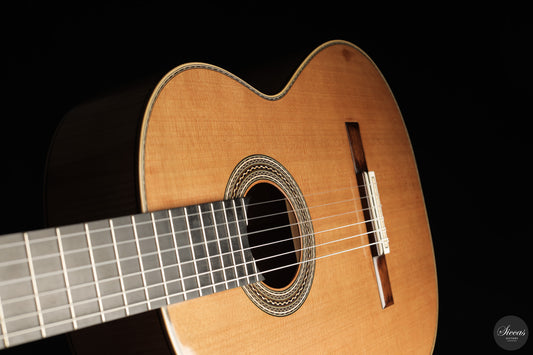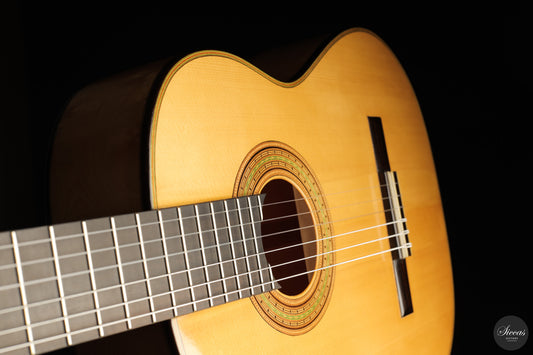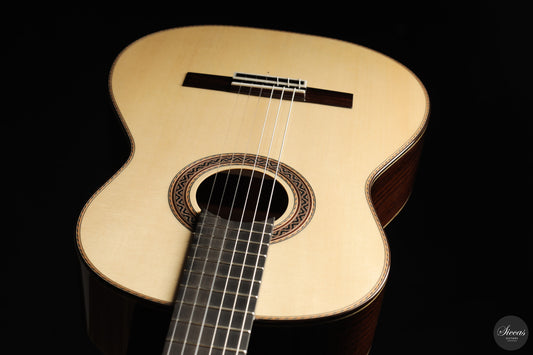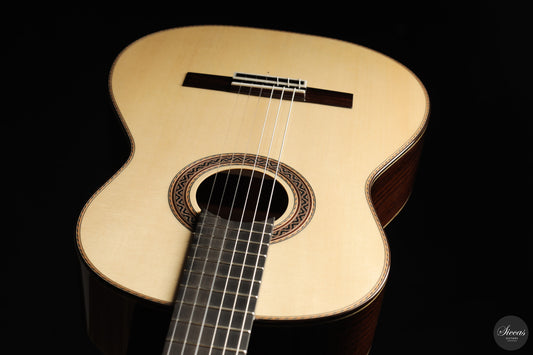

Vicente Carrillo – Classical Guitar Luthier
Vicente Carrillo is one of Spain's most respected contemporary classical guitar makers. Working from his workshop in Buendía, in the province of Cuenca, he has spent decades building instruments that are trusted by players ranging from dedicated students to seasoned concert professionals. His guitars stand out for combining the deep roots of the Spanish lutherie tradition with consistent, reliable craftsmanship — a combination that makes them highly sought after in the international classical guitar market.
Buendía: A Workshop Rooted in Spanish Tradition
The town of Buendía, nestled in the Cuenca region of Castilla-La Mancha, may not be the first name that comes to mind when thinking of Spanish guitar making centres. Yet it is precisely this quiet, focused environment that has allowed Vicente Carrillo to develop his craft without distraction. Spain has a long and celebrated history of guitar lutherie — a tradition that stretches back through generations of makers who shaped the sound of the classical guitar as we know it today. Carrillo's work is firmly rooted in this legacy.
The Spanish lutherie tradition emphasises a particular approach to construction: the solera method of building the top flat on a workboard, the integration of the neck into the body during the building process, and a disciplined relationship between tonewoods and geometry. These principles, passed down through the great workshops of Granada and Madrid, inform the way Carrillo approaches every instrument he makes. His guitars carry the hallmarks of this tradition — not as imitation, but as a living continuation of it.
For players who want to understand what connects a modern instrument to the broader arc of classical guitar history, exploring makers like Carrillo offers a direct link to that heritage. You can read more about the roots of the tradition in our guide to the romantic guitar and its history.
Guitar Models by Vicente Carrillo
Vicente Carrillo builds a range of models designed to serve players at different stages of their development and with different tonal preferences. Each model reflects careful attention to materials and construction, and all share the consistency of quality that has defined his reputation.
India Estudio
The India Estudio is aimed at the serious student market. It provides genuine Spanish craftsmanship at an accessible price point, making it an excellent choice for players who are ready to move beyond entry-level instruments but are not yet at the stage of investing in a higher-grade concert guitar. The word estudio — study — signals its intended audience clearly, but this is not a compromised instrument. It is built with the same care and respect for materials that defines the entire Carrillo range.
India Primera
Stepping up from the Estudio, the India Primera offers refined tonewoods and a greater degree of finishing detail. The Primera represents one of the most compelling value propositions in the contemporary classical guitar market: an instrument that delivers a genuinely musical response, with the projection and tonal balance expected of a serious player's guitar, at a price that remains accessible. Many intermediate players find that the India Primera is capable of carrying them well into advanced repertoire.
Herencia Madagascar
The Herencia (heritage) series takes its name from the Spanish word for inheritance — an apt description for instruments that draw consciously on the traditions Carrillo has absorbed throughout his career. The Madagascar variant features Madagascar rosewood for the back and sides, a tonewood celebrated for its warmth, depth, and responsiveness. Madagascar rosewood has become increasingly prized in lutherie for the richness it brings to an instrument's voice, and Carrillo's treatment of this material demonstrates his experience in working with premium tonewoods.
Herencia Palo Escrito
Alongside the Madagascar, the Herencia series also includes the Palo Escrito model. Palo escrito — sometimes called Mexican rosewood — is a tonewood with a distinctive character: it combines a warm, rounded bass register with clear treble articulation, producing an instrument with considerable tonal variety. For players interested in the tonal comparisons between different materials, our article on spruce vs cedar classical guitars offers a useful framework for thinking about how top wood choices shape an instrument's voice — a question equally relevant when considering back and side woods like palo escrito.
Gabriela II
The Gabriela II occupies the mid-range of the Carrillo lineup. Named in a tradition of personally significant model designations, it balances tonal quality with build refinement, and is popular with players who want an instrument that performs well in both solo and ensemble contexts. Its even projection and reliable intonation make it a practical working guitar as well as a musically rewarding one.
Primera Especial
The Primera Especial sits at the higher end of the Carrillo range and is intended for advanced and professional players. Special — especial — in this context means not just higher-grade materials but also a more individual approach to construction and voicing. These instruments reflect the full depth of Carrillo's experience, and they are capable of meeting the demands of concert performance. Players considering an instrument at this level will find that the Primera Especial competes seriously with guitars from other respected contemporary makers.
Value, Consistency, and the Professional Market
One of the defining characteristics of Vicente Carrillo's reputation is his commitment to value. In the world of hand-built classical guitars, it is not uncommon for quality to vary significantly from instrument to instrument even within the same maker's range. Carrillo's guitars are consistently noted by players and dealers alike for their reliability: when you buy a Carrillo, you know what you are getting.
This consistency has made his instruments particularly popular in the intermediate to professional player market. A player who is serious about classical guitar — who practises daily, performs regularly, and thinks carefully about the tools of their craft — needs an instrument they can depend on. Carrillo's guitars deliver that dependability without requiring the very highest price points of the custom concert guitar world. This combination of quality and accessibility is rare, and it is one of the main reasons his instruments are sought after worldwide.
For players who are deciding whether a classical guitar is the right choice for them in the first place, our comparison of acoustic vs classical guitar may be a helpful starting point. And for those who have committed to the classical guitar path and are thinking about what repertoire they might work towards, our list of famous classical guitar pieces offers an inspiring overview.
The Spanish Lutherie Tradition in the Contemporary World
It is worth pausing to consider what it means to continue the Spanish lutherie tradition in the twenty-first century. The great makers of the past — Torres, Hauser, Ramírez — established standards and techniques that shaped not just the sound but the very idea of the classical guitar. Their influence is felt every time a guitarist sits down to play. Contemporary makers like Vicente Carrillo carry that tradition forward not by copying the past but by absorbing its lessons and applying them with their own judgment and sensitivity.
Buendía may be a small town, but the guitars that come out of Carrillo's workshop travel far. They are played in conservatories, concert halls, and practice rooms around the world. Each one is a small argument for the continued relevance of hand-built Spanish instruments in an age of mass production — an argument made not in words but in wood, string, and sound.
For those interested in the broader world of great guitar makers and their influence on classical performance, our profiles of great classical guitarists and our dedicated article on Andrés Segovia offer context for how the relationship between players and instrument makers has shaped the art form. You can also explore makers who share a similar dedication to tradition in our José Ramírez collection.
Playing and Buying a Vicente Carrillo Guitar
Choosing a classical guitar is a deeply personal process. The right instrument depends on your current level, your repertoire, the sound you are drawn to, and the physical relationship between your hands and the instrument. Carrillo's range is structured to address a wide spectrum of these variables — from the student looking for their first genuinely professional instrument to the experienced player seeking a reliable concert guitar.
When you hold and play a Vicente Carrillo guitar, the first thing most players notice is the balance. The bass and treble registers speak with equal clarity, and the transition across strings feels natural and even. This balance is not accidental — it is the result of careful voicing and a disciplined approach to the selection and treatment of tonewoods.
The neck geometry is comfortable and consistent across the range, which matters enormously for players who are working on technique. If you are at a stage in your development where hand position and left-hand mechanics are a primary focus, an instrument that fights you — through uneven frets, a poorly-set nut, or inconsistent neck relief — is an obstacle. Carrillo's quality control removes these obstacles. His guitars are set up to play well, which means they let you focus on the music rather than the instrument.
For players who are still building their skills and wondering about the timeline of their development, our guide on how long it takes to learn classical guitar offers a realistic and encouraging perspective.
Browse our full selection of classical guitars to find the Vicente Carrillo model that suits you, and explore related categories including flamenco guitars and double-top guitars for a comprehensive view of what is available.
Summary
Vicente Carrillo is a Spanish luthier based in Buendía, Cuenca, whose instruments represent one of the most compelling offerings in the contemporary classical guitar market. His range — from the India Estudio to the Primera Especial — covers the needs of intermediate to professional players with consistent quality and excellent value. Rooted in the Spanish lutherie tradition, his guitars are sought after worldwide by players who understand that a great instrument is not defined by its price alone, but by the care, skill, and tradition embedded in its construction.