Villa-Lobos: The Twelve Études on Classical Guitar

Villa-Lobos: The Twelve Études on Classical Guitar

The Twelve Études by Heitor Villa-Lobos occupy a place in the guitar's repertoire analogous to Chopin's études for the piano: they address virtually every core technique of the instrument while also functioning as fully realised artistic compositions. Composed in 1929 and dedicated to Andrés Segovia, they have been central to classical guitar education and concert programming for nearly a century.

Technique as Art

Each étude targets a specific technical challenge — right-hand arpeggios, left-hand slurs, counterpoint, scale runs, chord balance — yet never sacrifices its identity as composed music. Étude No. 1 places perpetual-motion arpeggios over barre chords; No. 3 combines slurs with block chords; No. 5 builds a counterpoint of pedal notes against a broken-third melody; No. 12 demands full-fretboard position shifts and repeated chords. But in every case, the technical exercise is also a musical statement. Villa-Lobos's Brazilian musical world — modal harmonies, rhythmic drive, lush harmonic colour — runs through all twelve, giving them a coherent voice despite their diversity.

Segovia's Advocacy

Segovia described the études as containing formulas of surprising effectiveness for both hands, while also carrying musical beauties that transcend the purely pedagogical. It was through his championship — playing individual études in concert, teaching them to students across the world — that they became the cornerstone of the advanced guitar syllabus. They were published by Max Eschig in Paris in 1953.

Performed at Siccas Guitars

Goran Krivokapić — Étude No. 7 · 2013 Carsten Kobs
Sanel Redžić — Étude No. 1 · 1986 Kevin Aram
Roman Viazovskiy — Étude No. 12

Playing it

The Études span from advanced to virtuosic level. Even experienced players typically work through them one or two at a time rather than as a complete set. The notation appears deceptively simple; finding optimal fingering and executing the technical patterns at performance tempo is what makes them genuinely difficult.

See the full Villa-Lobos guide and the Five Préludes.

The Library
  • Classical Guitars

    The classical guitar, with its soft nylon strings and characteristic timbre, has become a symbol of chamber music, Spanish tradition, and concert repertoire. Its modern form was shaped by Antonio de Torres in the 19th century, setting the standard for the body, fan bracing, and the 65-centimeter scale length that are still used today. Instruments in this category open up a rich palette from the refined Romantic miniatures of Tárrega to the majestic concertos of Rodrigo. Here you will find guitars that preserve historical continuity and at the same time inspire new interpretations.
    Explore all classical guitars
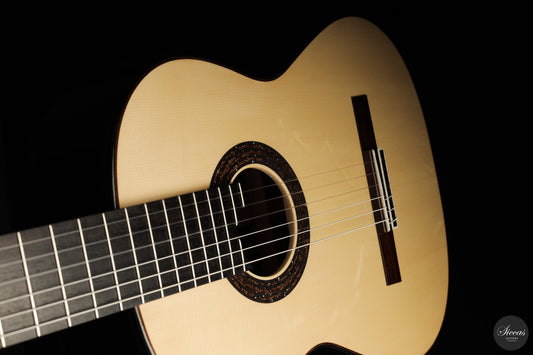
  • Luthier: Vicente Carrillo
    Construction Year: 2026
    Construction Type: Double-Top Guitars
    Top: Spruce
    Back and Sides: Madagascar rosewood
    Soundboard Finish: Nitrocellulose
    Body Finish: Nitrocellulose
    Air Body Frequency: G sharp / A
    Weight (g): 1670
    Tuner: Aparicio
    Condition: New
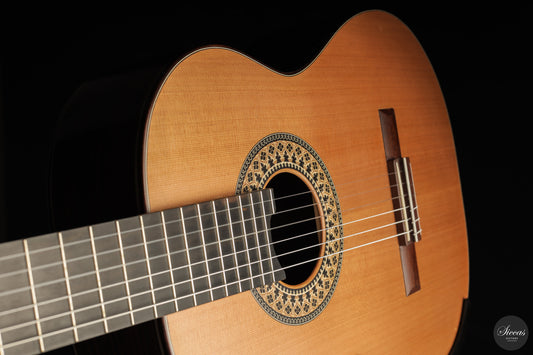
  • Luthier: Vicente Carrillo
    Construction Year: 2026
    Construction Type: Double-Top Guitars
    Top: Cedar
    Back and Sides: Madagascar rosewood
    Soundboard Finish: Nitrocellulose
    Body Finish: Nitrocellulose
    Air Body Frequency: G sharp / A
    Weight (g): 1845
    Tuner: Aparicio
    Condition: New
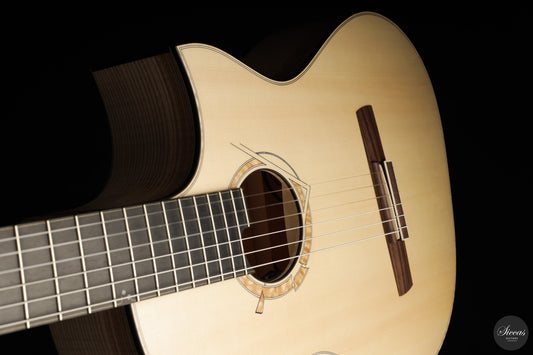
  • Luthier: Gary Southwell
    Construction Year: 2008
    Top: Spruce
    Back and Sides: Flamed Maple
    Soundboard Finish: French polish
    Body Finish: French polish
    Air Body Frequency: D / D sharp
    Weight (g): 1560
    Tuner: Rodgers
    Condition: Very good
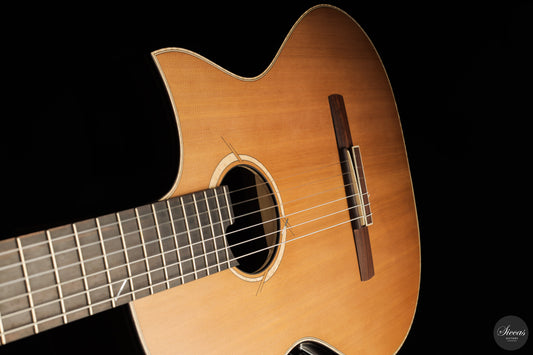
  • Luthier: Vicente Carrillo
    Construction Year: 2026
    Construction Type: Double-Top Guitars
    Top: Spruce
    Back and Sides: Madagascar rosewood
    Soundboard Finish: Nitrocellulose
    Body Finish: Nitrocellulose
    Air Body Frequency: G sharp / A
    Weight (g): 1760
    Tuner: Aparicio
    Condition: New
  • Luthier: Vicente Carrillo
    Construction Year: 2026
    Construction Type: Double-Top Guitars
    Top: Cedar
    Back and Sides: Madagascar rosewood
    Soundboard Finish: Nitrocellulose
    Body Finish: Nitrocellulose
    Air Body Frequency: G sharp / A
    Weight (g): 1680
    Tuner: Aparicio
    Condition: New
  • Luthier: Gary Southwell
    Construction Year: 2024
    Construction Type: Traditional
    Top: Spruce
    Back and Sides: Indian rosewood
    Soundboard Finish: French polish
    Body Finish: French polish
    Air Body Frequency: E / F
    Weight (g): 1300
    Tuner: Rodgers
    Condition: Excellent

Stay up to date with our news

Be the first to know about new guitars and exclusive discounts - subscribe to our weekly newsletter.