


Double-Top Guitars

-
Rafal Turkowiak - 2026 Opus Virtuoso No. 766
Price: 15.117,65 €Unit price per Tax free (0% US)Luthier: Rafal TurkowiakConstruction Type: Double-Top Guitars -
Antonius Müller - 2013 VI Doubletop
Price on requestLuthier: Antonius MüllerConstruction Type: Double-Top Guitars -
Luthier: Jakob LebischConstruction Type: Double-Top Guitars
-

 Reserved
Nils Schebesta - 2026 Doubletop
Price: 7.990 €Unit price per Tax free (0% US)ReservedLuthier: Nils SchebestaConstruction Type: Double-Top Guitars -
Patrick Mailloux - 2026 Palomée Doubletop 64 cm
Price: 5.873,95 €Unit price per Tax free (0% US)Construction Type: Double-Top Guitars -
Siccas Luthiers - Creation Doubletop Cedar 63 cm
Price: 2.260,50 €Unit price per Tax free (0% US)Manufacturer: Siccas LuthiersManufacturer: Siccas LuthiersConstruction Type: Double TopConstruction Type: Double-Top GuitarsConstruction Type: Short Scale -
Siccas Luthiers - Creation Doubletop Spruce 63 cm
Price: 2.260,50 €Unit price per Tax free (0% US)SoldManufacturer: Siccas LuthiersManufacturer: Siccas LuthiersConstruction Type: Double TopConstruction Type: Double-Top GuitarsConstruction Type: Short Scale -
Armin Hanika - 2026 Natural Doubletop 64 cm
Sale price 3.352,94 € Price:Unit price per Tax free (0% US)4.159,66 €Save: 806,72 €Manufacturer: Armin HanikaConstruction Type: Double-Top Guitars -

-
Vincent Humml - 2026 Doubletop No. 65
Price: 5.873,95 €Unit price per Tax free (0% US)ReservedLuthier: Vincent HummlConstruction Type: Double-Top Guitars -
Leonardo De Gregorio - 2024 Doubletop No. 250 64 cm
Price: 6.990 €Unit price per Tax free (0% US)SoldLuthier: Leonardo De GregorioConstruction Type: Double-Top GuitarsConstruction Type: Short Scale -
Marco Maguolo - 2026 Ducale Double Top No. 322 REG Limited Edition
Price: 9.990 €Unit price per Tax free (0% US)Roma Expo 2026Luthier: Marco MaguoloConstruction Type: Double-Top Guitars -
Felix Müller - 2025 Double top
Price on requestSoldLuthier: Felix MüllerConstruction Type: Double-Top Guitars -
Carsten Kobs - 2016 Double Top
Price: 17.990 €Unit price per Tax free (0% US)Luthier: Carsten KobsConstruction Type: Double-Top Guitars -

 Reserved
Pete Beer - 2026 Cir-Mheala No. 114
Price: 7.134,45 €Unit price per Tax free (0% US)ReservedLuthier: Pete BeerConstruction Type: Double-Top Guitars -
Armin Hanika - 2026 Natural Doubletop Custom 64 cm
Sale price 4.193,28 € Price:Unit price per Tax free (0% US)4.466,38 €Save: 273,10 €Manufacturer: Armin HanikaConstruction Type: Double-Top Guitars -
Michele Della Giustina - 2025 Double Top No. 438
Price: 8.990 €Unit price per Tax free (0% US)Luthier: Michele Della GiustinaConstruction Type: Double-Top Guitars -
Jost Von Huene - 2014 Doubletop
Price: 4.990 €Unit price per Tax free (0% US)Construction Type: Double-Top Guitars -
Dennis Tolz - 2015 Doubletop
Sale price 13.990 € Price:Unit price per Tax free (0% US)14.990 €Save: 1.000 €SaleLuthier: Dennis TolzConstruction Type: Double-Top Guitars -
Armin Hanika - New Century DTL 64 cm
Sale price 3.276,47 € Price:Unit price per Tax free (0% US)3.781,51 €Save: 505,04 €Manufacturer: Armin HanikaConstruction Type: Double-Top GuitarsConstruction Type: Lattice -
Siccas Luthiers - Legacy Doubletop Spruce 64 cm
Price: 3.352,94 €Unit price per Tax free (0% US)Manufacturer: Siccas LuthiersManufacturer: Siccas LuthiersConstruction Type: Double TopConstruction Type: Double-Top GuitarsConstruction Type: Short Scale

















Frequently Asked Questions About Classical Guitars
How do I choose the right classical guitar for my level?
Choosing the right classical guitar depends on your playing level, musical goals, and budget. Beginners benefit from studio-model guitars from renowned workshops, while advanced players and professionals often choose a handmade master guitar. We are happy to advise you personally and can send detailed sound samples and videos on request.
What is the difference between a master guitar and a studio guitar?
Master guitars are built entirely by hand in the workshop of a single luthier, using only high-quality, well-aged tonewoods. Studio guitars are made in small series, often under the supervision of the master luthier, and offer excellent value for students and ambitious amateur players.
Can I try a classical guitar at home for 14 days?
Yes — every guitar you purchase from us comes with a 14-day home approval period. This complimentary trial applies worldwide to all orders, whether you are in Germany, Europe, the USA, Asia or anywhere else. We ship your instrument fully insured in a high-quality case so you can play it under your own acoustic conditions. If the guitar is not the right one for you, simply send it back and receive a full refund of the purchase price.
Can I try a classical guitar before purchasing?
Absolutely. You are warmly invited to visit our showroom in Karlsruhe, Germany, and test the instruments at your leisure. We are happy to schedule a personal appointment. If a visit is not possible, we send detailed videos and sound samples, and offer extensive consultation by phone or video call.
What payment methods and financing options do you offer?
We accept bank transfer, PayPal, major credit cards, and Klarna. For high-value instruments, we offer individual installment plans on request. Please contact us directly — we will find a suitable solution for every budget.
How do I properly care for my classical guitar?
A classical guitar requires constant humidity between 45 and 55 percent. Store the instrument in its case with a humidifier, avoid direct sunlight and large temperature fluctuations. Change the strings regularly and clean the guitar with a soft microfiber cloth.
You may also be interested Double-Top Guitars
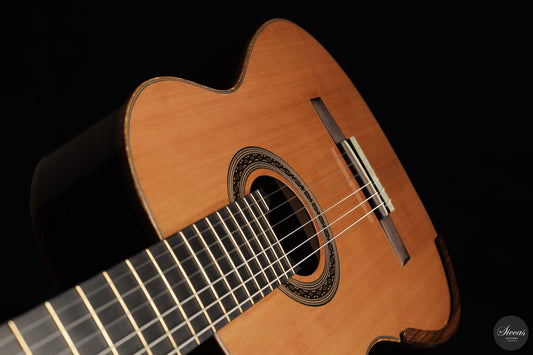
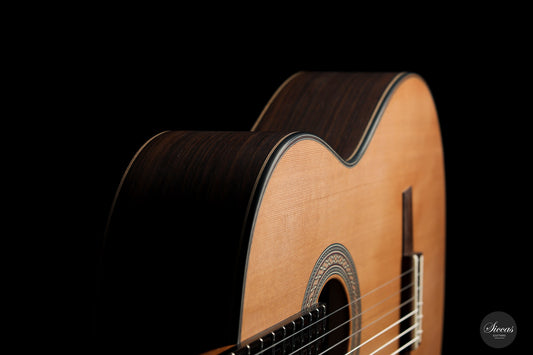
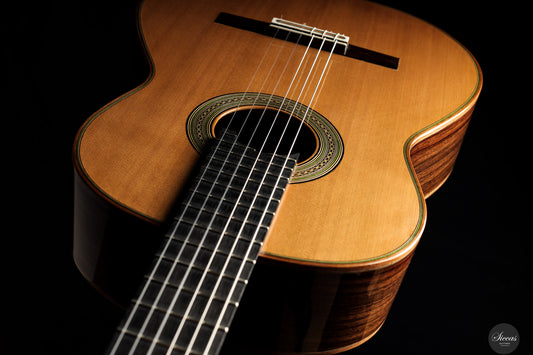
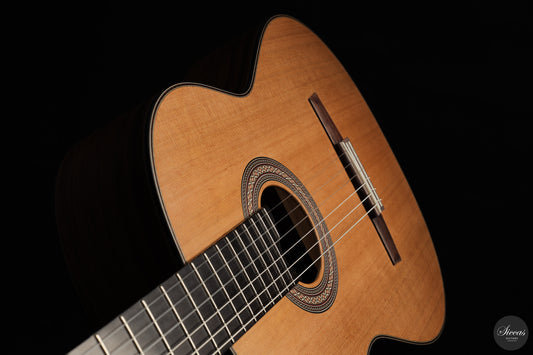
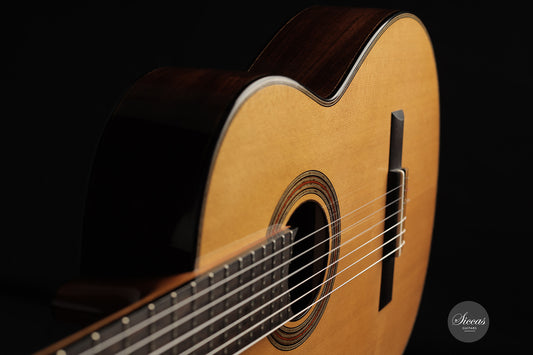
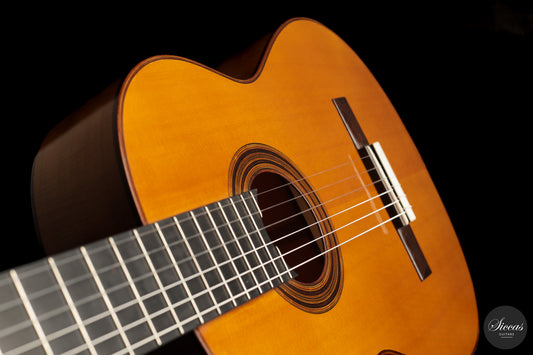
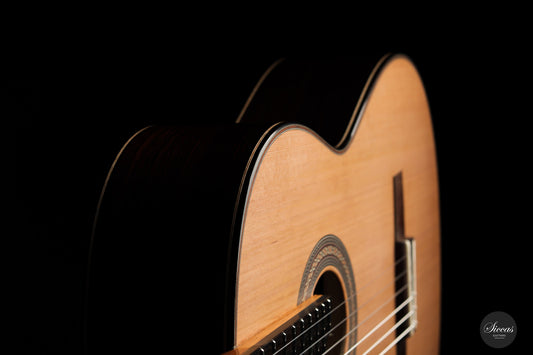
The double-top guitar is one of the most influential innovations in modern classical guitar building: a soundboard made of two ultra-thin layers of tonewood bonded around a lightweight honeycomb core. The result is a top that is lighter, stronger, and more responsive than a traditional solid soundboard — delivering greater volume, projection, and sustain. The term “double-top” is now standard, though “sandwich” or “composite” construction describes the laminated structure more precisely.
The Invention of the Double-Top
The best-known method was developed in the 1990s by the German luthiers Matthias Dammann and Gernot Wagner. Their design places two extremely thin layers of tonewood — usually European spruce or Canadian cedar — around a lightweight aramid honeycomb (Nomex). This reduces the weight of the soundboard while keeping it stiff, allowing the guitar to produce an exceptionally rich, powerful tone.
The principle has since inspired luthiers worldwide. Makers such as Jim Redgate, Michel Brück, and Kenny Hill have refined the concept, each developing their own variations in structure and materials — so you can experience how every builder interprets the double-top idea in their own way.
How Double-Top Construction Works
A double-top soundboard combines the best qualities of traditional tonewoods with the precision of modern materials. The outer layers provide the natural warmth and character of wood, while the inner Nomex core adds strength and reduces mass. The result is a soundboard that is both lightweight and highly responsive, improving sustain, projection, and tonal balance.
Beyond the top, many luthiers also use laminated sides and reinforced backs to increase structural rigidity and focus the sound. These components are built by gluing several thin layers of tonewood veneer, creating a strong, stable body that enhances both volume and clarity.
Volume and Projection
Because a double-top soundboard can weigh up to 25% less than a solid top, it vibrates more freely and produces a louder, more direct sound. The rigid laminated sides help project that sound forward, giving the instrument its characteristic brilliance and presence. Volume, though, is not the only goal — a good double-top also delivers a well-balanced tone across all registers.
Not every double-top is automatically louder than a traditional guitar: if the sandwich layers are built too heavy, the weight advantage shrinks. The finest instruments strike a precise balance between strength and lightness to unlock the design’s full acoustic potential.
Responsiveness and Playability
One of the greatest strengths of the double-top guitar is its exceptional responsiveness. The lighter top reacts quickly to the player’s touch, giving immediate tonal feedback, and transitions between a bright nail attack and rounder, more lyrical tones feel effortless. This agility makes double-top guitars especially appealing to concert players who need wide dynamic range and expressive precision.
The reduced mass also promotes rich high overtones, particularly near the bridge, producing a lively, complex sound with remarkable sustain and clarity — a quality many players describe as almost “singing.”
The Sound Character of Double-Top Guitars
Double-top guitars are built so that certain areas of the top stay slightly more flexible, allowing subtle tonal variation. The voice is typically clear, open, and refined, with long sustain and strong projection. Some players hear it as modern and precise; others value its warmth and responsiveness, which still retains the charm of traditional guitar building. In fact, many guitarists wouldn’t realise they were playing a laminated top if no one told them — proof of how far this technology has come.
Explore Double-Top Guitars at Siccas Guitars
The double-top classical guitar embodies the blend of innovation and craftsmanship: its sandwich construction enhances volume, sustain, and tonal flexibility while preserving the expressive qualities that define a fine classical guitar. Whether you are a professional seeking projection and precision or an enthusiast exploring modern luthiery, you’ll find instruments here from leading double-top makers — and you can compare them with the rest of our classical guitars. Every guitar includes personal consultation and a 14-day home trial, worldwide.