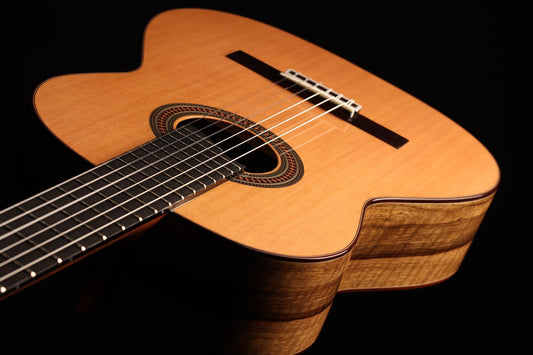
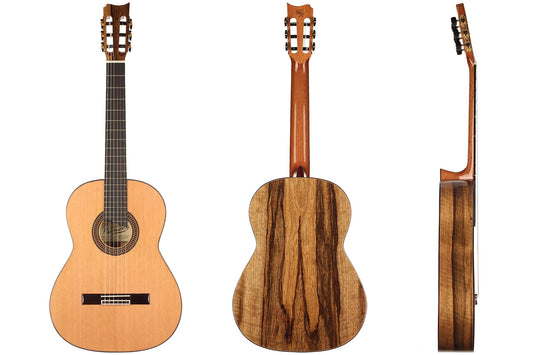
You may also be interested Raimundo Guitars
## Raimundo Guitars – Spanish Craftsmanship Since 1880
When you hold a Raimundo guitar, you are holding more than a hundred years of Spanish guitar-making tradition. Founded in Valencia in 1880 by Manuel Raimundo, this family firm is one of the oldest continuously operating guitar manufacturers in Spain. Few names in the world of classical and flamenco guitars carry the same combination of historical depth, consistent quality, and genuine accessibility.
### Valencia: The Heartland of Spanish Guitar Making
Raimundo guitars are made in Valencia — a city whose name is inseparable from the history of the Spanish guitar. While Andalusia, and Granada in particular, is often associated with the flamenco tradition, Valencia developed into a major centre of lutherie through the nineteenth and twentieth centuries, producing instruments that supplied players across Spain and beyond. Raimundo grew alongside that tradition, accumulating generations of craft knowledge and refining workshop methods that balance hand-finishing with reliable consistency.
That regional context matters when you evaluate an instrument. A guitar built in Valencia by a workshop with roots going back to 1880 is not an anonymous factory product. It reflects a specific lineage: local tonewoods knowledge, established voicing preferences, and a culture that treats guitar making as a serious craft discipline rather than a volume exercise.
### A Range Built for Every Stage of the Journey
One of the distinguishing features of Raimundo's catalogue is its breadth. The firm produces instruments across a wide spectrum of price points and construction approaches, which means a student starting their first serious instrument and an advanced amateur looking for a refined concert-level guitar can both find something meaningful in the range.
Entry and mid-range Raimundo models are built to deliver honest Spanish tone — warm, focused, and responsive — without demanding a concert budget. Higher-tier models incorporate premium tonewoods, more elaborate internal bracing, and greater amounts of hand work, producing instruments with the dynamic complexity and projection that advanced players require.
This consistency across the range is not accidental. It reflects the accumulated institutional knowledge of a workshop that has been solving the same lutherie problems for over a century. Whether you are choosing a [classical guitar](/collections/classical-guitars) as your first serious instrument or adding a Spanish guitar to an existing collection, a Raimundo rewards careful listening.
### Classical and Flamenco: Two Distinct Traditions
Raimundo produces both classical and flamenco guitars, and the distinction matters in terms of construction, feel, and sound.
Classical Raimundo guitars are built for the full palette of the concert repertoire — rounded body contours, cedar or spruce tops, standard scale length, and a voice oriented toward warmth, sustain, and tonal complexity. If you are working through the standard classical canon, exploring [great classical guitarists](/blogs/guitarists/great-classical-guitarists), or developing a fingerstyle technique, a classical Raimundo is built for that purpose.
Flamenco Raimundo guitars follow the traditional flamenco construction: typically cypress back and sides, a shallower body depth, lower string action, and a brighter, more percussive response that suits rasgueado, golpe, and the rhythmic demands of the flamenco tradition. If you are exploring the [flamenco guitar](/collections/flamenco-guitars) world, Raimundo offers entry points into that tradition without compromise on character.
Understanding which top wood suits your playing style is also worth considering. A [spruce top](/collections/spruce) will typically deliver a brighter, more articulate initial attack with a focused midrange, while a [cedar top](/collections/cedar) tends to respond with warmer overtones and slightly lower resistance — particularly forgiving for players still developing consistent right-hand pressure. For a detailed comparison, see our guide on [spruce vs cedar for classical guitar tone](/blogs/stories/spruce-vs-cedar-classical-guitars-tone-comparison).
### Why Buy a Raimundo at Siccas Guitars?
At Siccas Guitars, every Raimundo we sell has been individually filmed in a professional video review before it reaches you. You are not buying a catalogue specification — you are hearing the specific guitar you will receive, played by a skilled guitarist in our studio. That matters because two guitars of the same model can sound and feel meaningfully different due to natural variation in tonewoods, humidity history, and hand finishing.
We also offer a 14-day home trial on every instrument. You take the guitar into your own space, play it in your own acoustic environment, and decide with no artificial time pressure. If it is not right for you, you return it. This is how we think guitar buying should work — especially for an instrument as personal as a classical or flamenco guitar.
Our stock is hand-selected. We do not list every Raimundo produced; we list the ones that pass our own quality assessment and play well. If you are new to the classical guitar world and unsure whether classical is the right format, our article on [acoustic vs classical guitar differences](/blogs/stories/acoustic-vs-classical-guitar-key-differences-and-which-one-is-right-for-you) is a useful starting point.
### Frequently Asked Questions
**Are Raimundo guitars suitable for beginners?**
Yes. Raimundo's entry and mid-range instruments are well regarded as first serious classical or flamenco guitars. They are properly set up, correctly intonated, and built to the standard of a genuine Spanish workshop — not an unbranded import. A student can learn on a Raimundo without developing bad technique caused by a poorly built instrument.
**What tonewoods does Raimundo use?**
Depending on the model, Raimundo uses both spruce and cedar soundboards, combined with various back and side woods including rosewood and cypress. Each listing on our site specifies the exact tonewoods of the individual instrument.
**How does Raimundo compare to other Spanish makers?**
Raimundo occupies a reliable mid-market position. It is not a boutique luthier producing twenty instruments a year, but it is not an anonymous mass producer either. The workshop tradition goes back to 1880 and the instruments reflect that accumulated craft knowledge. Players looking for consistent quality, honest Spanish character, and fair value consistently find Raimundo a strong choice.
**Can I try a Raimundo before committing?**
Every Raimundo at Siccas comes with a 14-day home trial. You play it, live with it, and only then decide. That is our standard for every instrument we sell.