

Simon Ambridge
-
Luthier: Simon Ambridge
-
Luthier: Simon Ambridge
-
Luthier: Simon Ambridge
-
Luthier: Simon Ambridge




Ask us - right here.
Enrico, our AI team member, replies around the clock.
Instant reply · free · no obligation Rather use WhatsApp
Frequently Asked Questions About Classical Guitars
How do I choose the right classical guitar for my level?
Choosing the right classical guitar depends on your playing level, musical goals, and budget. Beginners benefit from studio-model guitars from renowned workshops, while advanced players and professionals often choose a handmade master guitar. We are happy to advise you personally and can send detailed sound samples and videos on request.
What is the difference between a master guitar and a studio guitar?
Master guitars are built entirely by hand in the workshop of a single luthier, using only high-quality, well-aged tonewoods. Studio guitars are made in small series, often under the supervision of the master luthier, and offer excellent value for students and ambitious amateur players.
Can I try a classical guitar at home for 14 days?
Yes — every guitar you purchase from us comes with a 14-day home approval period. This complimentary trial applies worldwide to all orders, whether you are in Germany, Europe, the USA, Asia or anywhere else. We ship your instrument fully insured in a high-quality case so you can play it under your own acoustic conditions. If the guitar is not the right one for you, simply send it back and receive a full refund of the purchase price.
Can I try a classical guitar before purchasing?
Absolutely. You are warmly invited to visit our showroom in Karlsruhe, Germany, and test the instruments at your leisure. We are happy to schedule a personal appointment. If a visit is not possible, we send detailed videos and sound samples, and offer extensive consultation by phone or video call.
What payment methods and financing options do you offer?
We accept bank transfer, PayPal, major credit cards, and Klarna. For high-value instruments, we offer individual installment plans on request. Please contact us directly — we will find a suitable solution for every budget.
How do I properly care for my classical guitar?
A classical guitar requires constant humidity between 45 and 55 percent. Store the instrument in its case with a humidifier, avoid direct sunlight and large temperature fluctuations. Change the strings regularly and clean the guitar with a soft microfiber cloth.
You may also be interested Simon Ambridge
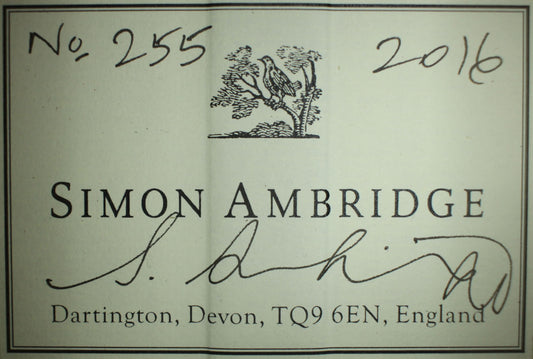
Simon Ambridge – Guitar Maker
Simon Ambridge, born in 1951 in London, comes from a family with a long woodworking tradition dating back to the 18th century. His interest in guitars began in the early 1960s during the rise of the pop music era. His first guitar—a simple burgundy acoustic with F-holes—sparked a passion that has continued ever since.
From Furniture to Guitars
Although passionate about woodworking from an early age, Ambridge first studied graphic design and later founded a successful furniture business in London. In 1978, he built his first acoustic guitar modeled on a Martin 0045. Soon after, under the guidance of Kevin Aram—now a renowned guitar maker—he created a small classical guitar in the Torres style. At that point, his path was clear—he was completely captivated. It would, however, take another ten years before he could devote himself entirely to guitar making.
Establishing the Workshop
The transition to full-time luthiery coincided with his move to Devon in southwest England, supported by a Crafts Council of Great Britain scholarship. The jury, which included José Romanillos, David Rubio, and Paul Fischer, recognized his talent and potential. In 1991, he received awards from the David Canter Memorial Fund and Southwest Arts. In 1995, he established his workshop on the Dartington Estate in South Devon, home to the Dartington International Summer School.
Recognition and International Reach
Over the years, Simon Ambridge has achieved international recognition, with clients in North and South America, Europe, Australia, and Asia. He lives with his wife Anna in South Brent within the Dartmoor National Park. Though largely self-taught, he credits many fellow luthiers and guitarists for their valuable guidance and encouragement throughout his career.
My Approach
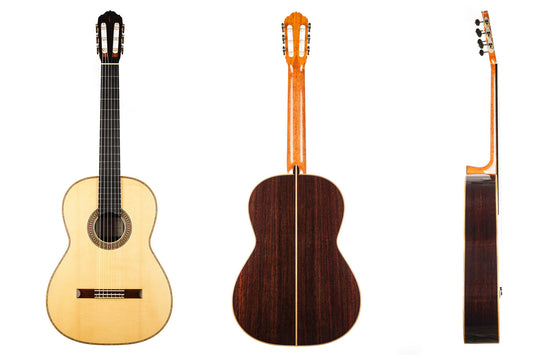
Ambridge’s guitars are inspired by the work of Antonio de Torres, Santos Hernandez, and Hermann Hauser I. By integrating classic design principles with his own innovations, he crafts lightly built, elegant instruments that achieve a rich, clear, and focused sound across the entire tonal spectrum.
Acoustic Design Philosophy
He employs a fan bracing system derived from Torres, which enhances sound projection and expands tonal color. Throughout construction, he evaluates plate resonances to ensure perfect cohesion between all structural elements. His preferred body resonance is around F, producing guitars with a strong fundamental tone and refined power.
While volume is essential for concert performance, Ambridge never sacrifices musicality for loudness. He believes that smaller guitars often possess remarkable projection and tonal presence, rivaling or surpassing their larger counterparts.
Playability and Feel
Players often praise the ease of play of his guitars. By balancing string tension and soundboard flexibility, Ambridge achieves optimal responsiveness. He also devotes particular attention to neck design, fingerboard setup, and fret finishing for maximum comfort and precision.
Artistry and Output
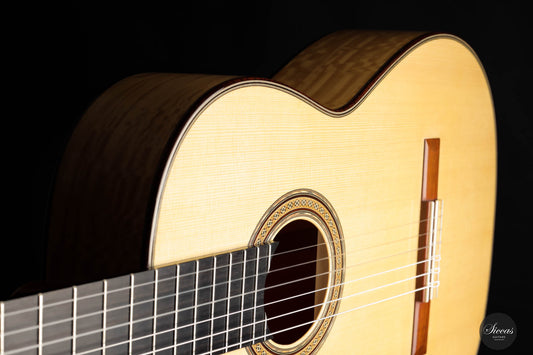
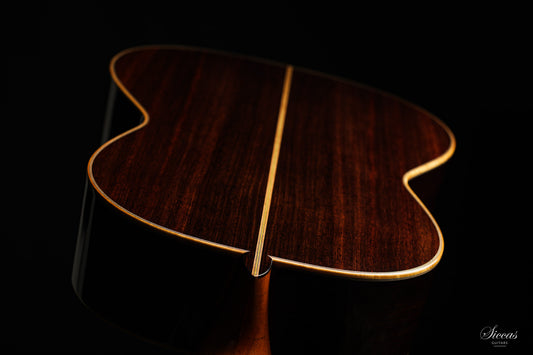
With his background in art and design, Ambridge combines craftsmanship with a keen eye for aesthetic detail. His guitars are admired for their musical refinement and visual harmony. Quality has always taken precedence over quantity—he produces around ten guitars per year, typically working on one or two at a time. Each instrument represents his personal dedication to excellence and artistry.
For Simon Ambridge, building guitars is both a privilege and a passion—an opportunity to create instruments of enduring beauty and sound in an age dominated by mass production. His goal: to craft guitars that bring lasting joy to players and listeners alike.