







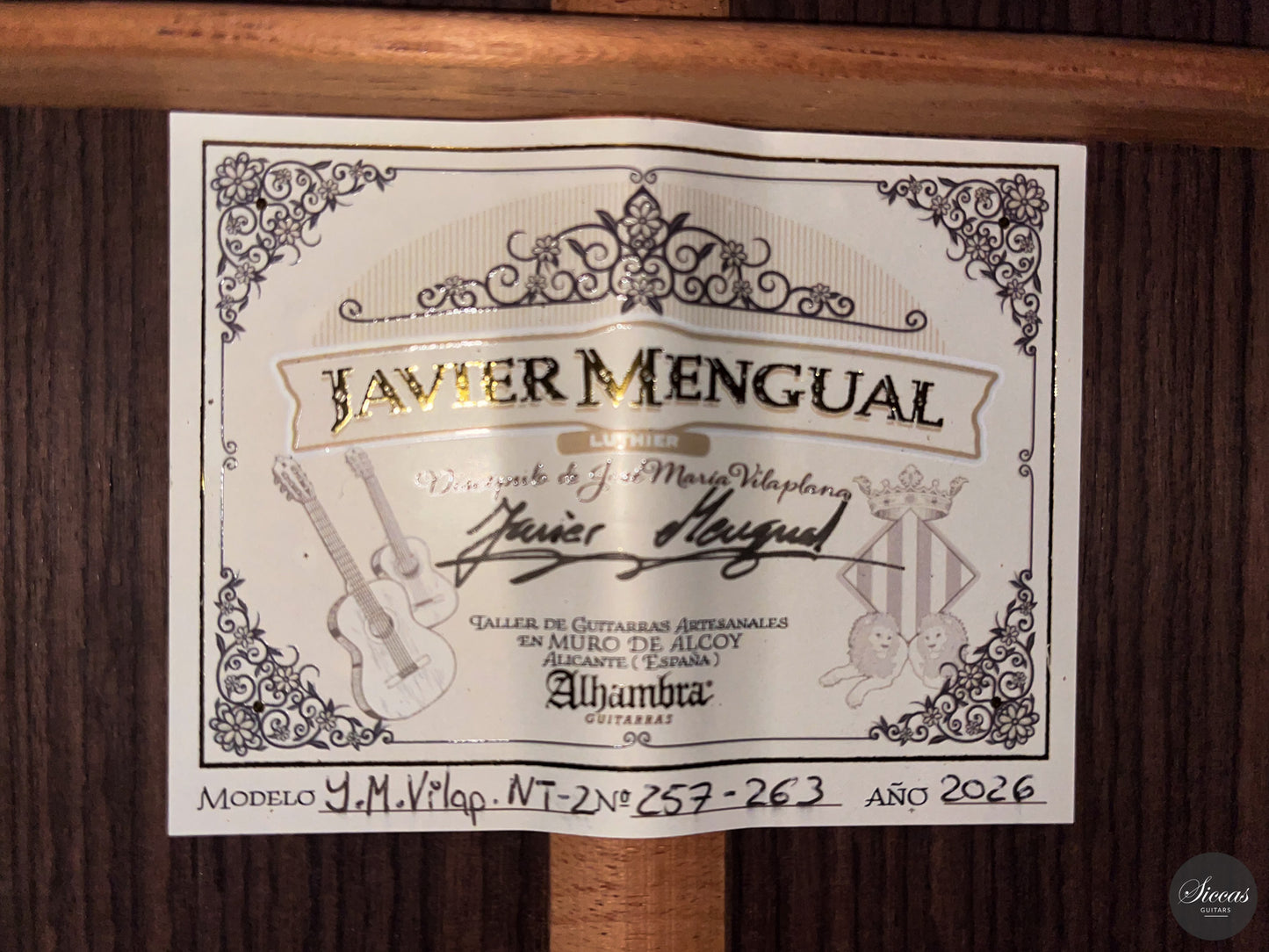
Alhambra - 2026 José María Vilaplana NT-2 No. 263


Details
Details
Overview
Overview
Shipping important note
Shipping important note
Important: Additional costs such as import taxes and custom duties may occur when importing goods from the EU into your country.
Delivery times are typically reliable and most instruments arrive within the estimated timeframe.
Should any unexpected delay occur, our team will keep you informed and provide support at every step. For all shipping details and exceptions, please see our Shipping Policy.
Details about GPSR
Details about GPSR
Ask us - right here.
Enrico, our AI team member, replies around the clock.
Instant reply · free · no obligation Rather use WhatsApp


Video overview


More details about the guitar
About the luthier
José María Vilaplana has been closely connected with Alhambra Guitars from the company’s earliest beginnings. As a young craftsman, he worked alongside his father in a small woodworking workshop in Muro de Alcoy, where the first experimental guitars were developed during the early 1960s. Together with Francisco Martínez Clavel and Ricardo Llorens, he helped establish the foundations of what became Manufacturas Alhambra in 1965.
Over more than three decades, Vilaplana refined his understanding of the Spanish guitar through patient study of its historical development and construction principles. The work of Antonio de Torres became a central reference, not as a model to reproduce literally, but as the basis for a contemporary concert instrument rooted in the proportions, responsiveness and tonal balance of the traditional Spanish school.
His instruments represent the most individual level of Alhambra’s production, combining the continuity of handcraftsmanship with carefully developed structural ideas. The José María Vilaplana series reflects this long experience: guitars conceived for professional musicians who require projection, security and an immediate response without losing the colour and articulation associated with the Spanish tradition.
About the guitar
The José María Vilaplana Serie NT-2 is a traditionally constructed concert guitar inspired by the work of Antonio de Torres, but developed through a series of precise structural refinements. Its solid red cedar soundboard is supported by seven fan braces, two closing bars and an additional transverse harmonic bar across the lower bout. This evolved bracing concept allows greater control of the soundboard’s resonant modes while preserving the directness and flexibility of the traditional Spanish design.
The result is an instrument with an immediate yet composed response. Notes emerge readily under a light touch, but retain a natural sense of weight and definition. The sound has a distinctly Spanish character: firm and focused in the attack, with a lively core that projects forward rather than spreading indistinctly around the player.
Its register balance is particularly convincing. The basses carry substance and warmth, while the trebles remain clear and articulate as the music moves into higher positions. Changes of register are even and continuous, allowing scales and melodic lines to pass across the fingerboard without abrupt shifts in colour or volume.
Fast passages benefit from the guitar’s quick release and controlled resonance. Individual notes remain separated even at greater speed, while chords retain a broad, full presence. This combination of responsiveness, projection and tonal order gives the NT-2 a secure concert character, capable of supporting both rhythmic precision and more sustained, colour-driven playing.
The visual identity is equally considered. The solid Indian rosewood body, French-polished cedar soundboard and distinctive decorative work at the rosette, bridge and headstock place the instrument clearly within Vilaplana’s personal interpretation of the Spanish concert guitar. Schaller Grand Tune Classic Hauser tuners complement the refined headstock design, while Sonata Royal Classics strings form part of the instrument’s supplied setup.
Regular care extends the life of the instrument
Even with careful use, a classical guitar may gradually change in appearance or respond to unstable storage conditions. Have a close look at your guitar regularly and be attentif to changes. If your instrument is suffering from its environement, it will let you know.
Protect Your Guitar: Handle with Care
Be mindful when touching your instrument with greasy or unwashed hands: any skin contact is a small attack on the varnish. Of course, a guitar is made to be played, but taking a few precautions helps preserve its beauty: wash your hands before playing, wear long sleeves, and avoid unnecessary direct skin contact with the body of the instrument.
Pro tip: Avoid playing with a button-up shirt, heavy jewelry, or a belt, as these can scratch the guitar. Also, make sure your guitar case is free of any objects that could damage the instrument during storage.
String care
A good habit to adopt is wiping down your strings briefly after each playing session. This small action significantly extends their lifespan and helps maintain a consistent, comfortable feel under your fingers.
Most importantly, clean strings are essential for keeping your instrument in tune. Corrosion, sweat, and dust can affect the uniformity of the strings and interfere with accurate tuning across the entire fingerboard.
Pro tip: If you're having trouble getting your guitar in tune, it might be time to change the strings. A useful test is to compare the pitch of the 12th fret harmonic with the fretted note at the 12th fret; if there's an unusually large gap between them, your strings may have lost their integrity and should be replaced.
Keep Your Shellac Finish Shining!
Got a guitar with a shellac (French polish) finish? Here's a simple trick: Take a clean microfiber cloth and gently breathe on the surface to create a light mist. Then, softly rub to remove fingerprints, sweat, and grease. That’s usually all it takes to keep it looking great, no products needed!
Pro tip: Every few years, treat your guitar to a check-up with a luthier to keep it in top shape.
Storing Your Guitar: Climate Matters
Your guitar can safely stay outside its case, as long as the surrounding environment maintains 42–55% humidity and a temperature between 18–25°C.
Keep in mind that humidity levels can still fluctuate inside the case, especially during seasonal changes.
- Too much humidity may cause overtightened strings and a dull tone.
- Too little humidity can lead to a bulging top, string buzz, or even cracks.
Avoid placing your guitar near radiators, air conditioners, or windows with direct sunlight.
Pro tip: Always close your guitar case while playing. This helps preserve a stable microclimate inside the case, so your instrument is protected the moment you put it back in.
Related guitars
Frequently Asked Questions About Classical Guitars
How do I choose the right classical guitar for my level?
Choosing the right classical guitar depends on your playing level, musical goals, and budget. Beginners benefit from studio-model guitars from renowned workshops, while advanced players and professionals often choose a handmade master guitar. We are happy to advise you personally and can send detailed sound samples and videos on request.
What is the difference between a master guitar and a studio guitar?
Master guitars are built entirely by hand in the workshop of a single luthier, using only high-quality, well-aged tonewoods. Studio guitars are made in small series, often under the supervision of the master luthier, and offer excellent value for students and ambitious amateur players.
Can I try a classical guitar at home for 14 days?
Yes — every guitar you purchase from us comes with a 14-day home approval period. This complimentary trial applies worldwide to all orders, whether you are in Germany, Europe, the USA, Asia or anywhere else. We ship your instrument fully insured in a high-quality case so you can play it under your own acoustic conditions. If the guitar is not the right one for you, simply send it back and receive a full refund of the purchase price.
Can I try a classical guitar before purchasing?
Absolutely. You are warmly invited to visit our showroom in Karlsruhe, Germany, and test the instruments at your leisure. We are happy to schedule a personal appointment. If a visit is not possible, we send detailed videos and sound samples, and offer extensive consultation by phone or video call.
What payment methods and financing options do you offer?
We accept bank transfer, PayPal, major credit cards, and Klarna. For high-value instruments, we offer individual installment plans on request. Please contact us directly — we will find a suitable solution for every budget.
How do I properly care for my classical guitar?
A classical guitar requires constant humidity between 45 and 55 percent. Store the instrument in its case with a humidifier, avoid direct sunlight and large temperature fluctuations. Change the strings regularly and clean the guitar with a soft microfiber cloth.