





This guitar is sold – but we may have something similar.
Our experts know every guitar in the house and are happy to advise you personally.
Ask about similar guitarsFrancois R. Leonard - 2024 No. 95 Lattice 64 cm
Details
Details
Overview
Overview


Video overview


More details about the guitar
About the luthier
François R. Leonard has been building classical guitars for nearly two decades and works from his workshop in Lorient, France. Over the course of his development, he learned from several guitar makers in England and also spent time in the Lakewood workshop in Germany. He additionally benefited from the guidance of Dominique Field as an occasional mentor. It is therefore unsurprising that his guitars show a clear affinity with the French tradition, especially with makers such as Daniel Friederich and Dominique Field, both in their visual restraint and in their structural thinking.
Leonard’s work is marked by refinement, control, and a strong sense of proportion. Rather than relying on visual excess, his guitars tend toward clarity of concept and careful execution. This gives his instruments a distinct elegance and places them within a lineage in which craftsmanship, tonal discipline, and musical usefulness are closely connected.
About the guitar
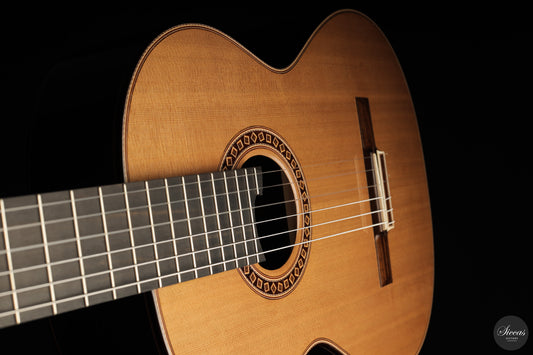
This No. 95 from 2024 is a lattice braced concert guitar with a cedar top and Indian rosewood back and sides. The model combines a compact 64 cm scale with a modern structural concept aimed at quick response, broad dynamic capacity, and an unusually active soundboard. The result is an instrument that reacts immediately to the player while maintaining substance and tonal breadth behind the initial attack.
A particularly strong aspect of this guitar is the way the trebles develop. They carry with notable amplitude and have a mature, settled quality rather than a merely brilliant surface. At the same time, the voice as a whole offers considerable resonance and depth, allowing the instrument to move easily between direct projection and more shaded, color oriented playing. This makes the guitar especially convincing for players who value precision in articulation without giving up richness of sound.
Its dynamic range and tonal palette contribute further to that impression. The guitar responds with clarity and flexibility across a wide range of touch, making it possible to shape lines with control and to preserve definition even in more demanding textures. Taken as a whole, this François R. Leonard presents itself as a highly responsive contemporary concert guitar whose lattice construction serves not raw output alone, but also depth, color, and musical control.
Condition
The guitar is in excellent condition with normal signs of wear. There are no cracks and no repairs.

While this one is sold, these are ready for you
-
Classical Guitars
The classical guitar, with its soft nylon strings and characteristic timbre, has become a symbol of chamber music, Spanish tradition, and concert repertoire. Its modern form was shaped by Antonio de Torres in the 19th century, setting the standard for the body, fan bracing, and the 65-centimeter scale length that are still used today. Instruments in this category open up a rich palette from the refined Romantic miniatures of Tárrega to the majestic concertos of Rodrigo. Here you will find guitars that preserve historical continuity and at the same time inspire new interpretations.Look all products of the collection -
Maxwell T. Sipe - 2026 No. 125 Lattice 64 cm
Price: 6.990 €Unit price per Tax free (0% DE)Luthier: Maxwell T. SipeConstruction Type: Lattice -
Michael Cadiz - 2026 No. 137
Price: 8.990 €Unit price per Tax free (0% DE)Luthier: Michael CadizConstruction Type: Lattice -
Robert Benedetto - 1997 "Manhattan" No. 39897
Price: 16.990 €Unit price per Tax free (0% DE) -
Carlos Juan Busquiel - 2023 "La Leona" No. 159
Price: 4.990 €Unit price per Tax free (0% DE)Luthier: Carlos Juan BusquielConstruction Type: Traditional -
Dominique Delarue - 2004 No. 263
Price: 6.990 €Unit price per Tax free (0% DE)Construction Type: Traditional -
César Vera - 1964
Price: 6.990 €Unit price per Tax free (0% DE)Construction Type: Traditional -
Friederike Linscheid - 2026 Doubletop
Price on requestReservedLuthier: Friederike LinscheidConstruction Type: Double-Top Guitars -
Martin Bretscher - 2026 Flow-Cut Crossover
Price: 7.490 €Unit price per Tax free (0% DE)ReservedLuthier: Martin Bretscher -

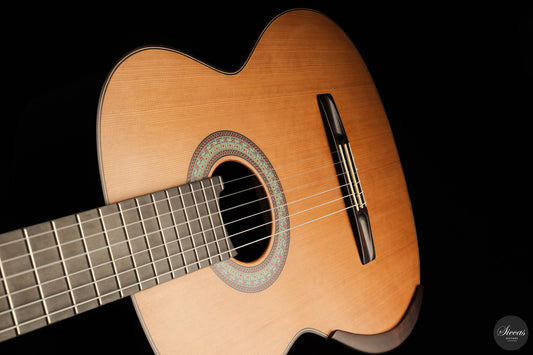 Reserved
Simon Marty - 2026 Classical Guitar
Price on requestReservedLuthier: Simon Marty -

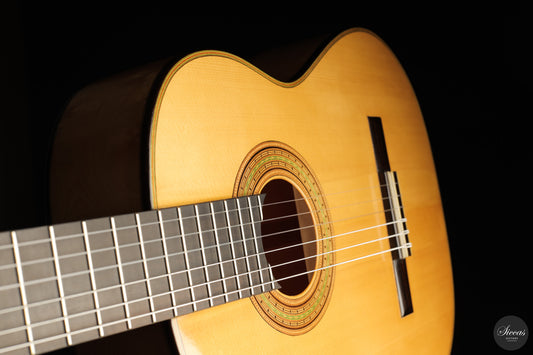 Reserved
Davide Scacchi - 2026
Price: 5.990 €Unit price per Tax free (0% DE)ReservedLuthier: Davide ScacchiConstruction Type: Traditional

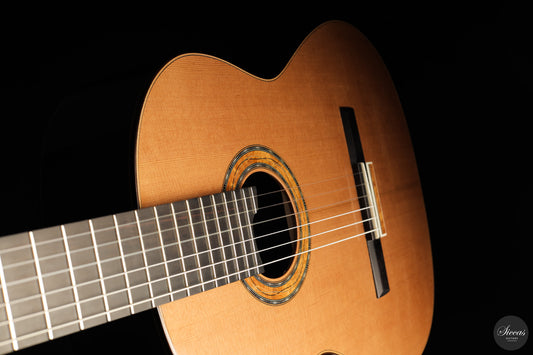

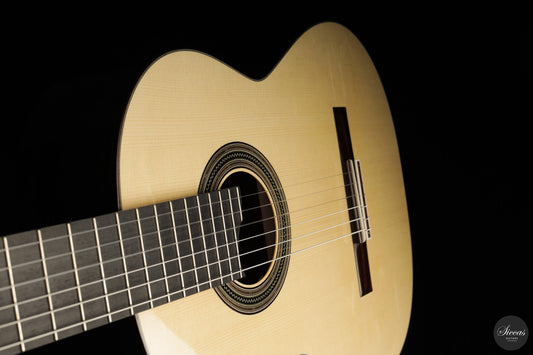








Related guitars
Frequently Asked Questions About Classical Guitars
How do I choose the right classical guitar for my level?
Choosing the right classical guitar depends on your playing level, musical goals, and budget. Beginners benefit from studio-model guitars from renowned workshops, while advanced players and professionals often choose a handmade master guitar. We are happy to advise you personally and can send detailed sound samples and videos on request.
What is the difference between a master guitar and a studio guitar?
Master guitars are built entirely by hand in the workshop of a single luthier, using only high-quality, well-aged tonewoods. Studio guitars are made in small series, often under the supervision of the master luthier, and offer excellent value for students and ambitious amateur players.
Can I try a classical guitar at home for 14 days?
Yes — every guitar you purchase from us comes with a 14-day home approval period. This complimentary trial applies worldwide to all orders, whether you are in Germany, Europe, the USA, Asia or anywhere else. We ship your instrument fully insured in a high-quality case so you can play it under your own acoustic conditions. If the guitar is not the right one for you, simply send it back and receive a full refund of the purchase price.
Can I try a classical guitar before purchasing?
Absolutely. You are warmly invited to visit our showroom in Karlsruhe, Germany, and test the instruments at your leisure. We are happy to schedule a personal appointment. If a visit is not possible, we send detailed videos and sound samples, and offer extensive consultation by phone or video call.
What payment methods and financing options do you offer?
We accept bank transfer, PayPal, major credit cards, and Klarna. For high-value instruments, we offer individual installment plans on request. Please contact us directly — we will find a suitable solution for every budget.
How do I properly care for my classical guitar?
A classical guitar requires constant humidity between 45 and 55 percent. Store the instrument in its case with a humidifier, avoid direct sunlight and large temperature fluctuations. Change the strings regularly and clean the guitar with a soft microfiber cloth.