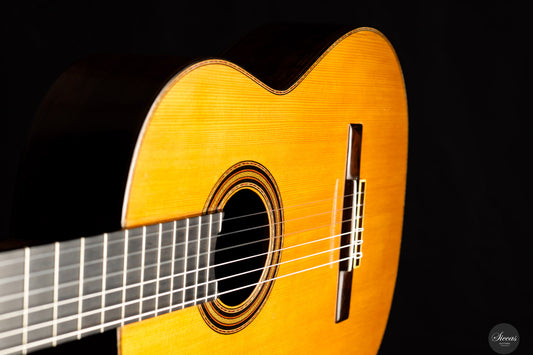








Tamara Stahl - 2025 No.20
Tamara Stahl - 2025 No.20
Details
Details
Overview
Overview


Video overview


More details about the guitar
About the luthier
Tamara Stahl began her path in guitar making in 2016 during her time at Siccas Guitars in Karlsruhe. Experiencing a large range of handcrafted instruments awakened her interest in how construction details shape the voice and feel of a guitar. In 2019 she graduated from the instrument making school in Mittenwald and continued her studies by moving to southern Spain where she learned from experienced makers in the region often regarded as the birthplace of the modern classical guitar. Since 2022 she has been working in Weimar where she shares a workshop with the luthier Johanna Vogl. This environment supports an exchange of ideas while allowing each maker to follow an independent artistic direction.
Her guitars are known for precision, refined visual design and a sound that joins traditional sweetness and clarity with the strength and projection expected in modern concert instruments. Stahl develops her building system through careful incremental adjustments. In every new guitar she seeks a balance of resonance, structural stability and expressive potential.
About the guitar
This instrument from 2025 with the number 20 reflects the evolution of Tamara Stahl’s mature building style. It is constructed in a traditional manner with a cedar top and Indian rosewood body, finished throughout with French polish. The doubled sides and the carefully weighted bridge contribute to increased projection and stability. The overall build feels compact and solid while remaining sensitive to the lightest touch. Kris Barnett tuning machines provide smooth and steady tuning.
The guitar produces a tone that is airy and full bodied. The character is slightly dark yet always open and round. The notes carry a noticeable weight and the sound has an appealing sense of depth. The instrument responds quickly across all registers and sustains with ease. The trebles are clear and smooth and the basses are present and supportive without dominating the texture. The result is a guitar that blends the intimacy found in traditional instruments with the headroom needed for concert playing. It encourages expressive shaping of lines and offers a wide range of colours with subtle gradations of tone.

While this one is sold, these are ready for you
-
Classical Guitars
The classical guitar, with its soft nylon strings and characteristic timbre, has become a symbol of chamber music, Spanish tradition, and concert repertoire. Its modern form was shaped by Antonio de Torres in the 19th century, setting the standard for the body, fan bracing, and the 65-centimeter scale length that are still used today. Instruments in this category open up a rich palette from the refined Romantic miniatures of Tárrega to the majestic concertos of Rodrigo. Here you will find guitars that preserve historical continuity and at the same time inspire new interpretations.Look all products of the collection -
Angelo Vailati - 2026 No. 262 REG Limited Edition
Price: 12.990 €Sale price 12.990 € Price:Unit price per Tax free (0% US)0 €Save: -12.990 €ReservedLuthier: Angelo VailatiLuthier: Roma Expo Guitars 2026Construction Type: Traditional -
Marco Maguolo - 2026 Ducale Double Top No. 322 REG Limited Edition
Price: 9.990 €Sale price 9.990 € Price:Unit price per Tax free (0% US)0 €Save: -9.990 €Luthier: Marco MaguoloLuthier: Roma Expo Guitars 2026Construction Type: Double-Top Guitars -
Antonio Marchese - 2026 Arias REG Limited Edition
Price: 9.990 €Sale price 9.990 € Price:Unit price per Tax free (0% US)0 €Save: -9.990 €Luthier: Antonio MarcheseLuthier: Roma Expo Guitars 2026Construction Type: Traditional -
Danilo Bazzana - 2026 N.76 REG Limited Edition
Price: 8.990 €Sale price 8.990 € Price:Unit price per Tax free (0% US)0 €Save: -8.990 €ReservedLuthier: Danilo BazzanaLuthier: Roma Expo Guitars 2026Construction Type: Traditional -
Antonio Marchese - 2026 Garcia REG Limited Edition
Price: 9.990 €Sale price 9.990 € Price:Unit price per Tax free (0% US)0 €Save: -9.990 €ReservedLuthier: Antonio MarcheseLuthier: Roma Expo Guitars 2026Construction Type: Traditional -
Ennio Giovanetti - 2026 Tonino REG Limited Edition
Price: 8.990 €Sale price 8.990 € Price:Unit price per Tax free (0% US)0 €Save: -8.990 €Luthier: Ennio GiovanettiLuthier: Roma Expo Guitars 2026Construction Type: Traditional -
Sebastiano Fracasso - 2026 Dolomia REG 2026
Price: 7.990 €Sale price 7.990 € Price:Unit price per Tax free (0% US)0 €Save: -7.990 €Luthier: Roma Expo Guitars 2026Luthier: Sebastiano FracassoConstruction Type: Traditional -
Marco Gilioli - 2026 Lattice REG No.74
Price: 8.990 €Sale price 8.990 € Price:Unit price per Tax free (0% US)0 €Save: -8.990 €Luthier: Marco GilioliLuthier: Roma Expo Guitars 2026Construction Type: Lattice -
Luca Santambrogio - 2026 Romanillos REG Limited Edition
Price: 6.990 €Sale price 6.990 € Price:Unit price per Tax free (0% US)0 €Save: -6.990 €Luthier: Luca SantambrogioLuthier: Roma Expo Guitars 2026Construction Type: Traditional -
Santos Hernandez - 1932
Price: 29.990 €Sale price 29.990 € Price:Unit price per Tax free (0% US)0 €Save: -29.990 €Luthier: Santos HernandezConstruction Type: Traditional