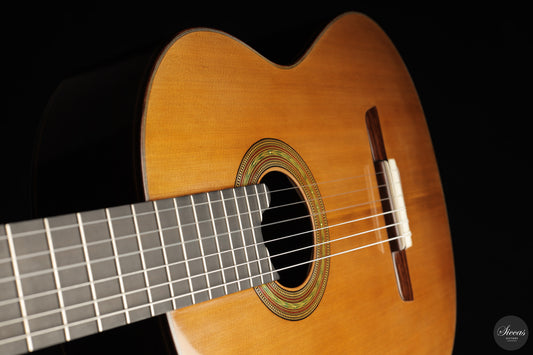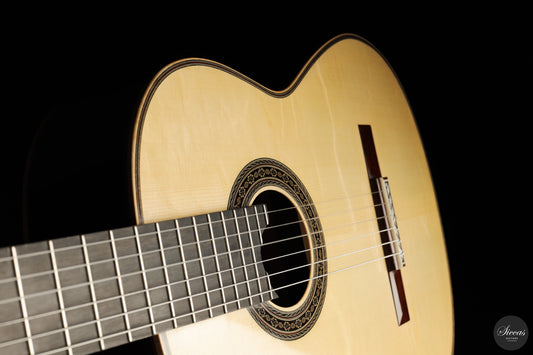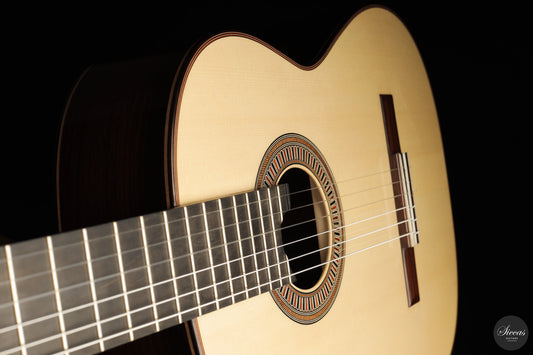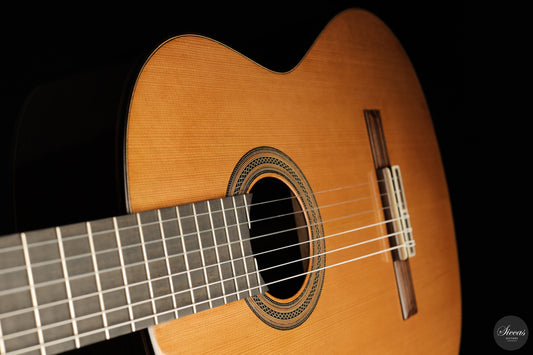

Dominique Field occupies a singular place among the great classical guitar makers of our time. Born on 30 July 1954 in Boulogne-Billancourt, France, he came to lutherie not through a conventional apprenticeship but through an intensely personal path — one that wound through law studies, years of conservatory guitar training, and a decade spent in quiet, attentive proximity to the legendary Robert Bouchet. Today, his instruments are counted among the most powerful, refined, and sonically complex classical guitars available anywhere in the world. Concert artists wait years to receive one, and collectors prize them as heirloom objects that only improve with time.
Biography & Training
Field's journey into guitar making was shaped as much by curiosity as by circumstance. He initially enrolled in law studies before turning decisively toward music, spending eight years at the conservatory in the 17th arrondissement of Paris studying classical guitar and solfège. His fascination with the instrument itself — its acoustics, its architecture, its hidden logic — gradually eclipsed his ambitions as a performer, and by the mid-1970s he had begun to teach himself the craft of lutherie.
His first guitar was completed in 1977, built with the assistance of Pierre Jaffré. The following year, 1978, he opened his first workshop at 16 rue Jean Cottin in Paris, where he would eventually construct his first 78 instruments and restore a number of historic collection guitars. What set Field apart from his contemporaries was not simply technical aptitude but the depth of his self-directed study. He immersed himself in the work of the foundational masters — Torres, Hauser, Ignacio Fleta, and above all Bouchet — and crucially, he had the extraordinary opportunity to learn from Bouchet directly.
Field first met Robert Bouchet in 1974, and over the following decade he attended Bouchet's workshop with regularity, absorbing the older master's approach to sound, structure, and materials. In 1982 Bouchet entrusted Field with the maintenance of guitars for several of his clients — a profound mark of confidence. When Bouchet passed away, Field inherited workshop notebooks and materials that he later donated to the instrument museum of the Paris Conservatory, ensuring that Bouchet's legacy would be preserved for future generations. This lineage — Bouchet to Field — represents one of the most direct transmissions in the modern French lutherie tradition, placing Field alongside figures such as Daniel Friederich as a steward of that heritage.
Construction Philosophy
What distinguishes a Dominique Field guitar in the hand — and even more so under the fingers — is the result of a construction philosophy that is both rigorous and original. Field's central aim is to create a maximally rigid structural frame for the back and sides, so that vibrational energy delivered by the strings is channelled directly into the soundboard rather than dissipated throughout the body. This philosophy stands in deliberate contrast to approaches that treat the entire guitar body as a resonating chamber. For Field, the top is the voice; everything else exists to support and amplify it.
To achieve this, he developed a proprietary bracing system for the back and sides that distributes tension laterally through the ribs, which are reinforced with approximately thirty small vertical bars per side. The back itself carries six bars — two lengthwise and four transverse. The result is an instrument of exceptional structural integrity, and the acoustic consequences are audible immediately: unusual clarity across all registers, a percussive presence in the attack, and a dynamic range that rewards both the intimate phrase and the concert hall projection. His guitars are considered among the most powerfully projecting instruments in the classical tradition, yet they never sacrifice elegance for volume. Whether built with a spruce or cedar top, a Field guitar retains a singing, aristocratic quality that experienced players describe as immediately recognisable.
His choice of materials reflects a corresponding seriousness. Field has worked with aged spruce sourced from Daniel Friederich's personal stock — wood acquired by Friederich in 1971 and passed to Field after Friederich's retirement — and with CSA rosewood received directly from Robert Bouchet in the 1980s. These materials carry not only exceptional acoustic properties but a provenance that connects his instruments to the broader lineage of classical guitar making in France. For Field, the selection and preparation of tonewoods is inseparable from the philosophy of the instrument itself.
Signature Models
Field does not build to a fixed catalogue of named models in the manner of some larger workshops. Each guitar he makes is, in a meaningful sense, a singular object — built to his own evolving specifications, shaped by the particular woods available and the acoustic goals of the moment. His instruments are numbered sequentially, and this numbering system, running well past 165 documented instruments, gives some indication of the measured pace at which he works. Collectors who follow his output note consistent features across his guitars: a clean, traditional aesthetic with no superfluous ornamentation, a scale length of 650 mm, and a tonal character that balances warmth and transparency in proportions few makers achieve. Both spruce-top and cedar-top variants are represented in his output, each offering a distinct tonal character while remaining unmistakably his work.
Field's guitars are frequently mentioned alongside the finest fan-braced instruments of the modern era — not because he follows convention but because, like the great masters, he has made his own version of the traditional form entirely his own. His later instruments, built after his 2020 relocation to Athens, Greece, continue to reflect this singular vision.
Notable Players
The roster of concert artists who have played Dominique Field guitars speaks directly to the instrument's standing in the professional world. Among those associated with his guitars are the Assad Duo, Eduardo Isaac, Vladimir Mikulka, Julian Byzantine, Adam Holzman, and Scott Tennant — players whose performing careers span diverse repertoire and stylistic approaches but who share a common demand for instruments of the highest acoustic and mechanical quality. That artists of this calibre have chosen Field guitars for concert and recording work is a testament to the instruments' ability to perform under the most demanding conditions. Field's guitars have also attracted attention from collectors beyond the performing world, a reflection of their intrinsic quality as objects as much as their sonic excellence.
Legacy
Dominique Field's legacy in the history of classical guitar lutherie is secure, though it remains — in the best sense — still in progress. His decades of work have established a body of instruments that are widely recognised as among the finest produced in the late twentieth and early twenty-first centuries. His intimate connection to Robert Bouchet, his self-directed absorption of the great lutherie tradition, and his development of a genuinely original construction system place him in a lineage that stretches back to Torres and forward to the makers he has himself influenced, including Dimitris Piperidis, to whom Field offered guidance in Athens.
He belongs to a generation of French and European makers — alongside Friederich and others — who transformed the classical guitar from a craftsman's instrument into an object of high art and exacting science. The long waiting lists his workshop has always attracted are not merely a sign of demand; they are evidence of a consensus, shared among the world's finest players, that a Field guitar represents something that cannot be replicated or rushed. His decision to relocate his workshop to Athens in 2020 marks a new chapter, but his commitment to the patient, uncompromising work of his hands remains entirely unchanged.
Browse available Dominique Field guitars → in the Siccas Guitars collection.