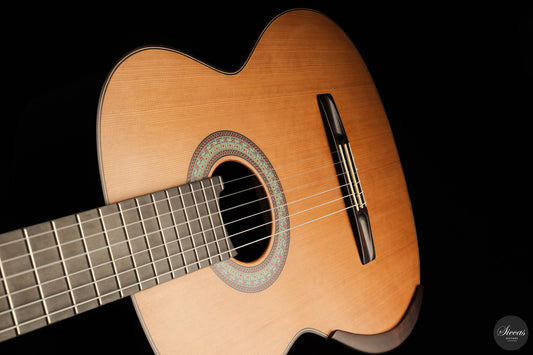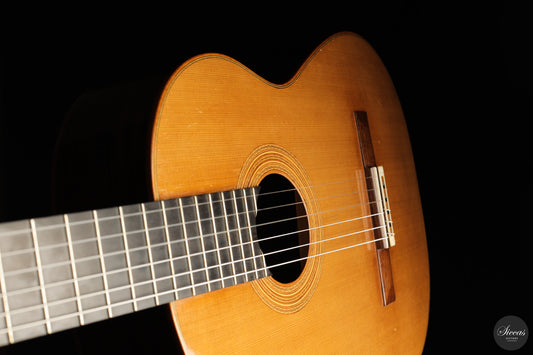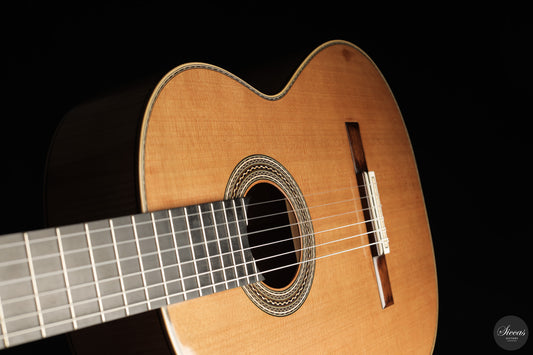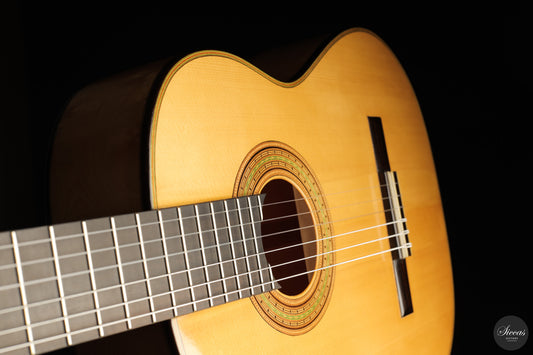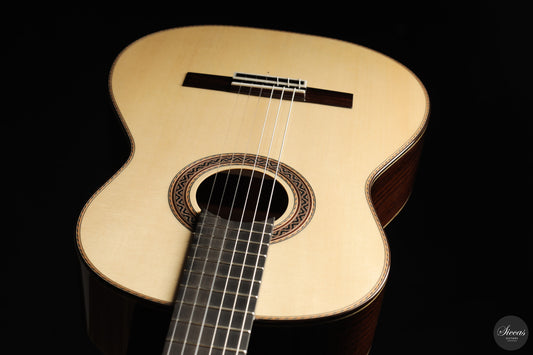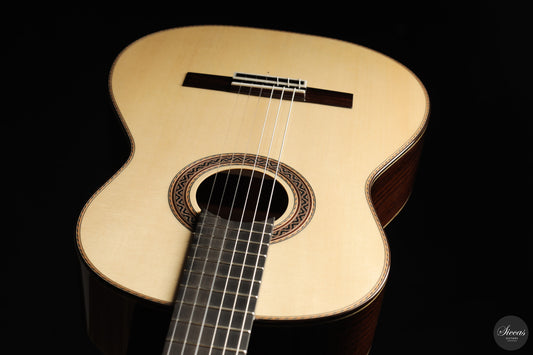

Elvis Pajares – Peruvian Luthier Building Concert Guitars of Rare Depth
From the mountain town of Namora in northern Peru, Elvis Pajares has emerged as one of the most distinctive voices in contemporary classical guitar making. His instruments carry the warmth and resonance of the great Spanish tradition while bearing an unmistakably Andean character — the product of a builder who listens as much as he builds, and who treats every piece of wood as a conversation rather than a raw material. In a world saturated with workshop output, Pajares produces just eight to ten instruments per year, each one shaped entirely by hand and guided by ear.
Origins and the Family Tradition of Craft
Pajares grew up in Namora, a small community in the Cajamarca region of Peru, where guitar making was not a distant aspiration but a living family tradition. From an early age he absorbed an understanding of tone, touch, and the acoustic behaviour of wood that no classroom alone can teach. That foundation — part inherited knowledge, part relentless curiosity — shaped the maker he would become.
His influences read as a who's who of the Spanish golden age: Antonio de Torres, Francisco Simplicio, and José Luis Romanillos are the builders whose work he returns to most often. What distinguishes Pajares from craftsmen who merely imitate their heroes is his insistence on understanding why the great masters made the decisions they did, rather than simply reproducing their measurements. He studies the physics of resonance and the behaviour of individual tonewoods before committing a single cut. The result is work that honours its lineage without being enslaved to it.
Construction Philosophy: Listening as a Method
Pajares describes his approach in terms that are as much musical as they are technical: "attentive listening, intuition, and a constant curiosity about the acoustic potential" of each instrument. Every guitar he builds begins with an extended period of listening to the raw materials — tapping, flexing, and reading the response of each plate before he decides how it will be worked. Because no two pieces of wood are alike, no two guitars leave his workshop identical. Each instrument is, in his words, shaped by the character the wood itself brings to the table.
He builds entirely without machine assistance. Thicknessing, bracing, voicing, and finishing are all carried out by hand, which gives him the sensitivity to make micro-adjustments at every stage. This is one reason his annual output remains deliberately small: quality and consistency of this order cannot be scaled without sacrificing the very qualities that define the work. For players seeking an instrument that rewards deep listening — the kind of guitar that reveals new dimensions as the player develops — a Pajares instrument offers something that production-line building simply cannot replicate. Those interested in how hand-building techniques compare across bracing styles will find useful context in the guide to fan-braced, double-top and lattice guitars.
Signature Models: Wayra and La Joia
Two models define the current output of the Pajares workshop. The Wayra — a Quechua word meaning "wind" — takes the double-top concept and strips it of its usual reliance on synthetic core materials. Where most double-top builders use Nomex or carbon fibre between two thin spruce or cedar faces, Pajares constructs the Wayra entirely from wood, achieving the power and projection of the double-top format while preserving the natural warmth and organic resonance that wood-core construction provides. The result sits in an intriguing position: it carries the clarity and dynamic range that modern players increasingly demand, yet it never loses the rounded, singing quality that connects the best contemporary instruments to the classical canon. The double-top pioneers Matthias Dammann and Stephan Nowak established the framework; Pajares has found his own answer within it.
The La Joia model takes a different path, looking directly to the legacy of Torres for its inspiration. Pajares designed La Joia to recapture "the elegance, balance, and luminous voice of the great Spanish instruments," and the guitar reflects that ambition in its voicing: clear, bell-like trebles, a bass register that sings rather than booms, and a midrange that sits just forward enough to carry melody with conviction. It is an instrument for players rooted in the Iberian tradition who want a modern level of consistency and refinement without sacrificing the tonal character that drew them to classical guitar in the first place.
Beyond these two principal models, Pajares has also incorporated cultural heritage from his Peruvian roots into his craft. One guitar features the Inca Tumi — a ceremonial knife from the ancient Inca civilization — carved into its palette through intricate woodwork, demonstrating his skill as a carver and his commitment to embedding Andean identity into the instruments he makes.
Notable Players and Artistic Collaborations
The circle of players working with Pajares instruments reflects both his international reach and the depth of trust that performers place in his work. Rodrigo Herrera, the Mexican classical guitarist, began a close collaboration with Pajares in 2023, working directly on the design and development of high-level concert instruments — a relationship that speaks to the seriousness with which Herrera regards the maker's abilities. Javier Echecopar, one of Peru's most respected guitarist-composers, has chosen a Pajares instrument for a forthcoming recording project documenting musical works at iconic sites across Peru — a project in which the national identity of the guitar is itself part of the artistic statement.
From Europe, the Croatian guitar trio Trío Evocación performs on Pajares instruments alongside guitars by Pavao Sever, while Marco De Biasi (Italy), Damjan Bučić (Croatia), and Luka Lovreković (Croatia) have all committed to his work at a professional concert level. That a builder producing fewer than ten guitars per year has attracted players from four continents is a measure of the esteem in which his instruments are held. Siccas Guitars is one of only two international dealers through which his work is available, alongside La Guitarrería de Paris.
A Distinctive Voice in the Contemporary Workshop Scene
Among the many talented builders working today, Elvis Pajares occupies a rare position: a luthier from outside the traditional centres of guitar making in Spain, France, and Germany who has nonetheless achieved recognition within the highest tiers of the concert world. His work belongs to the broader story told by classical guitar makers from every tradition, yet it carries a cultural specificity — Peruvian, Andean, shaped by a family inheritance — that makes it immediately his own. The masters he admires, from Daniel Friederich to the great Spaniards, found their voices by absorbing tradition deeply and then trusting their own ears. Pajares has followed exactly that path.
Browse available Elvis Pajares guitars → in the Siccas Guitars collection.