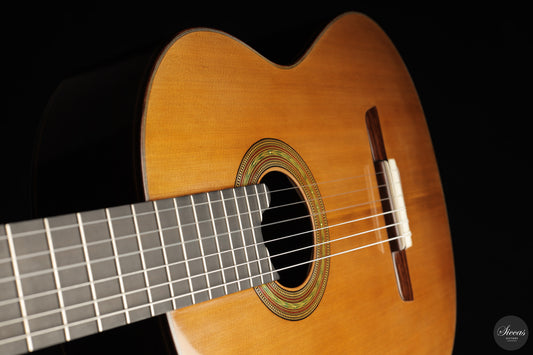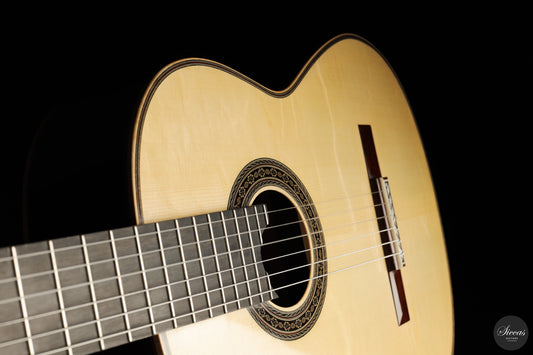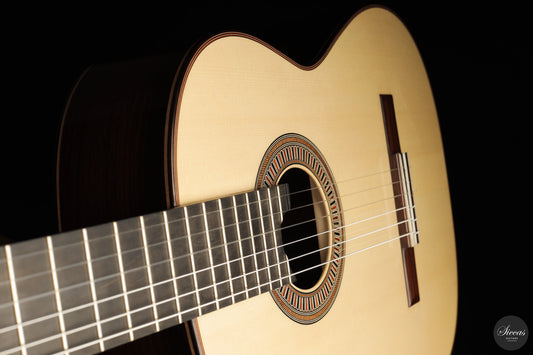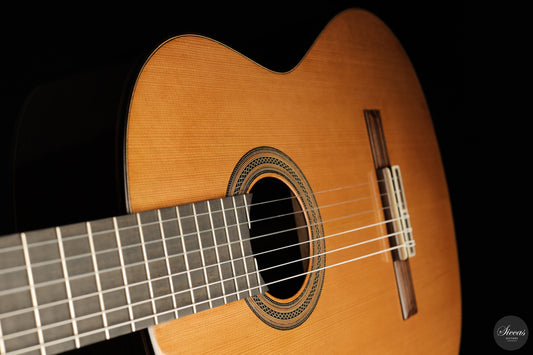

Fabio Zontini – Master of Historical Guitar Making
Among the most thoughtful voices in contemporary Italian lutherie, Fabio Zontini has spent more than three decades building classical guitars that speak the language of the great historical masters — Torres, Hauser, Simplicio, Bouchet — while retaining a distinctly personal voice. Working from his workshop in the olive-covered hills of Liguria, Zontini represents a tradition of disciplined craftsmanship that treats the guitar not merely as an instrument, but as a document of living musical history. His guitars, of which he has crafted over 250, are sought by players and collectors who prize tonal warmth, balance, and the rare integrity of genuine handwork.
From Milan to the Hills of Liguria – A Formation in the Old Way
Fabio Zontini was born in Milan in 1971, and his path into lutherie began with a chance encounter that would shape his entire career. In 1992, while still a young man, he met master luthier Carlo Raspagni in the latter's Milan workshop. The encounter lit something in Zontini that could not be extinguished: that same year he enrolled at the Civica Scuola di Liuteria in Milan, the city's prestigious civic school of instrument making. He graduated in 1996 with the diploma of Master Luthier and Restorer, completing a rigorous formation that grounded him equally in construction and in the conservation of historical instruments.
The dual focus — building new instruments and understanding old ones — has never left him. Shortly after his training, Zontini began deep archival and hands-on research into the great guitars of the 19th century, an enquiry that would lead him, in 2007, to the Museu de la Música in Barcelona. There he undertook an in-depth study of the 1859 guitar belonging to the Catalan virtuoso Miguel Llobet, as well as the celebrated Torres "Papier Mâché" of 1862 — the experimental instrument in which Antonio de Torres demonstrated that the top, not the body materials, is the soul of the guitar's sound. This kind of primary-source research, rare even among professional luthiers, distinguishes Zontini's approach and gives his historical replicas an authority that goes beyond surface appearance. The tradition of classical guitar makers who anchor their work in rigorous historical study is a long one, and Zontini stands firmly within it.
For more than twenty years he has chosen to live and work in Olle, a hamlet in Calizzano in the province of Savona, Liguria. The quiet of the countryside, the olive groves surrounding his home, and the distance from urban noise all feed into an approach to making that is unhurried and deeply considered. He is a member of ALI, the Italian professional luthiers' association, and has exhibited at national and international shows and given lectures at conservatories, music schools, museums, and guitar festivals across Italy, Europe, and Central America, including events in the Czech Republic and Mexico.
Construction Philosophy – Tradition as a Living Practice
Zontini's guitars are handcrafted in every detail, and his stated aim is to build instruments that are warm in tone and round in character, achieving a balance between projection and timbral richness that serves both the concert hall and the intimate salon. His historical influences are precise and specific: Antonio de Torres, Hermann Hauser I, Pietro Gallinotti, Francisco Simplicio, and Louis Panormo form the constellation from which he draws. But Zontini is not a copyist in the simple sense. His study of these makers is philological — he examines construction methods, bracing geometry, graduation patterns, and materials not to produce facsimiles, but to understand underlying acoustic principles that he can then apply with his own judgment.
Alongside his classical instruments, Zontini produces reproductions of romantic-era guitars by makers such as Antonio Rovetta, Louis Panormo, and Joseph Marconcini. This engagement with the history of the romantic guitar reflects the breadth of his historical curiosity and places him among the small group of luthiers who can speak credibly across different epochs of the instrument's development. Where many contemporary makers focus exclusively on the post-Torres concert guitar tradition, Zontini moves fluidly between centuries, finding in each its own logic and beauty.
His REG (Regular) series represents his standard concert model, offered in various scale lengths including 62 cm, 64 cm, and 65 cm formats to accommodate different player physiologies and repertoire preferences. These instruments are built with the same care and standards as his limited-edition work, and they have found their way through major dealers to players in the United States, Korea, and across Europe.
The REG Limited Editions and "La Delizia" – Where Lutherie Meets Art
In recent years, Zontini has extended his practice into territory that blurs the boundary between instrument making and visual art. His REG Limited Edition series takes the acoustic foundations of his standard models and surrounds them with extraordinary decorative work — inlays, painted surfaces, and visual programmes drawn from art history. The most celebrated example is "La Delizia," a project begun in 2021 and completed in time for its debut at the Roma Expo Guitars in 2025. One of the most remarkable features of this instrument is its painted interior, which reproduces passages from "The Garden of Earthly Delights" by the Flemish painter Hieronymus Bosch. The guitar is the second in a very limited series; the first, "La Sibilla," was completed in 2020 and became the subject of a short film that was presented at international film festivals, featuring concert pianist Elena Casoli.
This artistic dimension is not decorative indulgence: it reflects a coherent philosophy about the guitar as a cultural object, not merely an acoustic tool. Zontini's involvement in the 2016 "Arcimbolda" project — a unique guitar built collectively by fifteen luthiers on the occasion of the Roma Expo Guitar — speaks to the same sensibility. As the instrument takes its name from the Milanese mannerist painter Giuseppe Arcimboldo, known for portraits composed of fruits and flowers, the project asked its participating luthiers to think about the guitar as a composite artwork. It is precisely this engagement with the Italian artistic tradition, from the Renaissance to the Baroque, that gives Zontini's work its particular cultural texture. His Milanese roots and Ligurian present are united by a deep attachment to Italian craft as a form of thought.
The parallel can be drawn with other Italian makers who have worked at this intersection of craft and visual culture. The Italica project, in which twenty Italian master luthiers collaborated on a single instrument, is one further expression of this collective tradition, and Zontini's participation in the Arcimbolda project places him within that lineage.
Legacy and Place Among Contemporary Italian Luthiers
Italian lutherie has long occupied a distinctive place in the classical guitar world, and Zontini's work connects the present to some of the tradition's deepest roots. His Torres replicas draw on the same foundational figure who inspired Ignacio Fleta and, through him, an entire generation of Spanish and European makers. His engagement with the Hauser lineage places him in conversation with the German-rooted tradition that shaped the sound of Andrés Segovia and, through Segovia, the sound of the 20th-century concert guitar. The breadth of Zontini's historical palette means that his instruments carry resonances that reach across the full span of the classical guitar's development as a serious instrument.
What distinguishes Zontini in the crowded field of contemporary European lutherie is the consistency of his intellectual seriousness. He does not choose between the historical and the contemporary, between the decorative and the functional, or between the individual workshop and the broader community of makers. Each of his instruments is the product of a practitioner who has spent decades learning from the best examples the tradition has produced — and who continues, from the hills above Savona, to add his own considered voice to that conversation.
Browse available Fabio Zontini guitars → in the Siccas Guitars collection.