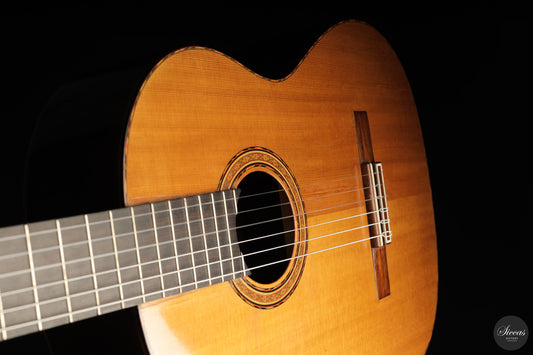
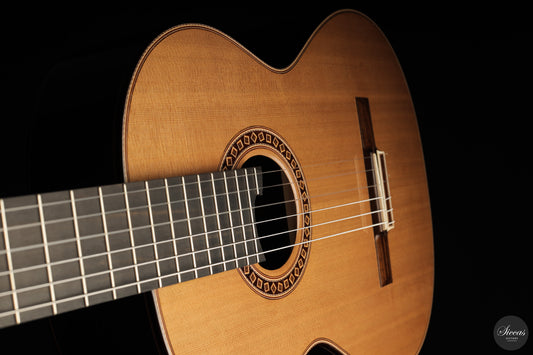
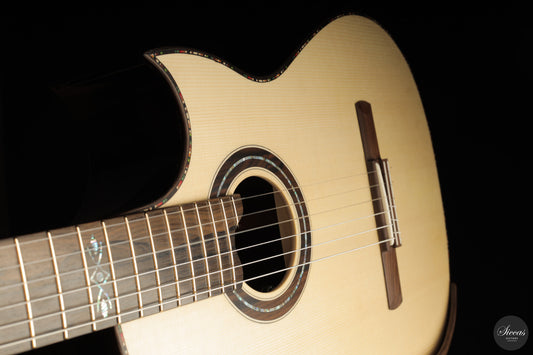
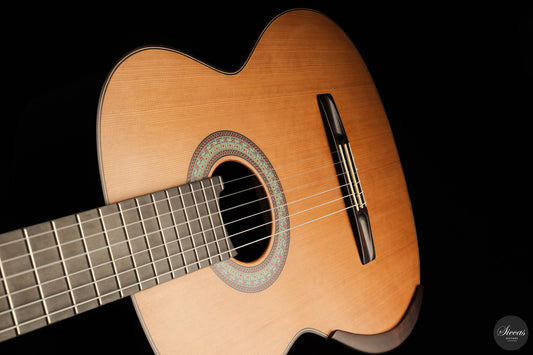
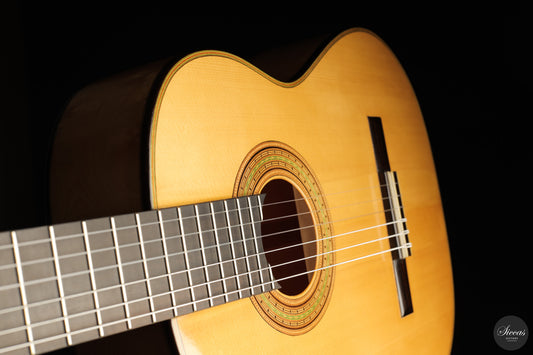
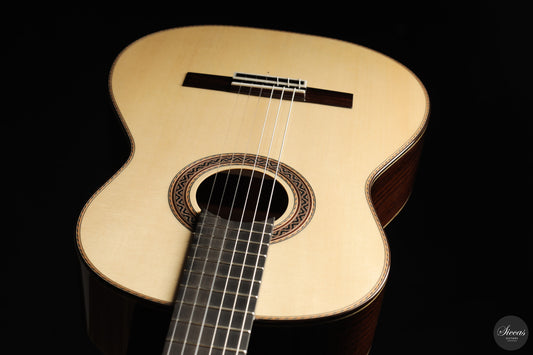
Among the great luthiers who have shaped the sound of flamenco guitar in the modern era, Francisco Barba stands as one of the most respected voices to emerge from Seville. Born in 1939, he built his reputation entirely through the quality of his hands and the clarity of his ears — teaching himself the craft, refining it over decades, and producing instruments whose tone has become recognisable to flamenco players around the world. His guitars are not merely tools; they are expressions of a living Sevillian tradition, made one at a time in the same workshop on Arroyo Street where he has spent his entire working life.
Biography & Training
Francisco Barba grew up in Seville, the historic cradle of flamenco guitar making. In the early 1960s he began his working life as a carpenter alongside his father, developing a feel for wood and joinery that would later prove invaluable. Still a teenager, he made the decision to dedicate himself entirely to guitar making — a choice that came not from formal schooling but from personal conviction and the deep musical culture of his city. He is largely self-taught, having learned through observation, experimentation, and an intimate relationship with the materials themselves. His workshop on Arroyo Street in Seville has been both his school and his studio, and it remains so today.
This self-directed path places Barba in a long tradition of Sevillian makers who absorbed guitar-building knowledge from the environment around them rather than from an institution. Seville has always been a city where guitar making was passed through neighbourhoods and families as much as through formal apprenticeships. Barba absorbed those lessons and made them entirely his own. Over time, his name became synonymous with a particular warmth and directness of tone that players and collectors associate specifically with the Sevillian school. Those interested in the broader landscape of Spanish luthiery will find Barba's work in strong conversation with the wider history described in our overview of classical guitar makers.
Construction Philosophy
Every Francisco Barba guitar is built entirely by hand. There are no shortcuts, no production-line compromises. This commitment to fully handmade construction is the cornerstone of his reputation, and it also explains why, at the height of his fame, clients regularly waited two to three years to receive an instrument bearing his label. Barba has never sought to scale up production at the expense of quality — for him, the integrity of the process and the integrity of the finished instrument are inseparable.
His approach to tone is rooted in the traditions of the Sevillian flamenco guitar. The classic combination of a spruce soundboard with cypress back and sides — a pairing long associated with the blanca tradition — appears frequently in his work, delivering the bright, percussive response that flamenco demands. Yet Barba has also worked with other tonewoods, including maple for back and sides, demonstrating a willingness to explore different tonal colours while keeping the fundamental character of his instruments firmly within the flamenco idiom. The bracing and internal architecture of his guitars reflect decades of refinement: each instrument is voiced individually, with the luthier adjusting thicknesses and brace profiles until the wood responds exactly as he intends. This painstaking process — what those who know his work often describe as laborious in the best possible sense — is what gives a Barba guitar its distinctive presence. Those wanting to understand the technical choices behind bracing traditions will find useful context in our guide to fan-braced, double-top and lattice guitars.
Signature Models
Barba's output centres on flamenco guitars, and within that focus he has produced instruments across a range of specifications. His flamenco blanca models — built with cypress back and sides — are perhaps the instruments most closely identified with his legacy: light, responsive and possessed of a singing treble register balanced by warm, resonant basses. The combination of quick attack and tonal complexity in these instruments has made them prized by professional flamenco performers for decades.
He has also produced flamenco guitars with maple back and sides, which offer a rounder, more sustained tone while retaining the dynamic immediacy that flamenco requires. In 1992 he produced a celebrated "25th Anniversary" model to mark a quarter century of guitar making, an instrument that has since been documented and discussed among collectors as a milestone in his career. Beyond these, Barba has on occasion built classical guitars, demonstrating the breadth of his mastery while always returning to flamenco as his primary language. The consistent thread across all models is the care and intentionality of the construction: a Francisco Barba guitar is always, unmistakably, a Francisco Barba guitar.
Notable Players
The roster of artists who have played Francisco Barba guitars reads as a roll-call of significant figures in flamenco. Pedro Peña, one of the most distinguished guitarist-composers associated with the Peña family tradition, has been among his clients. Riqueni — Rafael Riqueni, the Seville-born guitarist widely regarded as one of the most original voices in contemporary flamenco — is another name closely associated with Barba instruments. Others include Niño de Pura, Quique Paredes, Manuel Molina, José Manuel Roldán, Mariano Martín, Pepe Justicia and Manolo Franco, each a respected figure within the flamenco world. The fact that so many serious professional performers have chosen Barba guitars speaks directly to the instruments' suitability for demanding concert use: these are not collector pieces kept behind glass, but working guitars built to be played hard and rewarded by serious music.
Legacy
Francisco Barba's legacy is one of consistency, integrity and deep rootedness in place. He has never left Seville, never abandoned the workshop on Arroyo Street, and never compromised the handmade character of his instruments. In a guitar-making world that has seen significant technological change — new materials, CNC machinery, globalised supply chains — his continued adherence to the methods and values of the traditional Sevillian luthier represents something increasingly rare.
His sons Juan and José have joined him in the workshop, continuing the family tradition alongside their father and ensuring that the knowledge accumulated over more than sixty years of making will not be lost. This passing of craft from one generation to the next echoes the way guitar making has always survived and evolved in Seville: not through institutions alone, but through families and their shared devotion to the instrument. Barba's story invites comparison with other great Spanish masters such as Ignacio Fleta and José Luis Romanillos, whose careers similarly combined personal vision with deep roots in the Spanish tradition. His instruments also stand alongside the broader achievements of other European master luthiers who have dedicated their lives to pushing the handmade guitar forward.
For players, collectors and anyone drawn to the living heart of Spanish guitar making, Francisco Barba represents the finest that Seville has to offer: an unbroken line from tradition to the present day, expressed one instrument at a time.
Browse available Francisco Barba guitars → in the Siccas Guitars collection.