
Gerhard Oldiges – German Master of the Spanish Guitar Tradition
Among the most thoughtful and historically grounded classical guitar makers working in Europe today, Gerhard J. Oldiges occupies a singular position: a German craftsman who has devoted his career to the deep study and faithful continuation of the great Spanish lutherie tradition. Working from his workshop in Marburg, Germany, Oldiges builds instruments that trace a direct lineage back to Antonio de Torres, Hermann Hauser, and Manuel Ramírez — not as mere copies, but as living interpretations shaped by decades of hands-on research and personal mentorship under some of the finest luthiers of the modern era.
From Kitchen Table to Master's Workshop
Oldiges began building guitars in the mid-1970s, initially working on a kitchen table with the self-taught curiosity that marks so many of the world's great luthiers. He pursued formal education alongside his growing passion for the craft, and after completing university he undertook a two-year apprenticeship as a guitar maker between 1983 and 1985, gaining the structured technical grounding that would underpin all his later work. He subsequently spent time in the repair department of a specialist guitar shop, an experience that sharpened his understanding of how guitars behave over time and under the hands of serious musicians. In 1989 he passed his mastership examinations and opened his own workshop — the moment at which Oldiges the craftsman and Oldiges the independent maker became one.
That same year proved pivotal in another respect. Shortly after the publication of José Romanillos's landmark study of Antonio de Torres, Oldiges attended his first guitar-building course by José Luis Romanillos in Belgium in 1988. The encounter was transformative. Oldiges and a fellow participant, Tobias Braun of Vienna, resolved to translate Romanillos's Torres book into German, a project that deepened his immersion in the historical and theoretical foundations of the Spanish guitar. The collaboration with Romanillos did not end there: in 1996 and 1997 Oldiges assisted Romanillos's guitar-building courses in Córdoba, Spain, and from 2001 he became a regular assistant at courses held near Romanillos's home village of Guijosa, continuing a relationship of mentorship and collegial exchange that has profoundly shaped his approach to the instrument.
A Philosophy Rooted in Historical Tradition
Oldiges belongs to a school of lutherie that takes history not as a constraint but as a resource. His primary building style is anchored in the traditional designs of the past — most notably those of Hermann Hauser and the great nineteenth-century Spaniard Antonio de Torres — though he also works in the manner of Vicente Arias, Manuel Ramírez, and Santos Hernández. Each of these makers solved the central problem of the classical guitar in a subtly different way, and Oldiges has spent years understanding those differences from the inside, studying historical instruments with the rigour of a scholar and the sensitivity of a practitioner.
This approach sets him apart from the trend toward innovation that has characterised much of contemporary lutherie. Where many modern makers have pursued fan-braced, double-top and lattice construction as paths to greater projection and volume, Oldiges remains committed to the tonal vocabulary of the traditional Spanish guitar: a warm, complex, organically responsive sound that rewards nuanced playing. His finishing method of choice is French polish, which he regards as both tonally superior and philosophically consistent with the tradition he upholds — a method well suited to the small independent workshop and one that leaves the soundboard free to vibrate as its makers intended.
He works with a standard scale length of 650 mm but adapts his instruments to individual players when required, believing that playability is ultimately a matter of proper setup and the player's own development rather than a fixed specification. This attention to the individual musician reflects a wider attitude: for Oldiges, a guitar is not a product but a dialogue between maker, material, and player.
Craft, Teaching, and Community
Oldiges has never confined his contribution to the guitars that leave his bench. His role as assistant in the Romanillos masterclasses placed him at the centre of a living tradition of knowledge transmission, one that connects the contemporary workshop to the lineage running through Daniel Friederich, Robert Bouchet, and further back to the nineteenth-century masters. Beyond assisting in formal courses, he has contributed to the broader guitar-making community through workshops, seminars, and the kind of informal exchange between craftspeople that keeps a tradition vital and self-renewing.
His translation of the Romanillos Torres book into German deserves particular mention as a contribution to scholarship as much as to lutherie. By making that foundational text accessible to German-speaking readers, Oldiges helped ensure that the documentary heritage of the Spanish guitar tradition could inform the work of a new generation of makers in central Europe.
The Instruments
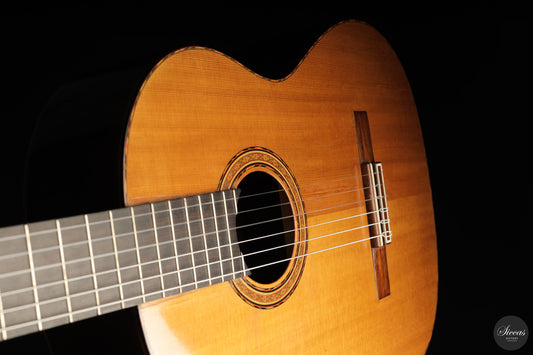
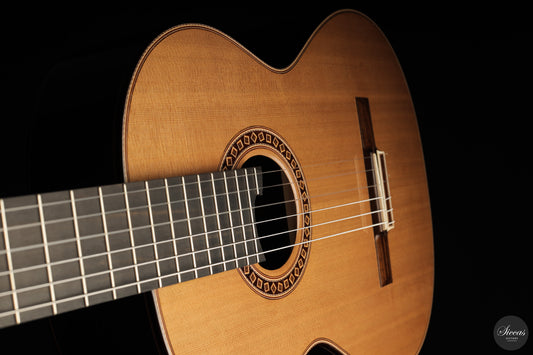
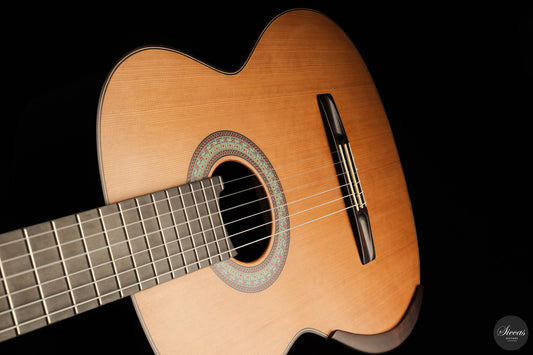
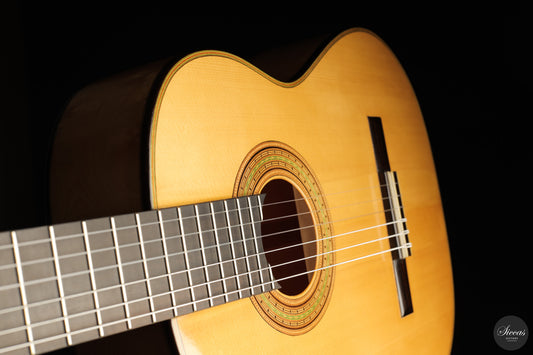
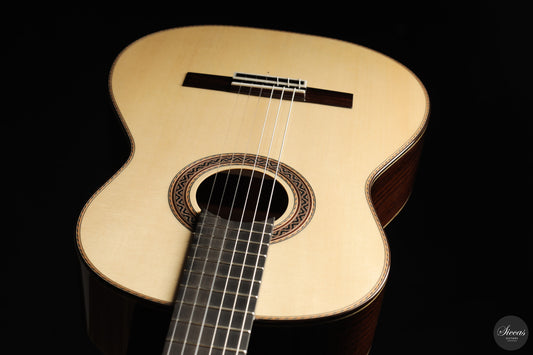
Guitars by Gerhard Oldiges are characterised by exceptional material quality, structural integrity, and a tonal character that speaks directly to the tradition he has spent his career studying. His Hauser-model instruments in particular are recognised for combining the warmth and depth associated with the great Munich school with a clarity and evenness of response across the fingerboard. His Torres-influenced guitars capture the lightness and singing treble register that made Torres's instruments the defining archetype of the classical guitar. Both lines reflect not academic imitation but genuine understanding — the difference between a craftsman who has studied an instrument and one who has truly absorbed it.
Wood selection is an area to which Oldiges brings considerable care. He maintains stocks of well-seasoned tonewoods and is mindful of the growing scarcity of traditional materials, approaching procurement with the same long-term thinking that characterises the rest of his practice. Instruments are finished entirely by hand, and the French-polished surfaces of his guitars have a depth and luminosity that reflects both his technical mastery and his respect for the aesthetic standards of the historical tradition.
Browse available Gerhard Oldiges guitars → in the Siccas Guitars collection.