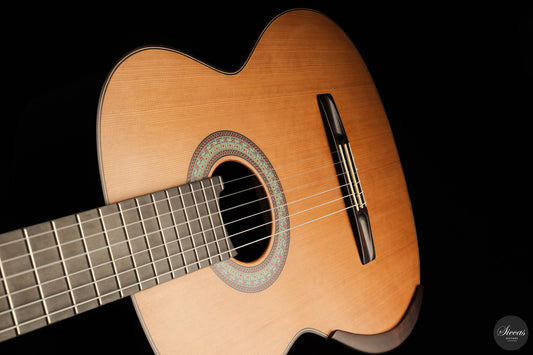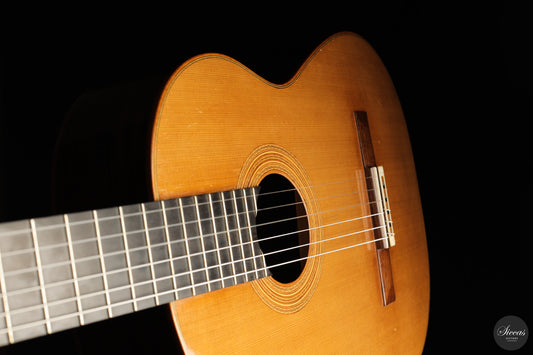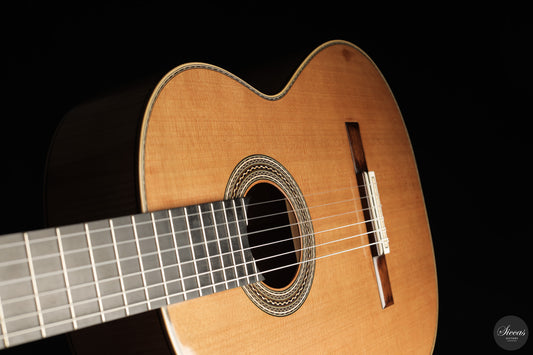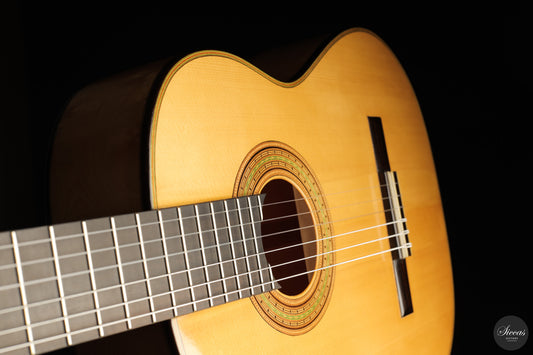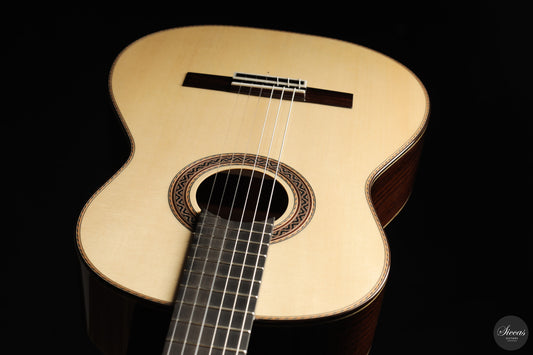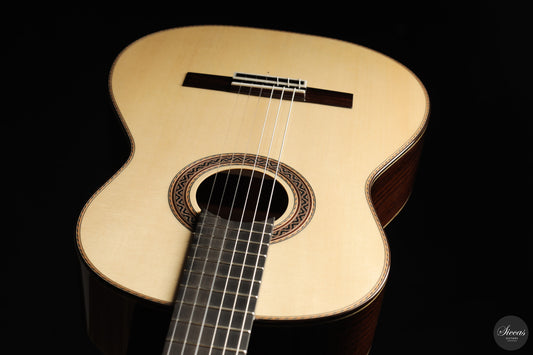

Hermann Hauser III
From 1974 onward, Hermann Hauser III and his father worked independently within the same workshop, with each instrument carrying his own numbering and signature. His guitars earned exceptional praise from leading artists: Andrés Segovia described their sound as “indescribably beautiful,” and Pepe Romero referred to his Hauser instrument as the classical guitar with the purest tone.
The distinctive character of a Hauser guitar is rooted not only in technical precision. Following the tradition of his ancestors, Hermann Hauser III cultivates close personal relationships with the musicians who play his instruments. He adjusts each guitar to the artist’s specific sound preferences, tailoring frequency response, neck profiles, fingerboards and string lengths based on an in-depth analysis of the guitarist’s individual requirements.
A central part of his work is the study of historical instruments, particularly those built by previous generations of the Hauser family. This research leads both to masterful restorations and to the development of special limited editions that reflect the legacy of the workshop.
For his craftsmanship, Hermann Hauser III has received major awards from professional organisations and widespread recognition within the international guitar community. His approach relies on an instinctive understanding of a guitarist’s playing style, a refined sense of form, exceptional handcrafting skills, musical intuition and, above all, a profound dedication to the art of lutherie.
The making of a single instrument requires between 150 and 240 hours of concentrated work. As a result, the workshop in Reisbach produces no more than seventeen guitars per year.
The waiting time for a new guitar is approximately five years. As Andrés Segovia once wrote in the Hauser family guest book, an instrument built with such care becomes “a friend for the rest of your life”.
A Four-Generation Legacy
The Hauser family represents one of the longest unbroken traditions in classical guitar making. The dynasty was founded by Josef Hauser (1854–1939), a zither maker; his son Hermann Hauser I (1882–1952) redirected the workshop toward classical guitar construction after meeting Spanish virtuoso Miguel Llobet in 1913. By studying Torres-school instruments closely, Hauser I developed a guitar that blended Spanish construction with German precision — culminating in the 1937 instrument that Andrés Segovia described as "the greatest guitar of our epoch," now in the permanent collection of the Metropolitan Museum of Art in New York. Hermann Hauser II (1911–1988) managed the workshop from 1952 to 1983. Hermann Hauser III (born 1958, Reisbach) began building independently within the family workshop in 1974, maintaining the philosophy of very limited annual production to ensure personal attention to every instrument. The workshop continues to use hand tools that date back generations — including a band saw from 1905 used by Hermann Hauser I himself.
The fifth generation is represented by his daughter Kathrin Hauser (born 1982), who completed her lutherie apprenticeship in 2007. Pepe Romero has described his Hauser instrument's tone as the purest he has encountered in any classical guitar.