
José Marin Plazuelo – Granada's Master of the Traditional Concert Guitar
Few luthiers working today embody the living continuity of the Granada guitar-making tradition as fully as José Marin Plazuelo. Born in Granada on 13 June 1960, he entered his uncle's workshop at the age of fourteen and never left — not spiritually, at least. Over five decades he has refined a voice entirely his own: instruments of tremendous projection, complex tonal colour, and a very Spanish directness that concert performers prize above all else.
Apprenticeship Under Antonio Marin Montero
In 1974 the young José Marin Plazuelo stepped into the workshop of his uncle, Antonio Marin Montero — today universally acknowledged as the patriarch of the modern Granada school. Alongside fellow apprentice José González López, he learned every stage of guitar construction from the ground up: the precise graduation of soundboards, the geometry of the fan bracing, the patient shaping of necks and ribs. Antonio Marin Montero had himself trained under Eduardo Ferrer, placing Plazuelo in a lineage that reaches back to the very roots of Granada craftsmanship. That lineage is one of the most distinguished in the world of classical guitar makers, a tradition built on unhurried attention to each individual instrument rather than on volume of output.
From the outset, Antonio praised his nephew's aptitude. The two men continued to share a workshop in a quiet residential street in the heart of Granada — close to the house once occupied by Manuel de Falla and within sight of the Alhambra — long after Plazuelo had established himself as an independent maker. That proximity was never merely sentimental; it meant a constant, living exchange of ideas between master and student that shaped every instrument Plazuelo went on to build.
The Granada Workshop and Construction Philosophy
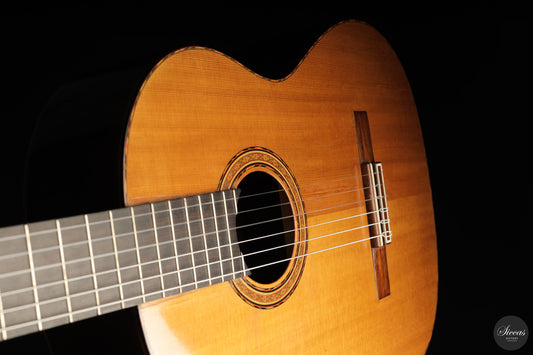
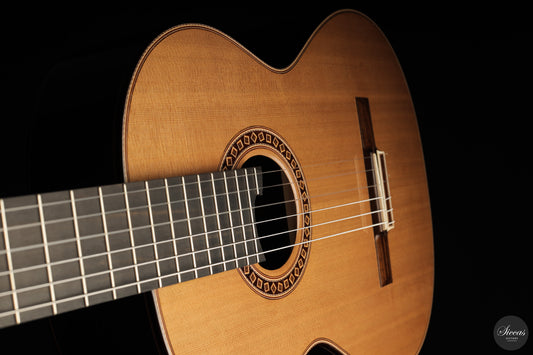
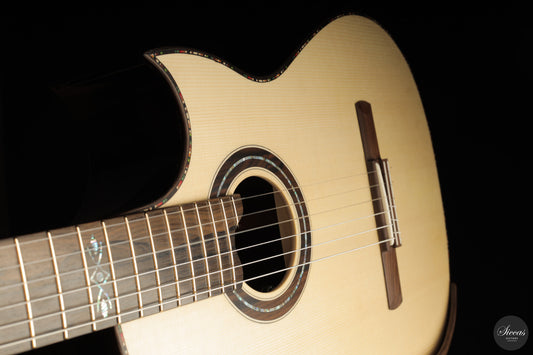
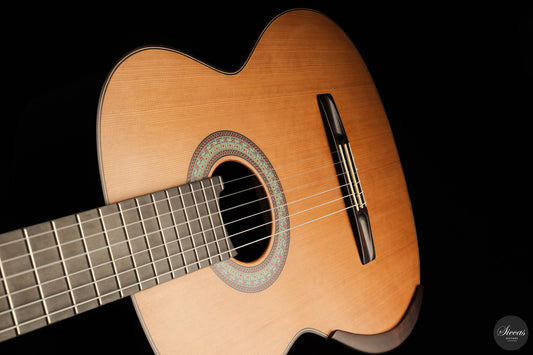
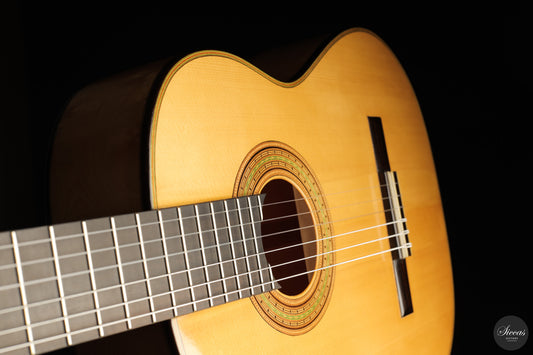
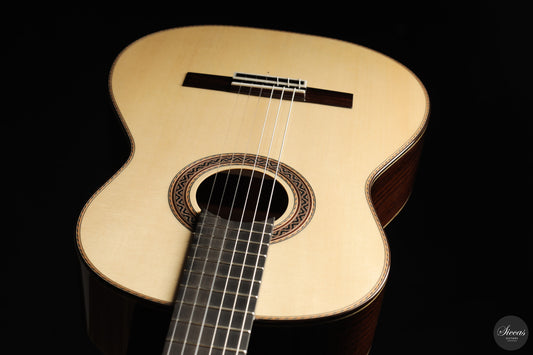
Plazuelo builds in the traditional Spanish manner: the guitar assembled on an internal solera, the neck integrated into the body from the first stages of construction, the whole instrument conceived as an organic unity rather than a collection of assembled parts. He selects tonewoods with exceptional care, working with both spruce and cedar soundboards depending on the tonal character he is seeking. Spruce-topped instruments from his bench carry a quality that surprises many players — a dark, round warmth that one might not expect from that wood — while his cedar instruments project a focused richness that suits the demands of the concert platform.
The fan bracing pattern follows the Granada school's characteristic approach, derived from the tradition codified by Antonio Torres and carried forward through generations of Granadan makers. Yet within that framework Plazuelo has developed a voice unmistakably his own. His basses are deep and defined, arriving with real authority rather than blooming loosely; his trebles are concentrated and singing, with a lush, sustained tone that rewards expressive playing. The result is a guitar of high volume and strong projection — instruments built explicitly for the serious performer. Players who have tested them at live performances have remarked that the guitar carries into a hall with an authority usually associated with larger acoustic instruments.
His flamenco instruments occupy a different aesthetic world, drawing inspiration from the guitars of the Catalan maker Francisco Simplicio (1874–1932), whose blanca guitars were prized for their immediacy and percussive attack. This dual mastery — of the rounded, sustained concert classical and the dry, rapid-response flamenco guitar — testifies to the breadth of Plazuelo's understanding of the Spanish instrument. The question of construction approach in its broader context is explored in the article on fan-braced, double-top and lattice classical guitars, which situates traditional building methods within the wider contemporary landscape.
The Granada Lineage
To understand José Marin Plazuelo it helps to understand what Granada means in the history of the concert guitar. The city produced, in the twentieth century, a concentration of luthiers unmatched anywhere in Spain: Eduardo Ferrer, Miguel Rodrigues, and above all Antonio Torres laid the foundations; subsequent generations built a school defined by warmth of tone, responsiveness to touch, and a craftsmanship rooted in pride rather than in commercialism. Antonio Marin Montero became the great transmitter of this tradition, teaching generously and inspiring makers both in Spain and abroad. His own instruments were shaped in part by his contact with the French master Robert Bouchet, with whom he spent time in Paris in the late 1970s — and that encounter ripples into Plazuelo's work indirectly, through the refinement of voicing and tonal balance that Bouchet's approach brought to the Granada tradition.
Plazuelo himself has built instruments in a Bouchet-inspired model, demonstrating the cross-fertilisation that characterises the very best of the Spanish school. Where makers such as Ignacio Fleta pursued a more symphonic sound influenced by the great Catalan tradition, and where José Luis Romanillos developed his singular voice in England under Julian Bream's influence, Plazuelo has remained rooted in Granada — absorbing external currents while keeping the essential character of his city's school intact.
Legacy and Reputation
José Marin Plazuelo is today considered one of the finest active guitar builders in Spain. His instruments are sought by professional and dedicated amateur players worldwide, traded in the most respected specialist galleries and consistently noted for their consistency of quality across decades of production. What distinguishes him in a field populated by extraordinary craftsmen is precisely that continuity: an unbroken apprenticeship with one of the greatest living luthiers, a workshop environment that has never been commercialised, and a personal commitment to building every instrument by hand with the same care whether it is his first or his five-hundredth.
The small Granada workshop, tucked into a residential neighbourhood between the Alhambra and the memory of Manuel de Falla, remains one of the most quietly important addresses in the world of the classical guitar. Each instrument that leaves it carries not only Plazuelo's own voice but the accumulated knowledge of a tradition stretching back to the very invention of the modern guitar. For players in search of a concert instrument with deep Granadan roots, expressive power, and a tonal character that rewards a lifetime of playing, his guitars represent one of the most compelling choices available today.
Browse available José Marin Plazuelo guitars → in the Siccas Guitars collection.