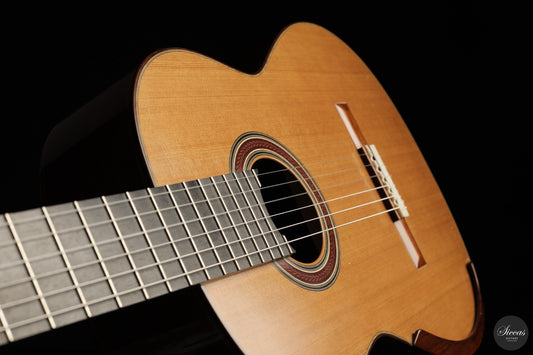

Luigi Sabbatini – A Musician's Eye for the Instrument
Some of the most compelling classical guitars are built by makers who have spent just as many years playing as they have working with wood. Luigi Sabbatini, a classical guitar teacher and luthier from Ascoli Piceno in the Marche region of central Italy, is precisely that kind of craftsman. Over the course of approximately two decades, he has developed a personal approach to guitar making that places musical expression at its centre — building instruments whose tonal balance, responsiveness, and sensitivity reflect a deep understanding of what players actually need from their guitars.
Background and Formation
Ascoli Piceno, an ancient town in the foothills of the Apennine Mountains, may not be among the first names one associates with Italian lutherie, yet Italy's rich tradition of instrument making reaches far beyond the famous workshops of the north. Sabbatini grew up immersed in classical guitar culture both as a musician and as a teacher, and it was this dual identity that eventually drew him toward building. Where many luthiers arrive at guitar making through a craft lineage or a formal apprenticeship with an established master, Sabbatini's formation is rooted above all in the act of listening — listening to what a finished instrument does, and tracing that sound back to the decisions made in its construction.
His approach is consistent with a broader Italian sensibility that values refined aesthetics alongside functional excellence. Italy has produced an extraordinary range of distinguished contemporary luthiers, and Sabbatini fits naturally within that tradition. The Italica project, in which twenty Italian master luthiers collaborated on a single instrument, speaks to the depth and vitality of the Italian classical guitar making scene to which Sabbatini belongs.
Construction Philosophy and Signature Models
Sabbatini's instruments are lattice-braced, a construction method that departs from the fan-braced tradition established by the great nineteenth-century Spanish makers and later codified by masters such as Ignacio Fleta. Lattice bracing, which uses a grid of carbon fibre reinforcement beneath a thin spruce or cedar soundboard, allows for exceptional projection and tonal clarity, making it a popular choice among builders working at the highest level of concert performance. The full range of fan-braced, double-top, and lattice construction each involves different trade-offs, and Sabbatini's commitment to the lattice reflects a considered preference for instruments that can project with confidence across the full dynamic range of the concert repertoire.
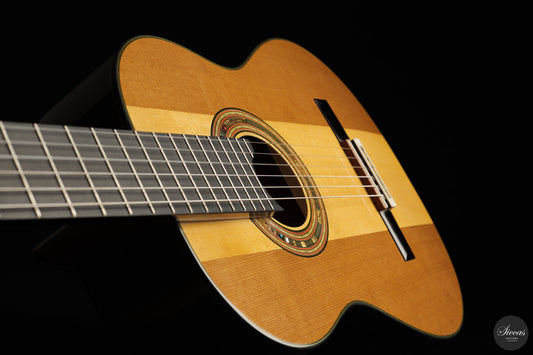
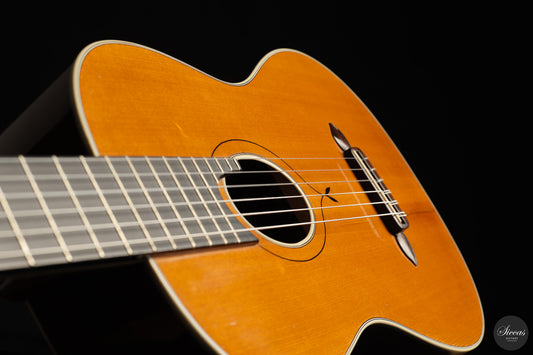
His 2024 Lattice model pairs a spruce soundboard with Indian rosewood back and sides, a cedar neck with ebony reinforcement, and an ebony fingerboard. The instrument is finished in tru-oil, a choice that allows the wood to breathe while providing a smooth, refined surface. Nicolò Alessi tuning mechanics are fitted as standard — a detail that reflects Sabbatini's attention to quality throughout the instrument, not merely in its acoustic elements. An oval-shaped monitor hole on the upper bout, a feature associated with contemporary high-performance guitar design, enriches the player's auditory experience by directing a portion of the sound back toward the performer.
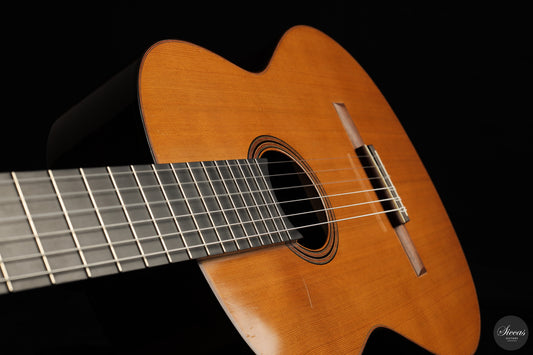
The 2025 Lattice model features a cedar soundboard over Indian rosewood, with lacquer finishing. Its tonal character has been described as achieving a sophisticated balance between power and refinement, with full, immersive volume and exceptional tonal equilibrium — each register projecting with clarity, neither bass nor treble dominating the other. This evenness across the fingerboard is one of the hallmarks of a well-realised lattice instrument, and it is a quality that Sabbatini pursues consistently across his work.
His instruments also reflect a strong sense of visual identity. The rosette of the 2025 Lattice pays homage to the graphic artist M.C. Escher, drawing on Escher's themes of continuity, metamorphosis, and transformation as a visual metaphor for music itself — fluid, ever-evolving, and limitless in its expression. Rosewood and mother of pearl detailing in the rosette and bridge frieze, matched by corresponding ornamentation on the headstock, give each guitar a coherent aesthetic that distinguishes it as a handmade object of considered beauty.
Sabbatini Among Contemporary Italian Makers
To appreciate what Sabbatini represents, it helps to situate him within the wider context of classical guitar making today. The great European masters of the twentieth century — figures such as Robert Bouchet and Daniel Friederich in France — demonstrated that exceptional guitar making could emerge from any city where a dedicated maker chose to work. Contemporary Italy has continued that tradition, producing a remarkable number of skilled luthiers who work across a range of construction philosophies. Among those working within the Florentine tradition, makers such as Andrea and Giovanni Tacchi have earned international recognition. Sabbatini, working from the Marche, represents the wider geographic spread of this excellence: quality Italian lutherie is not confined to a single workshop or region.
As both a teacher and a maker, Sabbatini occupies a particularly thoughtful position in the craft. His classroom experience gives him an unusually clear sense of what beginners struggle with, what intermediate players need, and what advanced performers demand from their instruments. That understanding — granular, practical, earned over years of listening — informs every guitar that leaves his workshop.
Legacy and Continued Work
Luigi Sabbatini is still actively building, and each new instrument builds on the accumulated knowledge of two decades of dedicated lutherie. His guitars have been presented through Siccas Guitars, bringing his work to the attention of players and collectors around the world. For those seeking an Italian lattice guitar that combines traditional material choices, meticulous finishing, and a maker's deeply musical sensibility, Sabbatini's instruments offer a compelling proposition.
His work is a reminder that the finest classical guitars are not always made in the most famous cities or the oldest workshops. Sometimes they come from a single dedicated craftsman in a historic Italian town, someone who has spent a lifetime learning how music is made — and who brings that knowledge, note by note, into the wood.
Browse available Luigi Sabbatini guitars → in the Siccas Guitars collection.