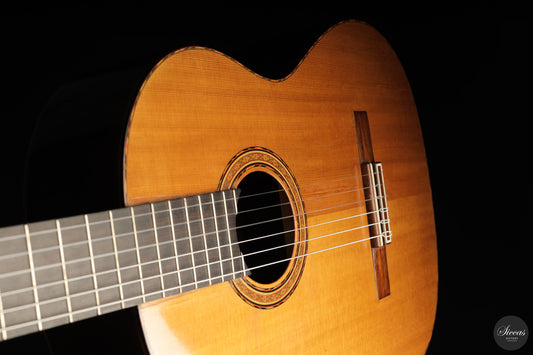
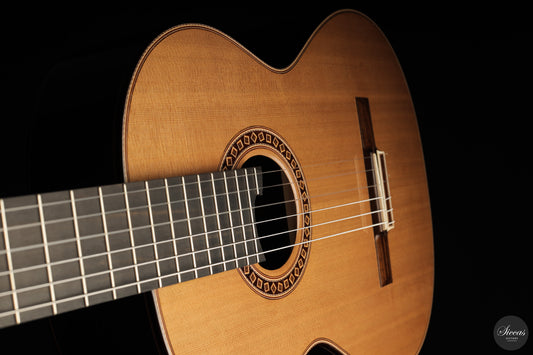
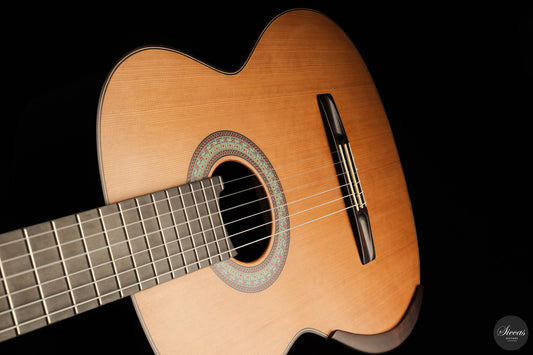
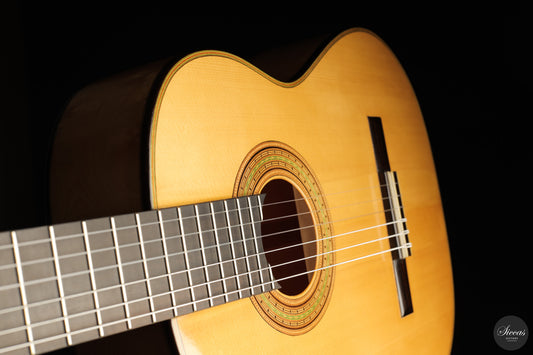
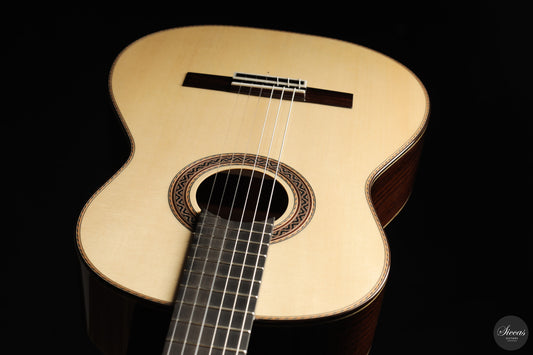
Manuel Contreras – The Innovative Spirit of Madrid Guitar Making
Among the great classical guitar makers of the twentieth century, Manuel Contreras stands apart as one of the most inventive and experimental minds the craft has ever produced. Born in Madrid in 1928, he transformed a career as a skilled cabinetmaker into a legendary luthiery, and over three decades delivered a series of design breakthroughs that continue to shape how builders and players think about the concert guitar. His instruments were not merely refined — they were genuinely new.
From Cabinet Shop to Guitar Workshop
Contreras grew up in Madrid and developed exceptional woodworking skills as a furniture maker. In 1959 those skills attracted the attention of José Ramírez III, who invited him to apprentice at the Ramírez workshop — one of the most prestigious addresses in world lutherie. Within roughly two years Contreras had absorbed enough of the Spanish tradition to feel confident in striking out on his own. In 1962 he opened his workshop at 80 Calle Mayor in central Madrid, an address that would become one of the most recognised in the guitar world and that the Contreras name has occupied ever since.
His formation at Ramírez gave him a firm grounding in the Torres-derived Madrid school — the elevated fingerboard, the cedar or spruce top over traditional fan bracing, the understanding of resonance as an architectural problem. Yet Contreras never allowed tradition to become constraint. Almost from the moment he opened his own doors, peers and players noticed an appetite for experiment that set him apart from the more conservative craftsmen around him. Where others refined within established parameters, Contreras questioned the parameters themselves.
Signature Models and Design Innovations
The 1970s were Contreras's great decade of experimentation. Working methodically through acoustic problems — how to increase volume without sacrificing warmth, how to improve the balance between bass and treble registers — he arrived at a series of solutions that were, at the time, without precedent. The most consequential was the Doble Tapa, or Double Top, presented in 1974. Rather than the conventional single soundboard, Contreras laminated a second layer of soundboard timber to the inner face of the back, creating a resonating back that worked in sympathetic relationship with the top. The result was a significant increase in projection and a broadened tonal palette. This model attracted immediate enthusiasm among leading soloists, most notably the Romero family — Celedonio, Pepe, Angel and Celin — all of whom adopted it enthusiastically. The idea that the back could be an active acoustic partner to the top was a conceptual leap that would reverberate through the craft for decades; it is worth noting that the approach is quite distinct from the later double-top construction explored by double-top pioneers such as Dammann and Wagner, whose technique involves a sandwich soundboard rather than Contreras's resonating back.
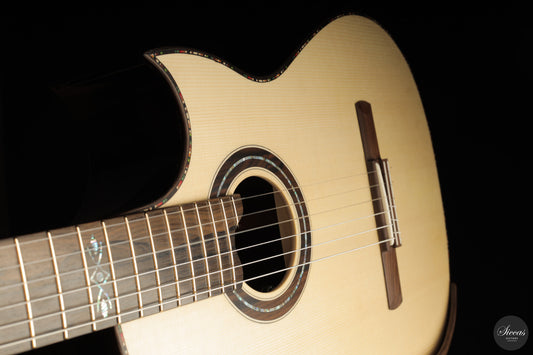
In 1983 Contreras introduced what many consider his most radical instrument: the Carlevaro model, developed in close collaboration with the Uruguayan composer, pedagogue and virtuoso Abel Carlevaro. The guitar departs from the classical silhouette in two striking ways: the waist on the bass side of the body is eliminated, giving the instrument an asymmetrical outline, and the soundhole is removed from the soundboard entirely. The sound instead projects through alternative apertures, producing a remarkably direct and focused tone. It is an instrument that challenges the player as much as the maker — a testament to what becomes possible when a luthier and a musician of the highest level work together over years toward a shared acoustic vision.
Two further innovations rounded out Contreras's contribution to experimental lutherie. In 1985 he introduced the Resonator system, a refined approach to back resonance, and he also developed an Alto Guitar — a smaller-bodied instrument tuned a third higher than the conventional guitar — that found a dedicated following in Japan, where the Niibori Guitar Orchestra helped bring it to wider prominence. Throughout this period, Contreras also continued to build his standard concert model, the 1a Especial, which remained one of the most sought-after instruments from the Madrid school.
Notable Players
The roster of artists who chose Contreras instruments reflects the breadth of his reputation across the classical guitar world. The Romero family's long association with his work brought visibility during the 1970s and 1980s that no amount of advertising could have replicated. Beyond the Romeros, players including Jorge Cardoso, José María Gallardo del Rey, Ernesto Cordero, Marcin Dylla, Denis Azabagic, Juan Serrano, Paco Peña and Costas Cotsiolis have all performed or recorded on Contreras guitars at various points in their careers. The diversity of that list — spanning flamenco, concert, and crossover styles — speaks to an instrument flexible enough to serve very different musical personalities, and to a maker whose designs were robust enough to survive far beyond the workshop.
Legacy and the Contreras Workshop Today
Manuel Contreras died in 1994, leaving behind not only a body of remarkable instruments but a workshop and a tradition. His son, Manuel Contreras II — born in 1957 — had been working alongside his father since the mid-1980s and assumed full creative direction of the workshop after his father's death. Contreras II proved to be a worthy heir, developing his own innovations while preserving the essential character of the family's work. His 10th Anniversary model, introduced in 1998 and featuring an internal Sounding Back Support system, won the prestigious Joaquín Rodrigo International Luthier Competition in 2000, confirming that the Contreras workshop remained at the forefront of the craft. Today the workshop at Calle Mayor continues under the direction of guitarist Victoria Velasco alongside luthiers trained in the Contreras tradition, ensuring that the legacy of experiment and quality remains alive.
It is fitting to consider Contreras alongside other great mid-century Spanish and European makers — the quiet technical radicalism of Robert Bouchet, the monumental ambition of Ignacio Fleta, the intellectual rigour of Daniel Friederich — and to recognise that each, in their own way, pushed the concert guitar toward new possibilities. Contreras's particular contribution was a willingness to question the body itself: its shape, its surfaces, its acoustic role. That willingness produced instruments of enduring quality and historical significance, and it set in motion ideas that luthiers are still exploring today.
Browse available Manuel Contreras guitars → in the Siccas Guitars collection.