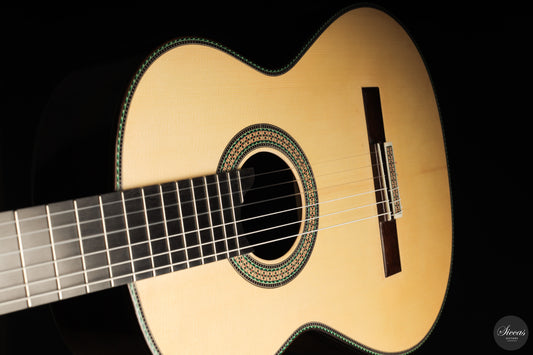

Maxwell T. Sipe builds classical guitars in his own small workshop in Portland, Oregon. He studied classical guitar before he turned to building, made his first guitar in 2005 and learned much of his craft during six years in a repair shop. Today he offers both traditional fan-braced guitars and modern designs with a wooden lattice.
Musician first
Music and making things by hand have run side by side through Sipe's life, as he describes it. He had piano lessons from an early age, started on electric guitar in middle school and went on to study classical guitar with Jeff Ashton at the University of Portland. At the same time he liked to build things, from model planes and cars to electronics and speaker cabinets, and at university he worked in the maintenance department on mechanical systems such as heating, electrics and plumbing.
After university he taught music and took guitar lessons with Scott Kritzer, who encouraged him to write a proper business plan. What Sipe really wanted at that time was to build a guitar. In 2005 he made his first one, because the instrument he was looking for was more than he could afford as a working musician. He says the first guitar was not particularly good, but it got him hooked and he had to try to make a better one.
Six years in a repair shop
Sipe eventually gave up teaching and performing and went to work in Kerry Char's repair shop, where he stayed for about six years and worked on a great number of instruments. For him the most valuable lesson of repair work was learning what not to do, seeing how many guitar designs failed over time and examining acoustic instruments from past decades and centuries. During that time he kept building his own guitars, until he had enough orders to set up on his own. He has built guitars full time ever since and has done professional repair and restoration work on fretted instruments since 2008. His workshop is on his own property in Portland, and at present he takes no new repairs so that he can concentrate on new guitars.
Models and bracing
Because players differ so much, and a strong right hand calls for a different guitar than a very light touch, Sipe builds several models with many options. His Signature model is aimed at the concert guitarist who wants a contemporary sound and is offered with two bracing systems. He describes the wood lattice as giving a little more saturation in the mids, a consistent response from the first position to the highest notes and a deeper resonance. The floating tie system is a modified fan bracing combined with stiffened sides, aimed at strong sustain, clarity and projection. Our guide to fan bracing, double tops and lattice explains how these approaches differ. The Signature model has an elevated fingerboard with a 20th fret, a rosette with a wave motif and burl wood, and a full French polish.
The Traditional model has a handmade mosaic rosette and bracing patterns closer to the fine guitars of the past. One is a seven-strut fan with an open harmonic bar, inspired by José Romanillos and Jeffrey Elliott, which he mainly pairs with spruce. The other is an asymmetric six-strut fan drawn from Spanish designs and often paired with cedar. The Spartan model uses the same construction with simplified decoration. Tops are European spruce, Engelmann spruce, western red cedar or redwood, and back and sides include Indian, Madagascar and Honduran rosewood and myrtle wood. Through a custom programme he also builds Romantic-era guitars, steel-string guitars and copies of instruments by Torres, Hauser and other makers. A guitar takes two to three months from start to finish.
Maxwell T. Sipe at Siccas Guitars
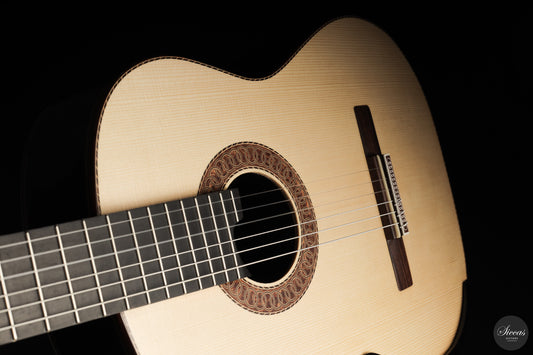
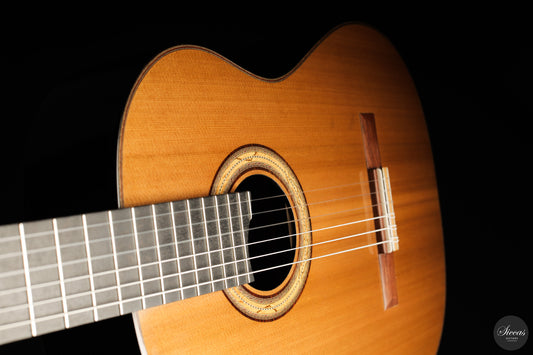
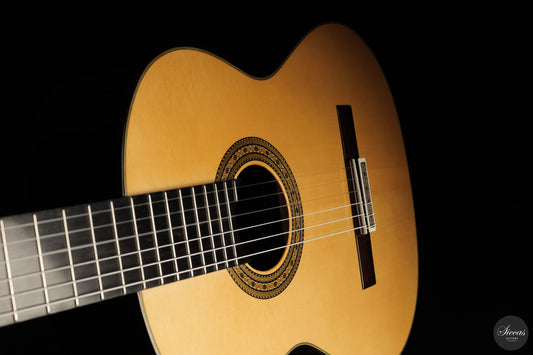
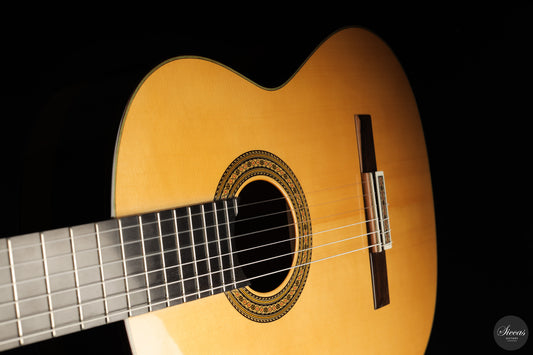
Siccas Guitars presented Sipe's guitar No. 117 from 2025, with an Engelmann spruce top braced as a seven-strut fan with floating ties, Madagascar rosewood back and sides and an elevated ebony fingerboard with a 20th fret. Its rosette combines California buckeye burl, pearwood and dyed koto. The 2026 guitar No. 125 uses his wooden lattice bracing under a cedar top, with Indian rosewood back and sides, an elevated fingerboard and a 640 mm scale. You can find his available guitars in our Maxwell T. Sipe collection.