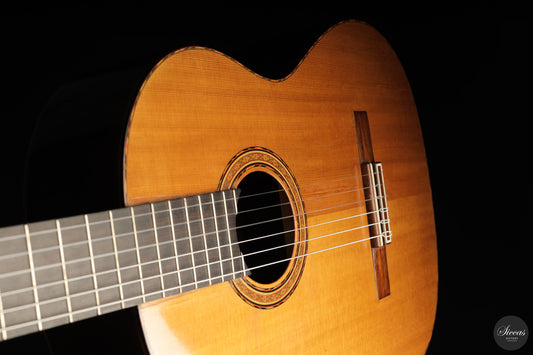
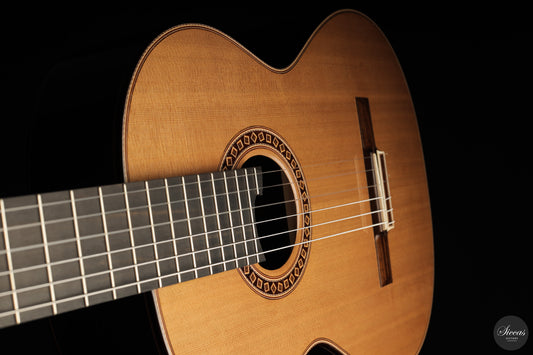
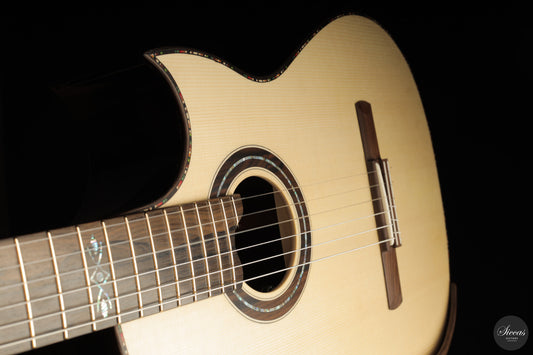
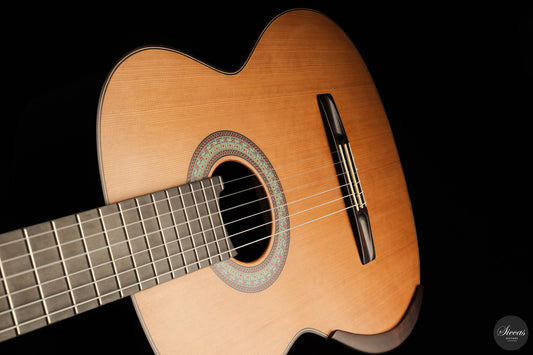
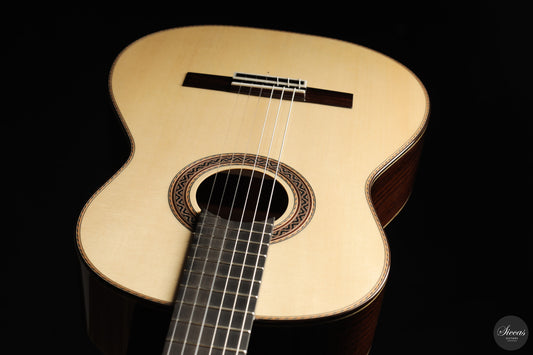
Oren Myers is one of England's most respected classical guitar makers — a luthier who arrived at his craft not through a formal workshop apprenticeship, but through a deep love of music, a rigorous self-taught foundation, and formative guidance from two of the great names in Spanish guitar tradition. Based in a workshop on a farm near Goring-on-Thames in Oxfordshire, Myers produces a small number of instruments each year, each one refined through years of careful experimentation with wood selection, dimensions, and structural detail. His guitars have earned the trust of professional soloists across Europe and beyond, and they stand as a compelling argument that the finest traditions of the Spanish guitar can take root in English hands.
Biography & Training
Myers began his musical life as a teenager with ambitions that had nothing to do with classical music. He picked up the guitar with Jimi Hendrix as his model, but his teacher quietly redirected him toward the classical repertoire — and the conversion, as Myers himself has described it, was a happy one. He grew his nails, absorbed the literature, and developed a serious commitment to sound quality: tone production, tonal variation, and expressive depth became the values that would later define his work as a maker.
He went on to study English Literature at university, maintaining his playing throughout. When he graduated in 2003, he made a decision that would shape the rest of his professional life: he would learn to build guitars. He started in a domestic garage, working from books and developing woodworking skills from scratch. In those early years he reached out to luthier Christopher Dean, who proved generous with knowledge and guidance over many years — a mentorship that gave Myers a solid grounding in craft discipline and quality standards.
The most decisive turning point in his training came when he attended a guitar-making course taught by José Luis Romanillos in Sigüenza, Spain. Romanillos — one of the defining figures in twentieth-century classical guitar making — introduced Myers to the principles of wood selection, Spanish construction methods, and the tonal aesthetics that underpin the finest concert instruments. That experience deepened Myers's understanding of what a guitar must do musically, and it left a permanent mark on his approach.
Construction Philosophy
Myers describes his guitars as falling within the broad category of "traditional" construction, though he is careful to note that he does not copy any particular maker. His designs draw on the structural logic of the fan-bracing tradition — informed by the work of Torres and Hauser as well as Romanillos — but each instrument represents his own synthesis of those influences rather than a replica of any historical model.
The philosophy behind his work is one of ongoing refinement. Myers approaches each guitar as part of a continuous development process: adjusting thicknesses, revisiting dimensions, and selecting tonewoods with close attention to their individual properties. His instruments are lightly built, designed to be responsive and singing, with the kind of warmth, sweetness, and intimacy that characterise the great traditional Spanish guitars. At the same time, through careful calibration of structure and mass, he works to bring genuine projection and power to those qualities — a balance that is difficult to achieve and that distinguishes the finest concert instruments from more modest work.
He works with a range of tonewoods — spruce and cedar for soundboards, Indian rosewood, cypress, and maple for back and sides — selecting each piece individually according to what the instrument demands. The decorative elements of his guitars, from rosettes to purflings, reflect the same commitment to craft that governs their structural design. For Myers, making a guitar is both a precise technical discipline and an act of aesthetic intention.
Understanding how to build guitars of this calibre depends partly on playing them, and Myers has always understood this. He studied exceptional instruments at Kent Guitar Classics, the specialist dealer through which he has also placed guitars for sale, and that direct contact with masterworks informed his developing sense of tonal possibility. His own background as a guitarist remains central to how he listens to, and evaluates, the instruments he builds. This relationship between playing and making echoes the approach described in resources like how concert guitarists practice — an ear trained by performance is an irreplaceable tool in the workshop.
Notable Players
The list of professional musicians who play or have played Myers guitars speaks clearly to the quality of his work. Polish guitarist Marcin Dylla, one of the most celebrated classical guitarists of his generation, is among those who have been associated with his instruments. Laura Young, a professional performer with hundreds of concerts to her credit, has described a Myers guitar as possessing an innate ability to "sing" — praising its depth of sound and tonal variety. Mark Eden, Gerald Garcia, Daniela Rossi, Kai Nieminen, Izan Rubio, and Frank Gerstmeier are among the other respected performers who have offered testimony to the musical qualities of his instruments.
Daniela Rossi's case is particularly striking: she has noted that since 2015 she has won major prizes — including the London Guitar Competition and the Heinsberg Guitar Competition in Germany — playing Myers guitars. That is the kind of endorsement that carries real weight in the competitive world of classical guitar performance.
Xuefei Yang, the internationally acclaimed Chinese guitarist, has also tried and praised a cedar-top Myers instrument — further evidence of the breadth of professional recognition his work has attracted. These players come from different traditions and different playing styles, but they share an appreciation for the musical integrity and craftsmanship that Myers brings to every instrument he makes. This is the hallmark of a luthier who, like the great makers of the classical guitar tradition, has learned to build not just beautiful objects but genuinely musical ones.
Legacy
Oren Myers occupies a distinctive position in contemporary classical guitar making. He is a British luthier working firmly within the Spanish tradition — not imitating it, but absorbing its deepest principles and reinterpreting them with his own voice. His path to the workshop was unconventional: a literature degree, a teenage love of rock music, and a self-taught beginning are not the typical CV of a master guitar maker. Yet the results speak for themselves. His instruments are played at the highest professional level, praised by some of the most discerning performers working today, and sought out by players who understand what separates a truly musical guitar from a merely well-made one.
The ongoing development that characterises his practice — the constant refinement, the attention to each piece of wood, the willingness to keep learning — is itself a mark of serious craft. Myers brings to guitar making the same qualities his teacher first cultivated in him as a young musician: an ear attuned to beauty, a commitment to expression, and an understanding that sound quality is not incidental but central to everything the instrument must do.
Browse available Oren Myers guitars → in the Siccas Guitars collection.