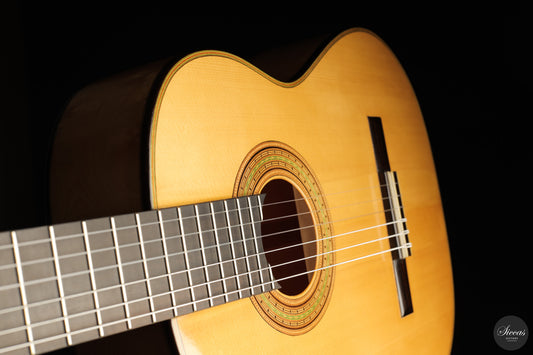
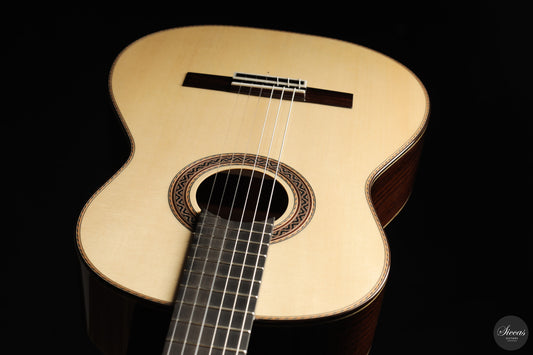
Among the handful of Japanese luthiers who have earned genuine international recognition, Yuichi Imai stands apart. Born in Tokyo in 1949, Imai has spent more than five decades crafting classical guitars that bear the hallmarks of the great Spanish tradition while expressing something distinctly his own — an instrument of warmth, depth, and commanding projection. Alongside Masaki Sakurai, he is widely regarded as one of the two figures who define what it means to speak of a Japanese school of lutherie, and the rarity of his instruments outside Japan makes each one that reaches a player abroad genuinely significant.
Biography & Training
Imai's path into lutherie began at the age of eighteen, when he became an apprentice to Akira Nakade, one of the pioneering figures of guitar making in postwar Japan. He spent three dedicated years under Nakade's guidance, absorbing the fundamentals of construction and the rigorous attention to detail that would later distinguish his own work. In 1971, having completed his apprenticeship, Imai opened his own workshop in Tokyo — a step taken while he was still in his early twenties, reflecting both ambition and unusual confidence in his craft.
The early 1970s were a formative period for classical guitar making in Japan. The Spanish school, epitomised by makers such as Ignacio Fleta and the great Madrid workshops, cast a long influence across the world, and Japan was no exception. Imai absorbed this tradition deeply, studying the construction logic, tonal aims, and structural disciplines that had defined the finest concert guitars of the 1960s. By 1975 he had developed sufficient confidence in his output to begin exporting, an early sign that his guitars were capable of meeting international standards.
Construction Philosophy
What defines an Imai guitar above all is its tonal character: warm, full-bodied, and weighty in the lower register, with a string separation and clarity in the trebles that allows even complex polyphonic passages to breathe. Those who have played his instruments often describe the experience as reminiscent of the great Madrid instruments from the 1960s and 1970s — a particular combination of power, body, and presence that many contemporary makers strive for but few achieve with the same consistency.
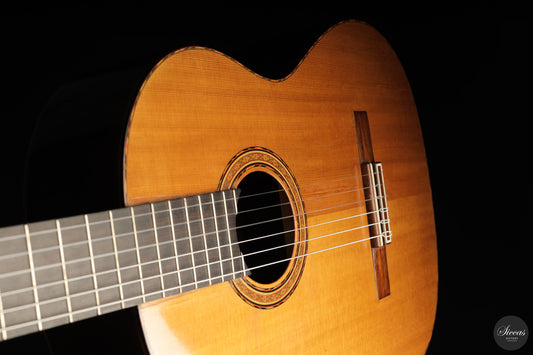
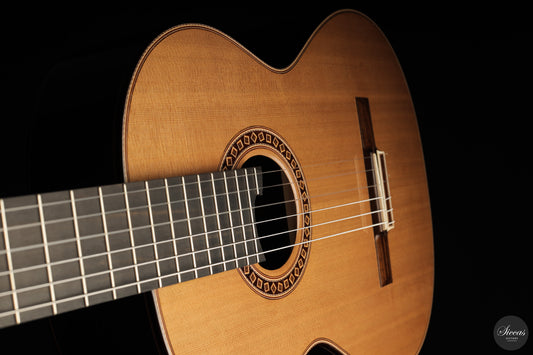
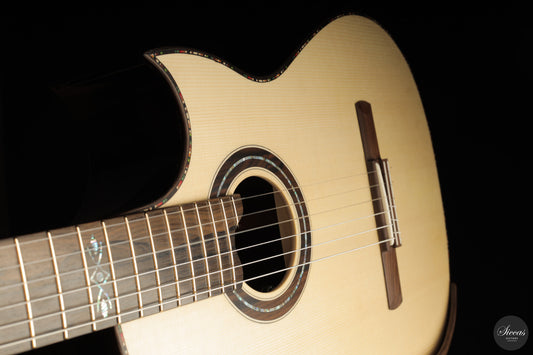
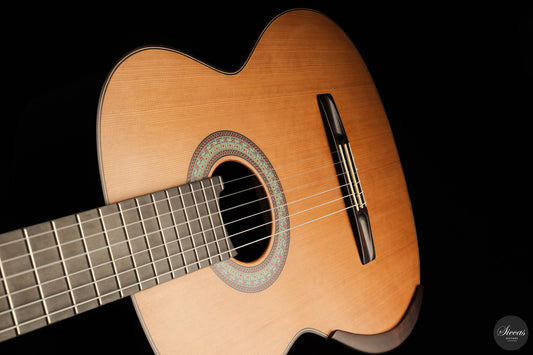
Imai works predominantly within a Spanish-influenced construction framework, using traditional fan bracing as the structural basis for his tops. His soundboards are selected with painstaking care, and he has worked with both spruce and cedar, each yielding a distinct tonal character. Cedar-topped examples tend toward immediate openness and a warm, relaxed resonance, while spruce-topped instruments offer a tighter response and a particular clarity of attack that rewards players who work at a high technical level. His back and sides are most often made from Brazilian rosewood — a wood whose increasing rarity makes its presence on a modern instrument a mark of both tradition and seriousness — paired with ebony fingerboards and quality machine heads.
For those interested in how bracing geometry shapes tonal outcome, the broader context is explored in detail in the guide on fan-braced, double top, and lattice guitars. Imai's commitment to the fan-braced tradition places him squarely in the lineage of the great Spanish and Franco-European makers, an approach explored further in profiles of figures such as Daniel Friederich and Robert Bouchet.
Signature Models
Over the course of his career, Imai has refined a small number of distinct models. The instrument most frequently encountered by international players and collectors is the Limited Model — a designation that reflects both its production volume and its standing as the fullest expression of Imai's craft. Available with cedar or spruce tops paired with back and sides of CSA rosewood or Brazilian rosewood, the Limited Model exemplifies his philosophy: sober, elegant aesthetics in service of sonic excellence. These guitars are built in small numbers, and the waiting time for a new commission from Imai has historically been considerable.
Instruments from across his career — from early 1980s examples through to recent years — show a consistent commitment to quality, with slight tonal evolutions reflecting the natural development of a maker who has never stopped learning. Older Imai guitars from the 1980s and 1990s are sought by collectors as much for their historical interest as for their musical utility, and they command serious respect on the secondary market when they appear.
Notable Players
The list of concert guitarists who have performed on Imai instruments speaks for itself. Aniello Desiderio, whose volcanic technique and expressive depth have made him one of the most celebrated players of his generation, has played Imai guitars in concert. Frank Bungarten, a guitarist of exceptional refinement, is another name associated with Imai's instruments. Roman Viazovskiy and Alvaro Pierri — both artists of international standing — have also been known to perform on his guitars. That such players have chosen Imai instruments for the stage is among the clearest endorsements a luthier can receive, and it confirms that his guitars perform not merely as objects of beauty but as serious tools of musical communication. For a deeper look at what concert players demand from their instruments, the article on how concert guitarists practice offers useful context.
Legacy
Yuichi Imai represents something rare in the world of classical guitar making: a maker who has maintained the highest standards across more than fifty years of independent work, in a country without the deep indigenous lutherie tradition of Spain or France, and who has nonetheless produced instruments that stand comparison with those of the greatest European makers. His influence on the development of Japanese lutherie is difficult to overstate. Along with Masaki Sakurai, he demonstrated that the ideals of the Spanish school could be absorbed, internalised, and ultimately transcended by makers working far from that tradition's geographic source.
The scarcity of his instruments outside Japan has, if anything, enhanced their reputation. Players who have sought them out often speak of the experience with particular intensity, describing guitars that feel and sound as though they were made with a singular musical purpose. At a time when guitar making has diversified enormously — into lattice bracing, double-top construction, and a range of new materials — Imai's continued commitment to the traditional concert guitar represents a quietly radical act of faith in the instrument's proven potential.
Browse available Yuichi Imai guitars → in the Siccas Guitars collection.