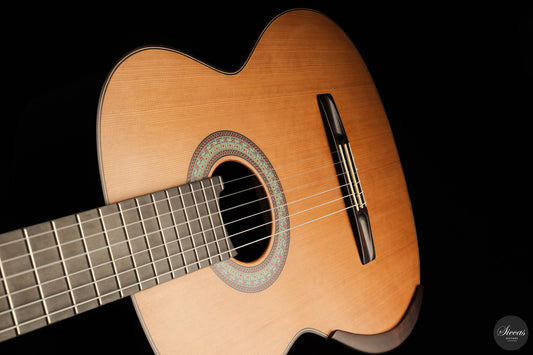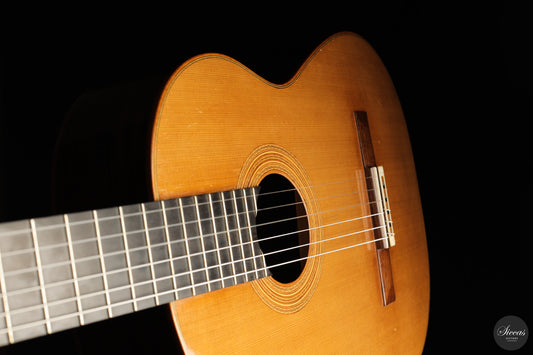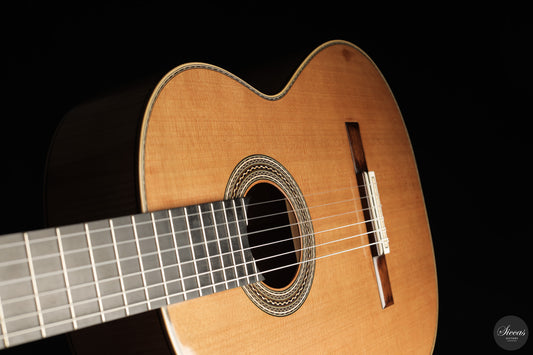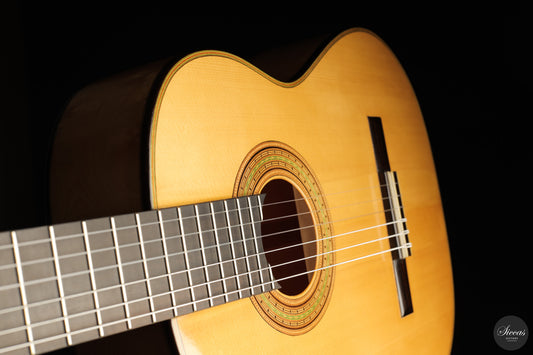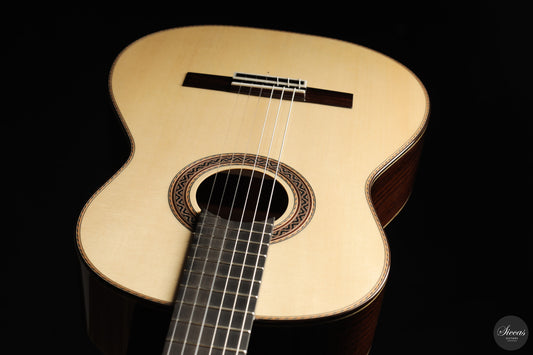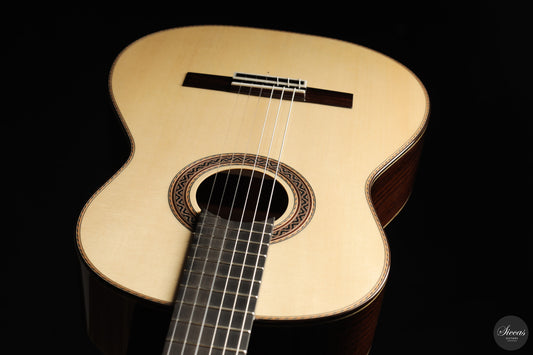

630 mm Scale Length – Understanding the Smaller Concert Guitar
When most players think of a classical guitar, they picture the standard 650mm scale length that has dominated concert stages since the mid-twentieth century. Yet a growing number of professional guitarists, teachers, and luthiers have come to regard the 630mm scale as something far more than a beginner's shortcut or a student compromise. At 630mm — roughly 24.8 inches from nut to saddle — this scale length produces an instrument that rewards careful listening and responsive playing in ways the full-size guitar sometimes cannot. Understanding what the 630mm scale actually means, and what it demands and offers in return, is essential for any player considering this path.
What Scale Length Means for a Classical Guitar
Scale length is the vibrating length of a string when played open — the distance from the nut to the saddle. It is one of the most fundamental variables a luthier works with, governing string tension, left-hand reach between frets, and ultimately the character of the sound. The classical guitar world coalesced around 650mm as its standard during the twentieth century, largely through the influence of Antonio de Torres and the Spanish tradition he established. A 650mm guitar strung with standard concert tension produces firm, projecting tone ideally suited to large concert halls.
The 630mm scale shortens each inter-fret distance proportionally and reduces string tension noticeably — typically by somewhere in the range of ten to fifteen percent compared with a 650mm instrument at the same pitch and string gauge. This is not a trivial change. Lower tension means strings deflect more easily under the fingertip, which translates into a softer, more yielding feel that many players describe as intimate or responsive. The tonal character tends toward warmth and roundness rather than the full projecting brightness associated with longer-scale instruments. Whether these qualities serve a player's musical goals is a question that deserves an honest answer rather than a hierarchy of value.
Who Benefits Most from a 630 mm Guitar
The practical advantages of the 630mm scale are clearest for players whose hand anatomy makes the full 650mm stretch genuinely uncomfortable. The distance between the first and fourth frets in the lower positions on a 650mm guitar is around 43mm; on a 630mm guitar that gap closes meaningfully, reducing the lateral spread required to hold a clean first-position chord. Players with smaller hands, shorter fingers, or narrower spans often find that the 630mm scale allows them to maintain cleaner left-hand technique with less muscular effort — and over long practice sessions, that difference accumulates.
Women guitarists, players with smaller builds, and those returning to the instrument after an injury have historically formed a significant part of the audience for shorter-scale concert instruments. But the 630mm scale is not exclusively a remedy for physical limitation. Many players with perfectly average-sized hands prefer the feel and sound of a shorter scale for purely musical reasons: the warmer tonal palette, the softer attack available from a relaxed right hand, and the ease with which expressive nuance can be drawn out of every note. Several respected concert artists have performed their entire careers on 630mm or similarly reduced-scale instruments without any sense of compromise — and their recordings demonstrate exactly why.
For players exploring the historical dimensions of the classical guitar repertoire, the 630mm scale also carries a certain logic. Many guitars of the Romantic period were built to scale lengths well below 650mm, and the lighter tension and fuller mid-range of a shorter-scale guitar can bring nineteenth-century works back into something close to their original acoustic context.
Construction Considerations and Luthier Approaches
Building a great 630mm guitar is not simply a matter of shortening the neck of a standard instrument. Responsible luthiers adjust bracing patterns, top thickness, and bridge geometry when working at a reduced scale length, ensuring that the top moves freely enough to compensate for the reduced string energy arriving from lighter-tension strings. A 630mm guitar built without these adjustments can sound thin or unresponsive — a problem sometimes blamed incorrectly on scale length itself when it is actually a consequence of inadequate adaptation in the construction.
The richest tradition of smaller-scale concert guitars comes from the Spanish school, where instrument dimensions were historically more flexible than they later became. Makers working in that tradition — including figures discussed in the classical guitar makers overview — understood that a well-proportioned smaller guitar could rival a standard instrument in projection and complexity of tone when every element of the build was calibrated to work together. Contemporary luthiers who build 630mm concert instruments typically treat them as a fully distinct project from their 650mm guitars, with separate plans, voicing approaches, and sets of tonal targets.
The choice of bracing system also interacts significantly with scale length. The principles behind fan-braced, double-top, and lattice construction all apply at 630mm, and each system responds differently to the lower tension environment. Fan-braced 630mm guitars tend toward warmth and complex overtones; lattice-braced instruments at this scale can achieve surprising projection despite their reduced string energy, because the stiff-yet-light top responds readily to the strings' input.
Sound Character and Musical Applications
Players who have spent time with high-quality 630mm concert guitars consistently report that the sound is not simply a quieter version of a standard guitar. The tonal profile shifts noticeably: the bass registers tend to be rounder and less percussive, the trebles carry a singing quality that can sustain beautifully at slow tempi, and the overall dynamic range at pianissimo is wider — it is easier to play very softly without notes disappearing entirely. This makes the 630mm guitar exceptionally well suited to intimate repertoire, the Spanish and Latin American music of the early twentieth century, and the salon works of the Romantic tradition.
For players working in the mainstream concert repertoire — the great works of Rodrigo, Brouwer, Villa-Lobos — a 630mm guitar demands that the right hand work efficiently to generate the projection a large hall requires. This is entirely achievable for players who develop their technique on the instrument, but it is a real consideration for anyone accustomed to the effortless projection of a long-scale guitar in large acoustic spaces. In smaller venues, recording studios, and domestic contexts, the 630mm guitar's natural warmth and balance become assets rather than limitations.
Buying a 630mm Classical Guitar – What to Look For
As with any serious instrument purchase, the maker and quality of construction matter more than the scale length itself. A well-built 630mm guitar from a skilled luthier will outperform a mediocre 650mm instrument in every meaningful dimension. When evaluating a 630mm guitar, listen specifically for evenness of tone across all six strings — shorter-scale instruments can sometimes exhibit imbalance between the bass and treble registers if the bracing has not been calibrated carefully. Check that notes sustain cleanly through their full decay without any buzzing or premature cutoff, and pay attention to the ease of intonation in the upper positions, which should be no more difficult than on a standard guitar.
String choice matters more on a 630mm guitar than many players realise. Because the scale is shorter, standard high-tension strings can feel deceptively easy at first but may actually over-drive the top of a lighter-built instrument; normal or even low tension sets often produce better results. It is worth experimenting with several string types before settling on a preference, and consulting the builder's own recommendations where possible.
Players considering a handmade concert instrument at the 630mm scale will find that the most respected contemporary luthiers treat this scale with complete seriousness, offering it alongside their standard 650mm work. The Spanish masters who helped define what the concert classical guitar could be — from the foundational work of Ignacio Fleta to the analytical precision of Daniel Friederich — all contributed to a tradition in which the specific proportions of an instrument were always subordinate to its musical outcome. That remains the right standard today: not the number on a specification sheet, but the sound and feel of the guitar in the hands of its player.
Whether you are drawn to the 630mm scale for physical comfort, tonal character, or historical curiosity, the most important step is to play as many examples as possible before making a decision. The scale length is the beginning of the conversation, not its conclusion.