
Acoustic vs Classical Guitar: 7 Key Differences Explained
You are standing in a guitar shop — or scrolling through pages of instruments online — and you keep running into the same question: what is actually the difference between an acoustic guitar and a classical guitar? Are they not just two names for the same thing? The short answer is no. The longer answer is what this article is about.
The acoustic vs classical guitar debate matters more than most beginners realise. Choosing the wrong instrument for your goals can slow your progress, strain your fingertips unnecessarily, and leave you frustrated. Choosing the right one, on the other hand, sets you up for a lifetime of music.
Below, we break down every meaningful difference between classical and acoustic guitar — from the strings and the neck to the sound, the technique, and the repertoire — so you can make a confident, informed decision.
1. The Strings: The Single Biggest Difference
The most fundamental difference between acoustic and classical guitar is the strings.
Classical guitars use nylon strings. The three treble strings (E, B, G) are made from solid nylon monofilament. The three bass strings (E, A, D) are nylon cores wound with silver-plated copper wire. Nylon strings produce a warm, mellow, rounded tone and are significantly easier on the fingertips. They have lower tension than steel strings, which makes pressing down and forming chords noticeably more comfortable, especially for beginners.
Acoustic guitars use steel strings. These produce a brighter, louder, and more projecting sound with a characteristic "twang" or "chime" that suits folk, country, singer-songwriter, bluegrass, and pop styles. Steel strings, however, are harder on the fingers. Beginners typically go through several weeks of discomfort before developing calluses. The tension is also considerably higher, which means the instrument must be structurally reinforced with a truss rod inside the neck — something classical guitars do not have.
This difference in strings cascades into almost every other difference on this list. You should never put steel strings on a classical guitar. The increased tension can warp the neck, pull the bridge away from the top, and cause structural damage that is expensive or impossible to repair.
2. The Neck: Width, Profile, and Feel
Pick up a classical guitar and an acoustic guitar back to back, and the neck will feel immediately different.
Classical guitar necks are wider. A typical classical guitar nut width is 52 mm (some luthiers go up to 54 mm). This extra width gives each finger more room, which is essential for the right-hand fingerpicking technique used in classical music, where the thumb and three fingers operate independently at all times.
Acoustic guitar necks are narrower — usually between 42 mm and 44 mm at the nut. This makes chord shapes involving a bar across all six strings (barre chords) significantly easier, which is why the narrower neck suits strumming styles and chord-based playing.
Classical guitars also have a flat (or very slightly radiused) fretboard, whereas most acoustic guitars have a curved (radiused) fretboard. Some players find a flat board more comfortable for single-note runs; others prefer the curved radius for chord work.
The neck joint is another distinction. On most classical guitars, the neck meets the body at the 12th fret. On most acoustic guitars, the neck meets the body at the 14th fret, giving easier access to the upper register for soloists.
3. The Body: Shape, Bracing, and Build
Classical guitars are typically smaller and lighter than their steel-string acoustic counterparts. The body shape is similar to what we call a "concert" shape — a modest waist, balanced upper and lower bouts, and a relatively shallow depth. This design maximises resonance from the lighter nylon strings while keeping the instrument comfortable to hold in the classical sitting position.
Acoustic steel-string guitars come in a wide range of body shapes: dreadnought, orchestra model (OM), concert, auditorium, jumbo, and parlour, among others. Dreadnoughts are the largest common shape and produce the loudest, fullest sound. Parlour guitars are small and intimate, closer in size to a classical guitar.
The internal bracing also differs. Classical guitars traditionally use fan bracing (or lattice bracing on more advanced models), which is optimised for the lower string tension and nylon-string tone. Acoustic guitars use X-bracing or variants of it, which handles the higher tension of steel strings without the top collapsing over time.
The materials used are similar at the high end — spruce or cedar tops, rosewood or mahogany backs and sides — but the construction philosophy differs significantly. If you are curious about how the top wood affects tone, our guide on spruce vs cedar classical guitars explains the differences in detail.
4. The Bridge and Saddle
Look closely at the bridge of each guitar type and you will notice another important structural difference.
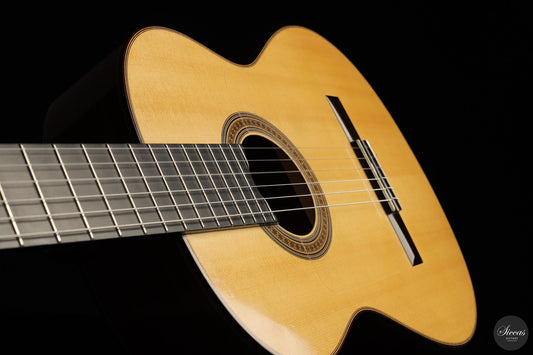
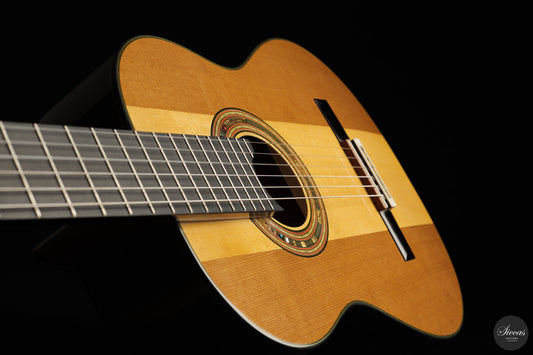
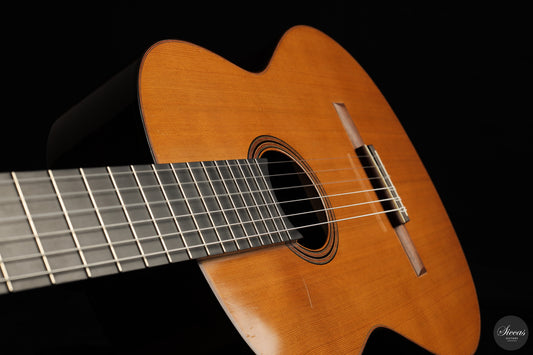
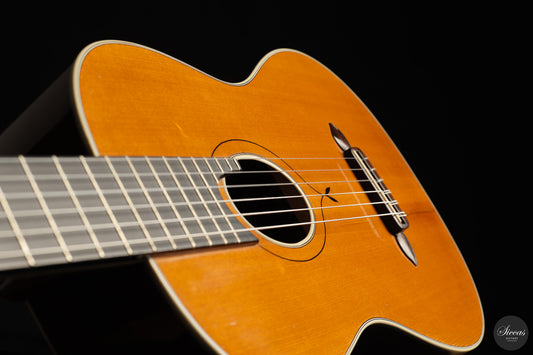
Classical guitars have a tie bridge. Strings are looped through holes in the bridge and tied in place. There are no bridge pins. This design works well for nylon strings, which have a slippery surface and would be difficult to anchor with pins.
Steel-string acoustic guitars use a pin bridge (also called a bridge pin system). The ball end of each string sits in a hole held in place by a small plastic or bone pin. This system is faster and easier to restring, which matters given that steel strings break more often than nylon strings under heavier playing conditions.
5. Sound and Projection
The tonal difference between acoustic vs classical guitar is dramatic and immediately recognisable.
Classical guitar sound is warm, nuanced, and rich in overtones. The nylon strings and fan-braced spruce or cedar top combine to produce a sound that responds to the finest variations in right-hand touch. A skilled classical guitarist can produce a huge range of timbres — from a bright, glassy sul ponticello (near the bridge) to a dark, velvety tasto tone (over the soundhole). The sustain is long and the decay is graceful. The overall volume, however, is moderate. Classical guitars are not amplified instruments by nature, and they are not designed to compete with drums or electric guitars in a band setting.
Acoustic steel-string guitar sound is brighter, louder, and more percussive. The attack is sharper and the note rings out with more presence in the midrange and treble frequencies. This makes the acoustic guitar well-suited for rhythm playing, strumming, and cutting through a mix with other instruments. The sound is less complex in terms of tonal colour but more immediately arresting to an untrained ear.
6. Playing Technique
This is where the difference between classical guitar and acoustic guitar becomes most profound — and most consequential for learners.
Classical guitar technique is a complete system developed over centuries. The guitar is held upright in a specific seated position, supported by a footstool or guitar support. The right hand plucks the strings with the flesh and nail of the fingertips (using the thumb and three fingers, abbreviated as p, i, m, a). Picks (plectra) are never used in classical technique. The left hand presses the strings with the fingertips and navigates all positions of the neck. Both hands work with extreme independence and precision. The technique takes years to develop properly and is best learned from a qualified teacher.
Acoustic guitar technique is more varied. Most acoustic players use a plectrum (pick) for strumming and sometimes for single-note leads. Fingerpicking is also common, especially in folk and fingerstyle genres, but it is generally less complex than classical technique. The sitting position is informal — the guitar rests on the dominant-side thigh, body slightly angled. Chord-based playing is the foundation of most acoustic styles.
If you want to play the works of Francisco Tárrega, Agustín Barrios, or Johann Sebastian Bach on guitar, a classical guitar and classical technique are not optional — they are the only appropriate tool for the job. If you want to play folk songs, pop songs, or country ballads around a campfire, an acoustic steel-string guitar is the natural choice.
7. Repertoire and Musical Context
The repertoire written for each instrument is largely distinct.
The classical guitar repertoire spans five centuries, from Renaissance lute transcriptions to 20th-century concert works. It includes solo pieces, concertos, chamber music, and song accompaniments. Works like Recuerdos de la Alhambra, La Catedral, and the Concierto de Aranjuez are written specifically for the classical guitar and would not be authentic on a steel-string acoustic.
The acoustic guitar repertoire is equally rich but draws from popular traditions: folk, blues, country, singer-songwriter, bluegrass, and indie. Artists like Bob Dylan, Joni Mitchell, James Taylor, and Tommy Emmanuel are associated with the steel-string acoustic sound.
There is, of course, overlap. Many acoustic players learn basic fingerpicking patterns inspired by classical technique. Some classical guitarists experiment with steel-string instruments. But for most learners, genre and repertoire goals should be a primary factor in choosing which type of guitar to study.
Which Guitar Is Right for You?
Choose a Classical Guitar If...
- You want to study formal classical technique and repertoire
- You are a complete beginner and want the gentler feel of nylon strings
- You are drawn to flamenco music (flamenco guitars are closely related — see our flamenco guitar collection)
- You have smaller hands or are buying for a child
- You want to study music theory and technique in a rigorous, structured way
- You are interested in the broadest tonal palette from a solo instrument
Choose an Acoustic Steel-String Guitar If...
- You want to play folk, country, pop, blues, or singer-songwriter music
- You plan to sing and strum chords as the primary activity
- You want a louder instrument that projects well in informal settings
- You are drawn to the bright, punchy sound of steel strings
- You plan to play with a pick most of the time
If you are still undecided, our full classical guitar collection offers instruments at every level, from student models to concert-grade luthier guitars. Browsing the range gives you a sense of what serious classical instruments look, feel, and sound like.
Frequently Asked Questions
Can I play acoustic guitar songs on a classical guitar?
Yes, in many cases. Simple chord-based songs can be adapted to classical guitar with some adjustments. However, the sound will be noticeably different — warmer and quieter. Songs that rely on the bright, percussive attack of steel strings will not translate perfectly. Strumming with a pick is also not recommended on a nylon-string classical guitar, as the pick can damage the strings and produce a harsh tone.
Can I play classical pieces on an acoustic guitar?
Some simpler classical pieces can be played on a steel-string acoustic, but the tone will be fundamentally different, and technically demanding classical works are designed around nylon-string response. For the full classical guitar experience — and the authentic sound of the repertoire — a classical guitar is the right instrument.
Which is easier to learn, classical or acoustic?
Neither is inherently "easier" in the long run, but in the very short term, nylon strings on a classical guitar are kinder to the fingertips. However, classical technique is more demanding and requires more structured study. Acoustic guitar chord-based playing can produce satisfying results faster for many beginners. The answer depends heavily on your musical goals. For more detail, read our guide on how long it takes to learn classical guitar.
Are classical guitars good for beginners?
Yes. A quality classical guitar at the student level is an excellent first instrument. The softer nylon strings reduce finger soreness, the wider neck helps avoid accidentally muting adjacent strings during chord practice, and the structured learning path available for classical guitar is well-developed and widely taught. The key is choosing the right repertoire and, ideally, finding a good teacher.
What about size? Are classical guitars smaller?
Full-size classical guitars are generally slightly smaller and lighter than full-size acoustic steel-string guitars. Classical guitars also come in fractional sizes (1/4, 1/2, 3/4) which are ideal for children. If you are buying for a young player, a classical guitar in the appropriate fractional size is usually the most comfortable and appropriate starting point.
Final Thoughts
The difference between classical and acoustic guitar goes far beyond the label on the instrument. Strings, neck width, body construction, bracing, bridge design, technique, and repertoire all diverge in meaningful ways. Understanding these differences before you buy is the most important step you can take as a new guitarist — or as someone buying a guitar as a gift.
If classical guitar is your path, explore our curated selection of classical guitars from some of the world's finest luthiers. And if you want to hear what a world-class classical guitarist sounds like on a great instrument, the video at the top of this page is a good place to start.