Air on the G String by Johann Sebastian Bach: The Timeless Beauty of This Masterpiece Adapted for Classical Guitar
"Air on the G String" is one of the most recognisable melodies in all of classical music. Originally composed by Johann Sebastian Bach (1685–1750) as the second movement of his Orchestral Suite No. 3 in D major, BWV 1068, this serene piece has moved listeners across continents and centuries with its flowing melody, tranquil mood, and extraordinary emotional depth. When adapted for classical guitar, it finds an intimate new voice — one that feels as natural and inevitable as if Bach had written it for the instrument himself.
In this article we trace the origins of the piece, the story behind its famous nickname, how it is arranged for classical guitar, and what it takes to perform it with genuine musical depth.
1. The Origins of "Air on the G String"
Historical Background
Johann Sebastian Bach composed his Orchestral Suite No. 3 in D major, BWV 1068 around 1730, during the period when he directed the Leipzig Collegium Musicum. The suite is scored for oboes, trumpets, timpani, strings, and continuo — a richly orchestral sound world designed to showcase grandeur and ceremonial splendour. Yet within this imposing framework, the second movement, marked simply Air, stands apart: unhurried, tender, and deeply personal in character.
The Air is built over a descending bass line in the strings and continuo, above which the first violins carry a long-breathed, ornamented melody. Its simplicity is deceptive — the interplay between the sustained upper voice and the walking bass creates a sense of gentle inevitability that has made the piece one of the most beloved in the entire Baroque repertoire.
August Wilhelmj and the Famous Arrangement
The title "Air on the G String" was not coined by Bach himself. It was introduced in the late 19th century by the German violinist August Wilhelmj (1845–1908), who transposed the piece down to C major so that the entire melody could be played on the violin's lowest string — the G string — alone. Wilhelmj also slowed the indicated tempo and instructed the player to use an abundance of bow, drawing out the lyrical, almost vocal quality of the line. The result was an arrangement that felt more intimate and emotionally immediate than the original orchestral setting, and it quickly became enormously popular across Europe.
This Wilhelmj arrangement is the version most listeners know today, and it opened the door for countless further transcriptions — including, eventually, for classical guitar.
2. Why "Air on the G String" Resonates with Guitarists
Melodic Simplicity and Emotional Depth
The Air is celebrated for its meditative, almost suspended quality. Very few notes are needed to create an immense emotional effect — a characteristic that suits the classical guitar especially well. The guitar's natural sustain, the warmth of a cedar or spruce soundboard, and the instrument's capacity for subtle dynamic shading all make it an ideal medium for the piece's long, arching phrases.
Where a violin sustains through continuous bowing, a guitarist must create the illusion of an unbroken melodic line through careful right-hand technique and sensitive voicing. Meeting that challenge is itself one of the reasons so many serious players are drawn to the piece.
Adaptability to the Guitar
Though originally written for string orchestra and continuo, the composition adapts well to a solo guitar setting. Its melodic range sits comfortably on the fretboard, the slow tempo allows for expressive phrasing and control, and the bass movement — so crucial to the character of the original — can be approximated on the lower strings in a way that retains harmonic clarity. The piece is accessible to intermediate players in simplified arrangements while still offering interpretive rewards to advanced performers in more complete transcriptions.
3. Arranging "Air on the G String" for Classical Guitar
Key Considerations in Transcription
Arranging the Air for guitar involves several important decisions. Most transcriptions work in D major (the original key of BWV 1068) or C major (following Wilhelmj), both of which offer idiomatic fingerings on the guitar. The choice of key affects which open strings are available, how the bass line moves, and how much inner voice activity can be preserved from the orchestral original.
A good arrangement preserves the essential three-layer texture: the singing melody in the upper voice, the steady walking bass, and some inner harmonic movement. Fully realising all three on a single guitar is demanding; many arrangements make practical compromises while retaining the expressive core of the piece.
Techniques for an Authentic Interpretation
- Legato Playing: Use smooth, connected phrase-shaping to mirror the original violin-like flow. Avoid any unnecessary percussive accents between notes within a phrase.
- Right-Hand Technique: Alternate between rest strokes (apoyando) for melodic emphasis on the treble strings and free strokes (tirando) for supporting voices. A well-produced rest stroke brings out the main melody with the singing quality the piece demands.
- Left-Hand Positioning: Prioritise economical movement and clean finger transitions. Any hesitation in the left hand will interrupt the legato quality that is central to the Air's character.
- Tone Colour: Experiment with right-hand position. Playing closer to the soundhole produces a warmer, rounder tone well suited to the main melody; moving slightly toward the bridge adds definition to bass notes and inner voices.
4. Tips for Mastering "Air on the G String" on Classical Guitar
Focus on Dynamics and Expression
The power of this piece lies precisely in its restraint. Use dynamics thoughtfully — subtle crescendos and decrescendos across long phrases deepen the emotional impact far more than obvious swells. Pay particular attention to the moments where the melody reaches its peak: a slight natural increase in tone here, followed by a gradual easing, creates the sense of breathing that makes the music feel alive.
Tempo Control and Rubato
The Air is slow, but slow does not mean static. Use a metronome to establish rhythmic security, then allow yourself controlled rubato — small, tasteful expansions and contractions of the pulse — to give individual phrases their expressive shape. The danger with this piece is either rushing through nervousness or stalling the forward motion entirely; finding the balance is one of the most instructive lessons it teaches.
Memorisation and Interpretation
Once the piece is technically secure, memorise it so that your attention can shift entirely to musical expression. A performance of the Air that is read from the page is rarely as convincing as one delivered from memory, where every gesture can be shaped in real time in response to the acoustic of the room and the mood of the moment.
5. Notable Recordings of "Air on the G String" on Guitar
Listening to fine guitarists who have recorded the piece is one of the most efficient ways to develop your own interpretive approach. Three performances are particularly instructive:
- Andrés Segovia: Segovia's recording brings warmth and noble elegance to the melody. His use of tone colour — shifting between a darker, more covered sound and a brighter, more projecting one — is a masterclass in how to sustain interest across a long, slow line.
- Julian Bream: Bream emphasises the contemplative, almost melancholic dimension of the piece. His rubato is freer than Segovia's, and the result is deeply personal and emotionally immediate.
- John Williams: Williams brings his characteristic precision and tonal clarity to the Air. His phrasing is clean and balanced, and his dynamic control is exemplary — an ideal reference for technical study.
6. The Legacy of "Air on the G String" in Modern Music
Influence Beyond Classical Music
The Air on the G String has transcended its Baroque origins to become part of the broader cultural landscape. Its calm, solemn quality has made it a standard choice for weddings, memorial services, and reflective film scenes. It has been recorded by jazz musicians, arranged for string quartets, sampled in popular music, and used in countless television advertisements — arguably making it one of the most widely heard pieces of classical music in the world.
Yet this ubiquity has not diminished it. Each new listener who encounters the piece for the first time experiences something that feels quietly profound — a testament to the depth of Bach's original invention.
The Guitar's Role in Keeping Bach's Music Alive
Guitar arrangements have played a vital part in bringing Bach's music to new audiences. From Segovia's landmark recordings in the mid-20th century to the many gifted players performing and recording today, the classical guitar has consistently offered a fresh and intimate lens through which to appreciate Bach's genius. A piece conceived for orchestral strings becomes, on the guitar, something more personal — a single voice speaking directly, without mediation.
If you want to explore more of Bach's works on classical guitar, our dedicated Bach classical guitar article covers his most important pieces and their guitar arrangements in depth. You might also enjoy our guide to famous classical guitar pieces for a broader overview of the repertoire.
7. Choosing the Right Guitar for Bach
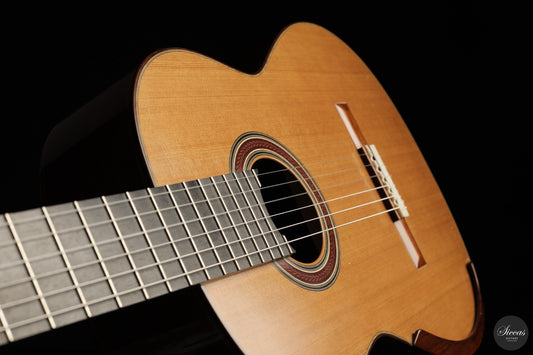
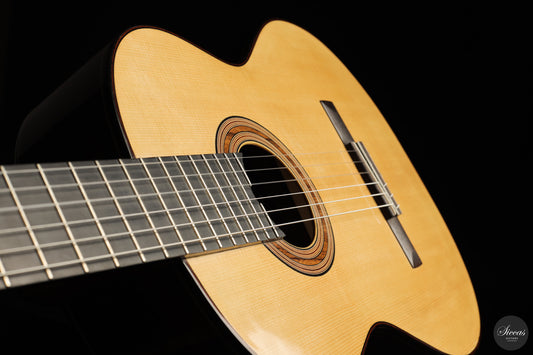
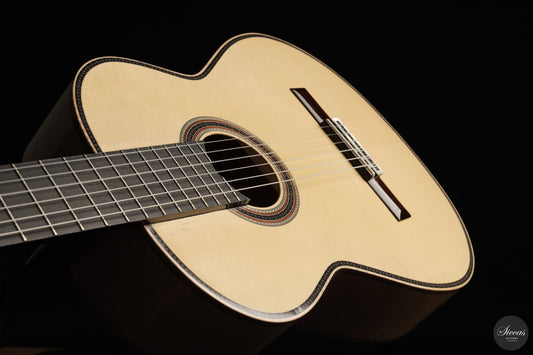
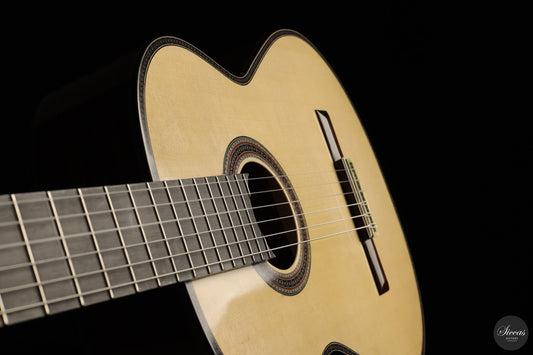
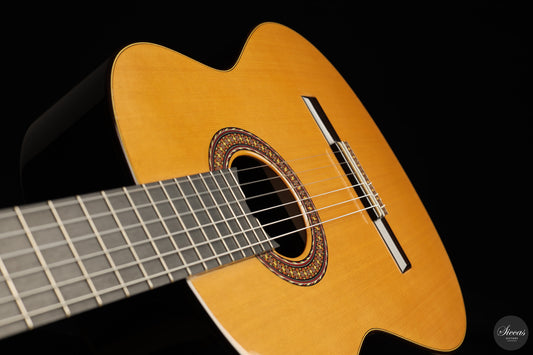
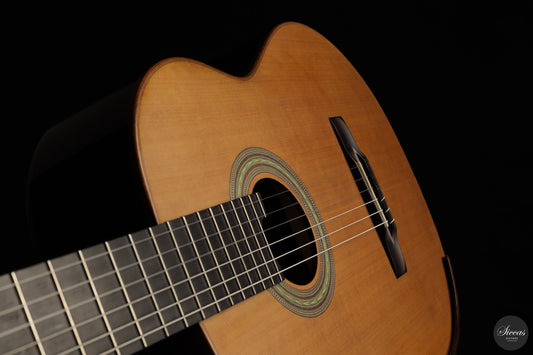
The Air on the G String rewards a guitar with clear sustain, a singing treble register, and a well-defined bass. Both cedar and spruce tops work well — cedar offers immediate warmth and richness that suits the meditative character of the piece, while spruce provides clarity and projection that can help the melody cut through in a larger acoustic space. Our spruce vs cedar tone comparison goes into detail on this choice.
For this repertoire, a concert-level instrument makes a genuine difference. The subtle dynamic gradations that this piece demands — the gentle swells and retreats in the long melodic line — are far easier to achieve on a well-made guitar that responds sensitively across its full dynamic range. Browse our classical guitar collection to find an instrument suited to your level and musical goals, or explore our selection of spruce-top guitars and cedar-top guitars separately.
8. How to Get Started Learning "Air on the G String" on Guitar
- Select a Quality Arrangement: Choose a transcription that matches your playing level. Beginners can work from simplified single-voice arrangements; intermediate and advanced players will benefit from editions that preserve some inner-voice movement and bass detail.
- Invest in a Good Edition: Use a professionally edited score rather than unverified online tablature. A well-edited score will include fingerings, phrasing marks, and dynamics that reflect careful musical thinking.
- Work in Sections: Divide the piece into manageable phrases and master each one before joining them. Pay special attention to the transitions between sections, where continuity of tone and tempo is most easily disrupted.
- Record Yourself: The Air is an unforgiving mirror. Recording your practice — even on a phone — will reveal rhythmic inconsistencies and tonal imbalances that are easy to miss while playing.
Conclusion
"Air on the G String" by Johann Sebastian Bach is more than a celebrated arrangement — it is one of those rare pieces of music that seems to speak directly to something universal in human experience. Its simplicity is its strength, and its ability to move listeners after nearly three centuries of performance is the clearest measure of Bach's genius.
On classical guitar, the piece acquires a new intimacy: a single instrument, a single player, and a melody that has lost none of its capacity to move. Whether you are learning it for the first time or returning to it after years away, the Air will always have something new to teach you about tone, patience, and musical expression.
For further reading, explore our guide to how long it takes to learn classical guitar, our overview of great classical guitarists, and our article on Recuerdos de la Alhambra — another piece that rewards patient, expressive practice.
Explore more: our guide to famous classical guitar pieces and the full article on Johann Sebastian Bach on classical guitar. Ready to play this masterpiece? Find the right instrument in our classical guitar collection.