Early Life in Linares, 1893
Andrés Segovia Torres was born on 21 February 1893 in Linares, a small mining town in the province of Jaén, in the Andalusian region of southern Spain. He was raised largely by an uncle and aunt in Granada, a city whose Moorish architecture and deep musical heritage would leave a permanent imprint on his artistic sensibility. It was in Granada that the young Segovia first encountered the guitar — not as a concert instrument, but as the sound of the streets, the cafés, and the domestic interior.
From the very beginning, Segovia's relationship with formal musical institutions was one of friction. He briefly attended the Granada Centre for Arts and Letters, but found little support for his chosen instrument. The classical music establishment of early twentieth-century Spain regarded the guitar as a folk curiosity, unsuitable for the concert hall. Rather than abandon the instrument, Segovia abandoned the institution. He taught himself to play, developing his own fingering, his own approach to tone production, and — crucially — his own conviction that the guitar deserved a place alongside the violin and the piano as a vehicle for serious musical expression. He was, in every meaningful sense, an autodidact.
This self-directed formation gave Segovia something that no conservatory curriculum could have provided: an utterly original technique and an unshakeable sense of mission. He would spend the rest of his life pursuing that mission with the discipline of a monk and the ambition of a conquistador.
First Steps: Granada, Madrid, Barcelona
Segovia gave his first public recital in Granada around 1909, while still a teenager. The response was encouraging enough to sustain his belief in what he was doing. He moved next to Madrid, where he performed for the first time in the Spanish capital in 1912 at the Ateneo de Madrid, one of the country's most prestigious cultural institutions. The reception confirmed that there was an audience for the guitar in serious concert settings — if the performer could command the room.
Barcelona became another critical platform in these formative years. The Catalan musical world was among the most cosmopolitan in Spain, shaped by Modernisme and deeply connected to the broader European concert tradition. Performing there allowed Segovia to refine his stage presence and to begin attracting the attention of critics and musicians who moved in international circles. He was already working on the repertoire problem that would define much of his career: there was almost no concert music written specifically for the classical guitar. Segovia responded by transcribing works originally composed for lute, keyboard, or violin — and by beginning to cultivate relationships with living composers who might write new pieces for him.
The Paris Début, 1924
The year 1924 marked the decisive step onto the world stage. Segovia made his Paris début at the Salle Érard, one of the French capital's established recital venues, to an audience that included leading figures of the Parisian musical world. The response was extraordinary. Critics who arrived expecting a curiosity act left convinced they had witnessed something historically significant. Here was a guitarist playing Bach and contemporary Spanish repertoire with a beauty of tone, a clarity of line, and an expressive depth that placed him in the company of the great instrumentalists of the age.
The Paris début opened every subsequent door. It led to invitations across Europe — London, Berlin, Vienna, Rome — and established Segovia as an international concert artist rather than a regional Spanish phenomenon. It also brought him into contact with the composers, impresarios, and recording companies that would shape the next phase of his career. The guitar, through Segovia's artistry, had arrived in the concert halls of Europe.
The New York Début, 1928
If Paris announced Segovia to Europe, New York announced him to the world. His American début took place in 1928 at Town Hall in New York City, one of the premier recital venues on the continent. The hall was full, the reviews were rapturous, and the career breakthrough was immediate and lasting. American audiences and critics embraced him with an enthusiasm that translated into decades of sold-out tours.
The United States would remain central to Segovia's career for the rest of his life. He toured North America regularly, recorded for major labels, and eventually spent considerable time teaching at American institutions, including the University of California, Berkeley. His presence in the American market helped establish classical guitar as a viable commercial and artistic enterprise at a time when the infrastructure for such a career barely existed.
Transcriptions: Bach, Handel, and Scarlatti for Guitar
One of Segovia's most consequential contributions to the guitar's repertoire was his systematic project of transcription. Faced with a concert instrument that had almost no dedicated solo literature of the calibre required for serious recital programmes, he turned to the keyboard and lute music of the Baroque era. His transcriptions of works by Johann Sebastian Bach — including the Chaconne from the Partita No. 2 in D minor, suite movements, and preludes — became cornerstones of the classical guitar canon.
He also transcribed works by George Frideric Handel and Domenico Scarlatti, finding in the Baroque idiom a natural affinity with the guitar's capacity for counterpoint, ornament, and sustained melodic line. These transcriptions were not mere arrangements; they were considered artistic re-imaginings, carefully adapted to exploit the specific tonal possibilities of the instrument. They remain in active use today, studied and performed by guitarists worldwide.
For lovers of famous classical guitar pieces, Segovia's transcriptions of Bach are among the most important contributions any single performer has made to the repertoire.
Commissioned Works: Building a Repertoire
Transcription could solve only part of the repertoire problem. Segovia's deeper ambition was to create a body of original concert music written specifically for the guitar by the leading composers of the twentieth century. He pursued this goal through personal relationships and direct commissions, and the results transformed the instrument's literary standing.
Federico Moreno Torroba, the Spanish composer, wrote a series of works for Segovia beginning in the early 1920s — among them the Suite castellana and the Sonatina — that became some of the most performed pieces in the classical guitar repertoire. Manuel Ponce, the Mexican composer, produced a body of guitar music for Segovia of remarkable depth and variety, including sonatas, variations, and the Concierto del Sur. Heitor Villa-Lobos, the Brazilian composer who reshaped South American classical music in the twentieth century, wrote his celebrated Études and Preludes for Segovia, as well as the Cinq Préludes and other works. Mario Castelnuovo-Tedesco, the Italian composer who later settled in the United States, wrote two guitar concertos and an extensive body of solo music for Segovia.
The cumulative effect of these commissions was to establish the guitar as an instrument capable of sustaining serious compositional attention from major figures of the international musical world. Without Segovia's persistent advocacy, the twentieth-century repertoire for classical guitar would be dramatically poorer.
The Instruments: Hauser I and Ramírez
Segovia was acutely attentive to the instruments he played, and his choices shaped the direction of luthiery for generations. In 1937 he acquired a guitar built by the German luthier Hermann Hauser I, a craftsman from Munich who had studied the construction methods of the great nineteenth-century Spanish makers, in particular Antonio de Torres. Segovia described the 1937 Hauser as "the greatest guitar of our epoch" — a judgement that has echoed through guitar-making circles ever since.
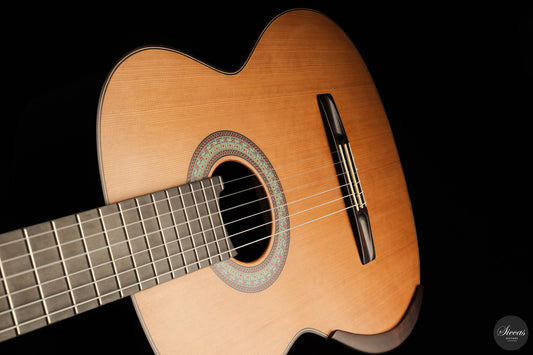
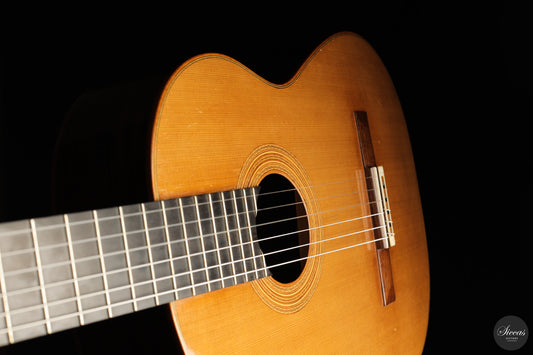
The Hauser I guitar, with its powerful bass, singing treble, and exceptional projection, was the instrument on which Segovia made many of his most celebrated recordings. The endorsement transformed Hauser's reputation and established a lineage of German-Spanish synthesis in guitar construction that continues today. Players and collectors who wish to explore instruments from this tradition can browse Hermann Hauser I guitars at Siccas Guitars.
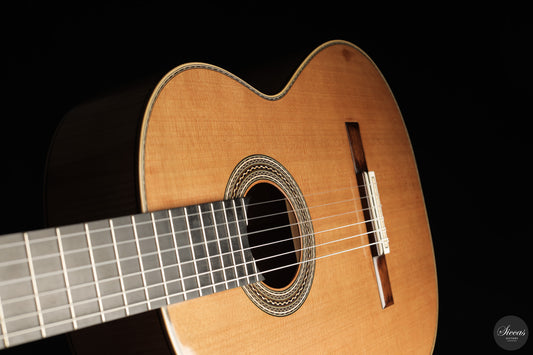
From around 1969, Segovia began performing on a guitar built by José Ramírez III, the Madrid-based luthier whose family workshop had been central to Spanish guitar making since the nineteenth century. The Ramírez guitar offered a different tonal palette — warmer, with a distinctive richness in the mid-range — and accompanied Segovia through the final decades of his performing career. The Ramírez family's instruments remain among the most sought-after classical guitars in the world; you can explore Ramírez guitars in our collection.
Teaching and the Formation of a Generation
Segovia's influence extended far beyond his own performances and recordings. Through decades of masterclasses and private instruction, he formed a generation of guitarists who carried his approach to the instrument to every corner of the world.
Among his most celebrated students was John Williams, the Australian-born guitarist who became one of the defining concert guitarists of the second half of the twentieth century. Williams studied with Segovia at the Accademia Musicale Chigiana in Siena — the Italian summer school that Segovia made into one of the most important centres for classical guitar teaching in the world — and went on to build a career of extraordinary range and longevity.
Oscar Ghiglia, the Italian guitarist, was another Chigiana alumnus who built a major international career and became an influential teacher in his own right. Christopher Parkening, the American guitarist, studied with Segovia and became one of the most prominent classical guitarists in the United States. Alirio Díaz, the Venezuelan guitarist, brought Segovia's approach to South American repertoire and audiences, helping to cement the guitar's position in Latin American concert life.
This pedagogical lineage connects Segovia to virtually every major strand of contemporary classical guitar. The technical and aesthetic principles he developed — right-hand nail technique, the cultivation of tonal variety through varied attack, the organisation of the guitar's voices into a quasi-orchestral texture — remain foundational to the instrument's teaching tradition. For more on the guitarists he inspired, see our overview of great classical guitarists.
Later Life and Continuing Career
What is remarkable about Segovia's career is not merely its scale but its duration. He continued to perform at the highest level well into his eighties, giving recitals in the major halls of Europe and North America into the 1980s. His technique inevitably changed as he aged — the tone became softer, the tempos more measured — but his musical intelligence and the depth of his interpretations remained compelling to audiences who had followed him for decades and to younger listeners encountering him for the first time.
He was married twice, and his later years were spent largely between Madrid and his home in Spain. He was made a Marquis by King Juan Carlos I of Spain, a recognition of his role as a national cultural ambassador of the highest order. In 1986, the Recording Academy of the United States awarded him the Grammy Lifetime Achievement Award, acknowledging the breadth and permanence of his contribution to recorded music.
Segovia remained connected to the guitar world until the very end, giving occasional masterclasses and maintaining the network of relationships — with students, luthiers, composers, and institutions — that he had built over seven decades.
Death in Madrid, 1987
Andrés Segovia died in Madrid on 2 June 1987, at the age of ninety-four. He had been born in a world in which the guitar was not considered a serious concert instrument and he died having personally transformed that reality on every continent where Western classical music was performed. The tributes that followed his death were universal and genuine: from concert guitarists, from luthiers, from composers, and from audiences who had experienced his playing in person or through his recordings.
Legacy and Influence
The legacy of Andrés Segovia operates on multiple levels simultaneously, each of them profound.
At the level of the instrument itself, he demonstrated that the guitar was capable of sustaining a full solo recital programme at the highest artistic level — something that had not been established before his career. The history of the classical guitar has a clear before and after, and Segovia is the dividing line.
At the level of repertoire, he created — through transcription and commission — a body of music for the guitar that had not previously existed. The twentieth-century guitar canon, from Torroba to Villa-Lobos to Castelnuovo-Tedesco, exists largely because of his advocacy. Contemporary guitarists like Julian Bream built directly on the foundations he laid, extending the commissioning tradition into new harmonic territories.
At the level of lutherie, his championship of Hauser I and Ramírez directed the attention of the world's finest makers and most demanding players toward the tonal ideals those instruments represented. The standards of the modern classical guitar — its scale length, its bracing patterns, its tonal balance — were shaped in significant part by the instruments Segovia chose to play and the descriptions he gave of what he was seeking.
At the level of pedagogy, his teaching at Siena and elsewhere produced a lineage of players that now spans three further generations, each carrying forward a set of technical and aesthetic principles rooted in his practice.
And at the level of cultural history, he achieved something that very few musicians of any instrument have managed: he moved the needle of public perception. He changed what people thought a guitar was, and what they believed it could do. That is perhaps the most durable legacy of all.
Quick profile and videos: Andrés Segovia – Guitarist Profile →
On the lasting impact he had: Andrés Segovia – Legacy & the Guitar Before and After →
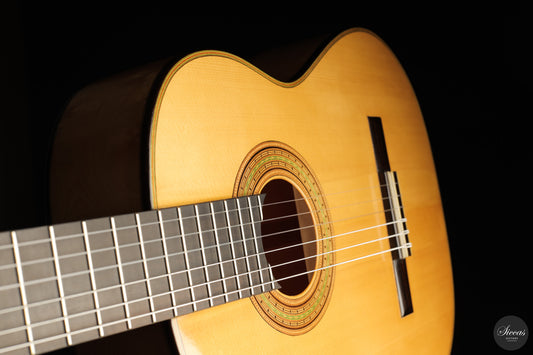
Browse our curated selection of classical guitars — instruments in the tradition that Segovia spent a lifetime defining.