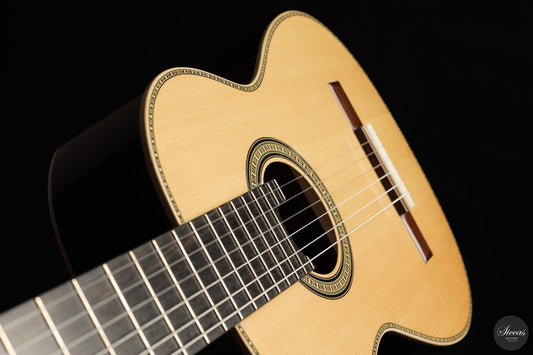
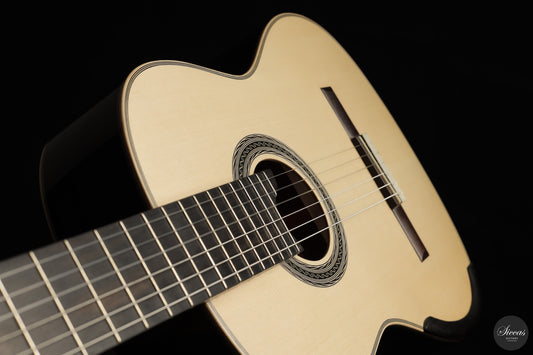
Asturias is the most recognisable classical guitar piece in the world — and one of the most misnamed. The music Isaac Albéniz wrote is pure Andalusian flamenco, rooted in the Phrygian mode of southern Spain. It has nothing to do with Asturias, the green, Celtic-inflected region in the north. The title was added posthumously by a German publisher and has stuck ever since, in spite of the geography.
The Real Origin
Albéniz composed the piece as a Prélude — the opening movement of a three-piece collection called Chants d'Espagne, Op. 232, published in 1892. It was a piano piece, and its piano textures are characteristically un-pianistic: a hammering open-string drone in the bass, a melody in the Phrygian mode above it, and the driving rhythmic feel of the bulería, one of the most energetic flamenco forms. After Albéniz died in 1909, a German publisher issued an expanded edition of the Suite Española and assigned the piece the name Asturias (Leyenda) — "Leyenda" meaning simply "legend" — inserting it into a suite it was never part of. The name has outlasted any attempt to correct it.
The confusion over its origins runs deeper than just the title. Some catalogue editions list the piece under Suite española Op. 47, while musicologists trace it to Chants d'Espagne Op. 232. Both attributions circulate in concert programmes, recordings, and printed editions, and the ambiguity is unlikely to be resolved definitively. What is certain is this: Albéniz wrote music that breathes the southern Spanish air of Andalusia, and the region of Asturias — rain-soaked, Celtic, and utterly distinct in character — had nothing to do with it.
The Piano Original
On the piano, the outer sections of Asturias are relentless and percussive. The left hand hammers a repeated bass pedal on E, while the right hand drives a Phrygian melody in triplet arpeggios. The effect is deliberately hypnotic — the repetition is the point, building tension through accumulation rather than harmonic movement. The middle section shifts mood entirely, introducing a cantabile melody with a flavour close to the malagueña, one of the lyrical forms of Andalusian song. This contrast — violence and lyricism, drone and song — gives the piece its dramatic arc and explains why it transfers so naturally to the guitar.
Albéniz (1860–1909) was himself a child prodigy who performed across Europe as a pianist from an early age. His mature compositional voice drew deeply on the folk and flamenco idioms of Spain, filtering them through a European Romantic harmonic language he absorbed studying in Leipzig and Brussels. Asturias sits at the intersection of those two worlds: it is formally a Romantic character piece, but its soul is flamenco.
On the Guitar
Francisco Tárrega made the first guitar transcription, transposing the piece to E minor — a key in which the central pedal note falls on the open B string, giving the drone its characteristic resonance and sustain. Andrés Segovia refined and extended this arrangement, adding the triplet figures in the melody that most guitarists now consider part of the standard text. In E minor, the piece sits perfectly in the guitar's middle register, the open strings ringing freely and the Phrygian melody singing above them. The contrast between the driving outer sections and the introspective malagueña-influenced middle section gives the piece its theatrical arc.
The transcription works as well as it does because the guitar is, in many ways, the instrument Albéniz was imagining even when he wrote for piano. The drone bass on a repeated open string is a technique fundamental to flamenco guitar. The rapid arpeggiated treble figures sit naturally under the fingers in a way they do not under the hands at a keyboard. Guitarists sometimes employ a slight scordatura — retuning the sixth string from E down to D — to add weight to the bass pedal, though most performances use standard tuning. On a fine concert instrument with a responsive bass and clear treble separation, the piece reveals layers of colour that are genuinely electric.
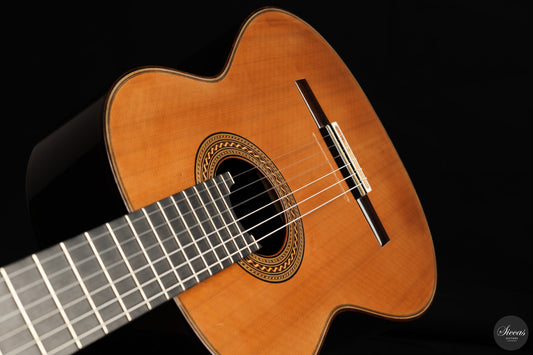
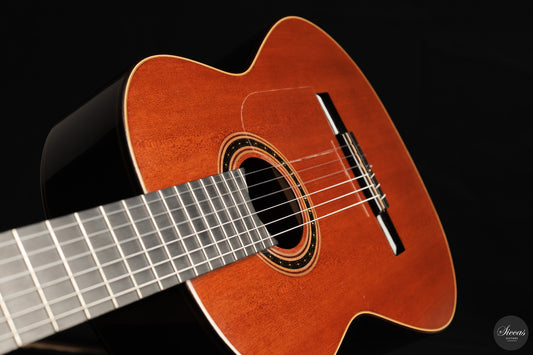
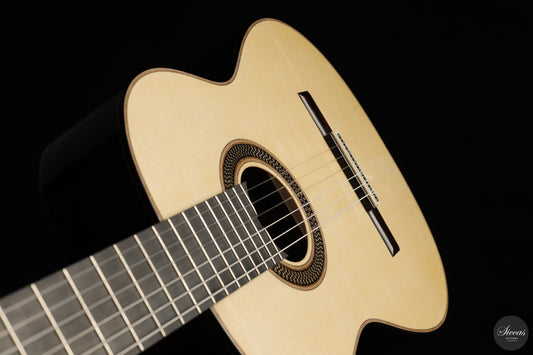
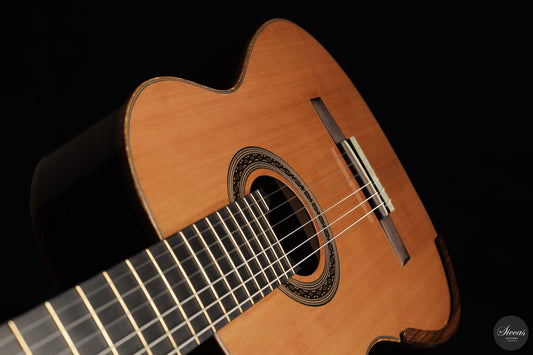
The choice of guitar matters considerably. The powerful bass pedal tones demand a instrument with a focused, sustained low register that does not boom or blur. The rapid treble arpeggios require clarity and even response across all strings. Concert-level classical guitars built with European spruce tops often bring the outer sections of Asturias to life with particular authority, while cedar-topped instruments can give the middle section a warmer, more intimate character. Some players prefer the dry projection of a double-top guitar for the piece's demanding dynamic range.
Technique and Practice
At advanced level, Asturias presents distinct technical challenges in each of its sections. The outer sections demand sustained speed and endurance: the right-hand arpeggio pattern must remain clean and even across several minutes at tempo, while the thumb maintains the bass pedal with consistent tone and weight, independent of what the fingers are doing above. Many players find that the right-hand stamina required for the outer sections is the principal obstacle — the pattern itself is not complex, but maintaining precision as fatigue sets in requires specific conditioning.
The middle section demands a different skill set entirely. Here the challenge is expressive legato phrasing and clean voice separation: the inner melody must sing above an accompaniment that supports without obscuring it. Position shifts in the left hand need to be smooth enough that the melodic line does not break. The return to the outer section after the middle requires an immediate reset of both physical approach and musical character.
Players working on the piece benefit from isolating the thumb line and playing it alone — checking that each bass note has a consistent tone and that the thumb is not gripping or tensing through the repeated motion. Slow practice of the arpeggio with attention to the angle and contact point of each finger pays dividends at tempo. The Phrygian mode gives the piece a distinctive harmonic colour: the semitone between the first and second scale degrees (F natural and E in E Phrygian) is the source of much of its tension, and leaning into that interval in performance clarifies the piece's flamenco character.
For context on the broader technical demands of the classical guitar repertoire, the guides on Recuerdos de la Alhambra and Capricho árabe — both by Tárrega, both central repertoire — are worth reading alongside this one.
Performed at Siccas Guitars
Place in the Repertoire
Asturias occupies a peculiar position in the classical guitar canon. It is simultaneously the piece most likely to be heard at a beginner recital — in simplified arrangements — and one of the most demanding works in the standard repertoire when performed in full at tempo. Its fame means that audiences arrive with expectations, which creates its own pressure for the performer. It is also one of the clearest examples of how the guitar transcription tradition has shaped the repertoire: without Tárrega and Segovia, this piece would be a footnote in the piano literature rather than a cornerstone of the guitar world.
Placed in the broader context of Spanish music for guitar, Asturias belongs alongside Tárrega's own compositions and the works of Agustín Barrios as music that defined what the classical guitar could be. Its influence on the perception of the instrument — dramatic, southern, urgent, expressive — is difficult to overstate. Guitarists from Julian Bream to John Williams to the current generation of concert artists have recorded it, and the number of interpretations available on record is a reliable indicator of its centrality to the repertoire.
If you are exploring the great classical guitar pieces or looking for guidance on where Asturias sits among other works of similar difficulty, the great classical guitarists guide offers useful context for the performers who have defined these pieces in the ears of audiences worldwide.
Summary
The piece Albéniz wrote is not about a region. It is about a mode, a rhythm, and a sound — the Phrygian drone of Andalusian flamenco, channelled through a Romantic piano idiom and then, by the hands of Tárrega and Segovia, returned to the instrument it always sounded like. On a fine classical guitar, Asturias is one of the most viscerally compelling things in music. The wrong name has never diminished it.
See the full Albéniz guide and Sevilla.