
Canon in D – History, Meaning & Why It Never Dies
Few pieces of music have traveled as far, or as strangely, as Pachelbel's Canon in D. Written around 1680 for three violins and a bass line, it vanished almost completely for nearly three centuries — gathering dust in a library while the world moved on without it. Then, in 1968, a French conductor named Jean-François Paillard pressed record, and everything changed. Today, Canon in D is played at more weddings than almost any other piece of music on earth. It appears in films, video games, pop songs, and YouTube tutorials watched by tens of millions. It is the piece every beginning guitarist wants to learn and every advanced guitarist finds a way to reimagine.
This article tells the full story: who Pachelbel was, what he actually wrote, why the Canon disappeared for so long, and why it refuses to stay forgotten.
Johann Pachelbel: The Man Behind the Canon
Johann Pachelbel was born in Nuremberg on September 1, 1653. He grew up in one of the great cultural centers of seventeenth-century Germany, a city known for its craftsmen, its merchants, and its deep tradition of church music. From an early age, Pachelbel showed exceptional musical talent, and he received training from local organists before moving to Regensburg and then to Vienna to continue his studies.
In Vienna, Pachelbel worked as deputy organist at St. Stephen's Cathedral — one of the most prestigious musical positions in the German-speaking world at the time. He absorbed the influences of the South German and Italian organ traditions, developing a keyboard style that was harmonically rich, technically demanding, and deeply rooted in counterpoint. This training would shape everything he later composed, including the Canon.
After Vienna, Pachelbel's career took him across the German-speaking world. He served as court organist in Eisenach, where he became a close friend of the Bach family — specifically of Johann Ambrosius Bach, the father of Johann Sebastian Bach. When Johann Ambrosius died, Pachelbel took on the role of teacher and guardian for the eldest Bach son, Johann Christoph, who later became Johann Sebastian's primary keyboard teacher. The direct line from Pachelbel to J.S. Bach is one of the most important pedagogical chains in the history of Western music.
From Eisenach, Pachelbel moved to Erfurt, where he worked as organist at the Predigerkirche for twelve years — the longest tenure of his career. His reputation grew substantially during this period. He was considered one of the finest organists in Germany, widely sought after as a teacher, and prolific as a composer. His output included chorale preludes, toccatas, fantasias, fugues, suites for harpsichord, and a substantial body of sacred vocal music.
In 1695, after a decade in Stuttgart and Gotha, Pachelbel returned to his native Nuremberg to take the position of organist at St. Sebaldus Church — the most important Protestant church in the city. He held this post until his death on March 3, 1706, at the age of 52. He was buried in Nuremberg, and his grave, like his Canon, would not receive much public attention for a very long time.
What Is a Canon? The Music Theory Behind the Piece
Before the history, a word about the music itself — because understanding what a canon actually is makes the story of this one far more interesting.
A canon is a contrapuntal composition in which a melody is imitated by one or more voices entering at a fixed time interval after the first. In its simplest form, think of "Row, Row, Row Your Boat" sung in rounds: one group starts, a second group begins the same melody a few beats later, and the two lines interweave. That is a round, which is the simplest type of canon.
Pachelbel's Canon is more sophisticated. It is written for three violins above a ground bass — what composers call a basso ostinato, meaning an "obstinate bass." The bass line consists of just eight notes, repeated over and over again, without variation, throughout the entire piece. That two-bar bass pattern — D, A, B, F#, G, D, G, A — plays approximately 28 times in a standard performance. It never changes. It never rests. It is the foundation on which everything else is built.
Above this unchanging bass, three violin voices enter in canon: the first voice begins a melody, the second voice enters two bars later playing the exact same melody, and the third voice enters two bars after that playing the same melody again. All three voices are therefore always playing the same music, but offset from each other by two bars. What you hear is a beautiful, cascading interweave of voices, each one chasing the one before it — and because the bass never changes, each repetition of the melody lands on the same harmonic foundation, creating a sense of continuous, satisfying motion.
The piece is built on a sequence of 28 variations over that repeating bass. Each variation introduces a new rhythmic figure or melodic idea — beginning with long, held notes and gradually increasing in rhythmic complexity, moving from half notes to quarter notes to eighth notes to sixteenth notes. By the end of a standard performance, the texture has become rich and intricate, a long-form study in how much can be built from so little.
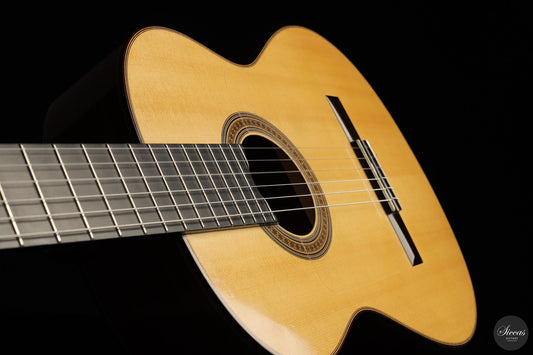
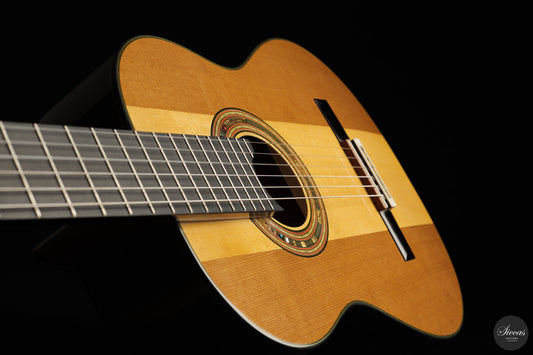
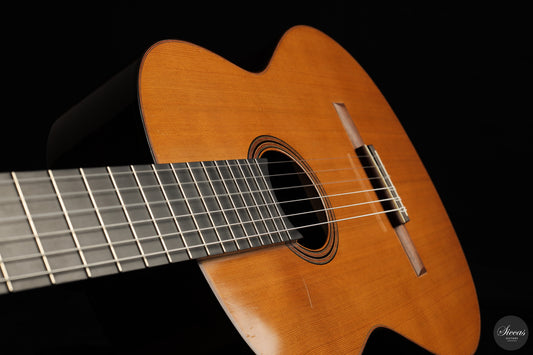
On the classical guitar, the piece is most commonly arranged in D major, often using a capo at the second fret to preserve the open-string resonance that gives the original its characteristic warmth. The ostinato bass, originally assigned to the cello, becomes the responsibility of the guitarist's thumb — a gentle, insistent pulse that holds everything together while the melody unfolds above it.
When Was the Canon Written — and Why Was It Forgotten?
Musicologists date the Canon in D to approximately 1680, based on stylistic evidence and the period of Pachelbel's career at Erfurt. It was almost certainly composed as functional music — intended for performance at a specific occasion, possibly a court celebration or a church service, rather than as an artistic statement intended for posterity.
This distinction matters enormously when trying to understand why the piece disappeared. In the seventeenth century, composers did not typically think of their music as lasting monuments. They wrote for immediate use. A court organist composed music that would be played at a specific event, and when that event was over, the manuscript went into a drawer. If it was published, it might circulate among other musicians. If it was not published — and a great deal of Baroque music was never published in its composer's lifetime — it depended entirely on the survival of individual manuscripts.
Pachelbel's Canon survived in manuscript form, but it did not circulate widely. It was not published during his lifetime. After his death in 1706, his musical legacy was largely eclipsed by the towering reputation of Johann Sebastian Bach, whose extraordinary output reshaped how the entire generation of earlier Baroque composers was remembered. In the shadow of Bach, Telemann, and Handel, Pachelbel became a footnote — an influence, a teacher, a minor historical figure rather than a canonical (in the literary sense) master.
The Canon in D sat in archives, occasionally catalogued and occasionally overlooked, for nearly 250 years. Then, in 1919, a German musicologist named Gustav Beckmann published a scholarly edition of Pachelbel's chamber music. He had found the manuscript in the Stralsund municipal library — a collection of handwritten parts that had been quietly preserved while the rest of the world moved on. Beckmann's edition made the piece technically available to scholars and performers, but available in the musicological sense: present in a library, printed in an academic edition, theoretically playable.
For another fifty years, it remained a curiosity. A piece that specialists knew about. A piece that could be performed. Not yet a phenomenon.
Jean-François Paillard and the Recording That Changed Everything
Jean-François Paillard was born in Vitry-le-François, France, in 1920. He studied at the Paris Conservatoire and later founded the Jean-François Paillard Chamber Orchestra in 1953, an ensemble dedicated to performing Baroque and early Classical music with period-informed sensibility. Through the 1950s and 1960s, the orchestra built a strong reputation in France and began recording for Erato Records, the French classical label.
In 1968, Paillard's orchestra recorded a selection of Baroque pieces for what would become one of the most commercially successful classical recordings of the twentieth century. Among those pieces was Pachelbel's Canon in D — a piece that had received very few professional recordings before this one.
What Paillard did with the Canon was simple, but its effect was transformative. He chose a slow, stately tempo — slower than the manuscript's implied pace, slower than most subsequent performances. He gave the piece a sense of ceremonial gravity, of something timeless and weightless simultaneously. The recording opened with the bass line alone, establishing its hypnotic pulse before the violins entered. Each variation unfolded with unhurried clarity. The sound was warm, intimate, and, in a word that would define the piece's reception for decades to come, beautiful.
The record sold. Then it kept selling. Erato re-released it. American labels licensed it. Radio stations played it. By the mid-1970s, Pachelbel's Canon had become one of the most frequently requested pieces in classical music programming. Concert audiences who had never heard of Pachelbel recognized the opening bass line immediately. Record stores filed it not under "Baroque" but under "Classical Favorites."
The timing was not accidental. The 1968 recording arrived at a cultural moment when Western audiences were searching for music that felt stable, serene, and deeply rooted — a counterweight to a decade of upheaval. The Canon's repeating bass line, its patient unfolding, its refusal to rush toward resolution, offered something that very few pieces of music offer: a sense that the world is, underneath everything, in order.
Why Canon in D Became the Wedding Piece
The transition from "beloved classical recording" to "default wedding processional" happened gradually but, once it started, with remarkable completeness. By the late 1970s, professional wedding musicians in the United States and Western Europe were regularly including the Canon in their repertoire on request. By the 1980s, it had become the default — the piece that couples chose when they wanted something classical and dignified for the processional. By the 1990s, it was so thoroughly associated with weddings that it had achieved a kind of cultural saturation no one fully intended.
Several structural features of the Canon make it exceptionally suited to this function. The repeating bass line means that a live ensemble can extend or shorten the piece to match the length of the processional — simply play more variations or fewer, and the piece accommodates any aisle length without awkward cuts or repetitions. The tempo is flexible and dignified. The harmonic language is universally accessible: there is nothing dissonant, nothing challenging, nothing that might unsettle an emotionally charged room. And the gradual increase in melodic activity creates a natural arc — a sense of building, arriving, completing — that mirrors the emotional experience of watching someone walk toward the altar.
The piece appeared in films with increasing frequency: Ordinary People (1980), Platoon (1986), A Good Year (2006), and dozens of others used it to signal either romantic beauty or contemplative sorrow, often both simultaneously. Television advertisements adopted it for the same reason. It became the audio equivalent of a wide, golden landscape — a sonic shorthand for things that matter and endure.
By the time the internet arrived, the Canon's cultural position was already fixed. YouTube amplified it enormously. The 2006 video "Canon Rock" by guitarist JerryC — an electric guitar arrangement that turned the ostinato into a rock riff — received tens of millions of views and introduced the Canon to an entirely new generation who had no idea they were listening to something composed in 1680.
The Musical Structure That Makes It Work
Part of what makes the Canon so durable is that its structure is, at some level, unavoidable. The eight-note bass line is harmonically complete — it moves through the tonal center in a way that feels natural, inevitable, and deeply satisfying. Musicians and theorists have noted that this progression (I – V – vi – III – IV – I – IV – V in Roman numerals, or D – A – Bm – F# – G – D – G – A in D major) underlies an enormous number of popular songs across every genre.
This is not coincidence, and it is not plagiarism. The Canon simply found and codified a harmonic pattern that resonates with human listeners at a deep, probably neurological level. When musicians say "that song sounds like Pachelbel," they are usually right — not because the later composer copied Pachelbel, but because both composers discovered the same fundamental truth about how chords move in a way that feels both forward-moving and deeply stable.
The canonic texture adds another layer. Hearing the same melody in three voices, offset from each other, creates a sensation of being inside the music — surrounded by it — rather than observing it from outside. It is immersive in a way that a simple melody-and-accompaniment texture is not. Every time a voice completes a phrase, another voice is beginning it, and another voice is in the middle of it. The piece is never quite finished, never quite beginning — it simply is, continuously, for as long as it plays.
Canon in D on Classical Guitar
The guitar arrangement of Canon in D occupies a special place in the repertoire precisely because it bridges two worlds. In its simplest form — just the melody with basic chord support — it is genuinely accessible to intermediate players, making it one of the few pieces of genuine classical pedigree that a self-taught guitarist can realistically learn to play. In its most complete arrangements, incorporating the bass ostinato, the canonic imitation between voices, and the full set of variations, it becomes a demanding and rewarding concert piece that rewards years of study.
The bass ostinato is the defining technical challenge. On guitar, the thumb must maintain the repeating bass pattern with absolute evenness of tone and timing, functioning like a cello section of one, while the fingers simultaneously build the melody above. This independence of voices — thumb doing one thing, fingers doing another, both arising from the same hand — is one of the core disciplines of classical guitar technique, and the Canon provides an extended, beautiful exercise in exactly this skill.
For players beginning their journey with this piece, we recommend starting with a simplified arrangement that isolates the melody and a basic accompaniment before attempting the full bass-plus-melody texture. The piece rewards patient, methodical practice. If you are looking for guidance on technique and fingering, our full tutorial is a natural next step.
Möchtest du Canon in D auf der Gitarre lernen? Canon in D on Classical Guitar – How to Play — mit Fingersatz, Technik-Tipps und Übungsanleitungen.
Canon in D also serves as an excellent point of entry into classical guitar repertoire more broadly. Players who master even a simplified version gain skills — right-hand independence, left-hand position changes, sensitivity to voicing — that transfer directly to other pieces in the classical canon. For more pieces at a similar level, see our guide to easiest classical guitar pieces for beginners, and for the full sweep of the repertoire, our overview of famous classical guitar pieces provides an excellent map.
Pachelbel's Broader Legacy
It would be a distortion of history to remember Pachelbel only as the man who wrote the Canon. During his lifetime, his reputation rested on his keyboard music — particularly his chorale preludes for organ, which were widely admired and directly influenced J.S. Bach's approach to the form. His Hexachordum Apollinis (1699), a set of six arias with variations for keyboard, demonstrates harmonic sophistication and expressive depth that go far beyond the Canon's gentle repetition.
His pedagogical influence was immense. Johann Christoph Bach, who studied with Pachelbel in Erfurt, passed his teacher's principles directly to the young Johann Sebastian. The clean voice-leading, the careful treatment of dissonance, the integration of German and Italian styles — these are Pachelbel's gifts to Bach, and through Bach, to virtually all of Western classical music.
To hear Pachelbel only through the Canon is something like knowing Bach only through the Air on the G String — a beautiful, genuine piece, but a small window into a large and varied house.
Why the Canon Will Never Die
The Canon in D has now survived two deaths. The first was the neglect that followed Pachelbel's death in 1706 — nearly 250 years of near-silence. The second was the backlash that followed its cultural saturation in the 1980s and 1990s, when musicians and critics began to tire of its ubiquity, and professional wedding musicians started half-jokingly referring to it as "that song."
Neither death took. The Canon absorbed both — the neglect and the overexposure — and emerged from each with its core intact. The reason is simple: the piece is structurally indestructible. Its bass line is a foundation so solid that anything can be built on it. Its harmonic language is so universally accessible that it crosses every cultural boundary. Its canonic texture is so intrinsically satisfying that listeners who have heard it a hundred times still feel something when the third violin enters.
Every generation rediscovers it. Classical guitarists, rock guitarists, jazz pianists, string quartets, a cappella groups, electronic producers — all of them have found in Pachelbel's eight notes something that feels new and inexhaustible. This is not sentimentality. It is music doing what music does best: giving form to something that does not change.
If you are exploring the classical guitar repertoire beyond the Canon, our guide to Recuerdos de la Alhambra offers a look at one of the most distinctive tremolo pieces in the repertoire, and our article on great classical guitarists introduces the performers who have shaped how we hear this music. For practical guidance on getting started, see how long it takes to learn classical guitar and how to tune a classical guitar. And when you are ready to find an instrument, our collection of classical guitars is an excellent place to begin.
Frequently Asked Questions
Who composed Canon in D?
Canon in D was composed by Johann Pachelbel (1653–1706), a German Baroque composer and organist from Nuremberg. He is best known for this single piece, though his broader body of work — particularly his organ chorale preludes — was highly influential on the generation of composers that followed him, including Johann Sebastian Bach.
When was Canon in D composed?
Musicologists date the Canon to approximately 1680, during the period when Pachelbel was working as organist at the Predigerkirche in Erfurt, Germany. The exact occasion for which it was composed is not known.
Why was Canon in D forgotten for so long?
The Canon was never published during Pachelbel's lifetime and existed only in manuscript form. After his death in 1706, his reputation was overshadowed by later composers, and the manuscript circulated only among specialists. It was rediscovered in the Stralsund municipal library and published in a scholarly edition in 1919, but remained largely unknown to general audiences until the 1968 recording by Jean-François Paillard brought it to worldwide attention.
How did Canon in D become popular?
The modern popularity of the Canon traces directly to a 1968 recording by the Jean-François Paillard Chamber Orchestra for Erato Records. Paillard's slow, stately interpretation gave the piece a dignified, timeless quality that resonated with radio audiences and record buyers. It spread from classical radio to popular culture through use in films, advertising, and weddings, eventually becoming one of the most recognized pieces of music in the world.
Is Canon in D hard to play on classical guitar?
The Canon exists in arrangements of widely varying difficulty. A simplified melody-only version is accessible to intermediate players. A full arrangement incorporating the ostinato bass, canonic voices, and complete variation set is a genuinely demanding piece that requires strong right-hand independence and technical control. Most guitarists begin with a simplified version and develop their arrangement over time.
Why is Canon in D so popular at weddings?
The piece is well-suited to processionals because its repeating bass structure allows performers to adjust the length to match any aisle, its tempo is dignified without being funereal, and its harmonic language is warm and universally accessible. Its gradual increase in melodic complexity also creates a natural sense of arrival that mirrors the emotional arc of a wedding processional.