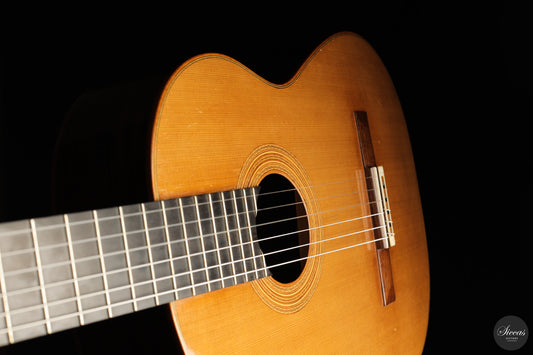
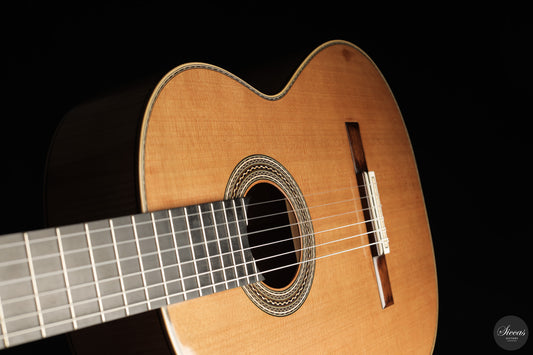
A fine classical guitar is a remarkably delicate object — thin pieces of living wood, held under string tension and shaped to vibrate. Treated well, it can last and improve for a century; treated carelessly, it can crack in a single dry winter. The good news is that proper care is mostly simple habits. Here is how to keep your guitar healthy for life.
The big one: humidity
Humidity is by far the greatest threat to a guitar — and the most overlooked. Wood absorbs and releases moisture from the air, swelling when it is humid and shrinking when it is dry. Too dry, and the top can shrink until it cracks, the action drops, and braces can come loose; too humid, and the wood swells, the action rises, and the tone goes dull and flabby. The sweet spot for most guitars is roughly 45–55% relative humidity.
Using a humidifier
In dry conditions — winter heating is the classic culprit — you need to add moisture. A small case humidifier placed in the guitar case is the simplest, most effective protection: keep the guitar in its case when not playing, with the humidifier maintained. A hygrometer (humidity meter) in the case lets you actually see what's happening rather than guess. In very humid climates the opposite problem applies, and a dehumidifying product or air conditioning may be needed.
Temperature and sudden changes
Guitars dislike extremes and, above all, rapid changes. Never leave a guitar in a hot car, by a radiator, in direct sun or against a cold window. If a guitar comes in from the cold, let it warm up in its closed case for a while before opening it, so the wood adjusts gradually and condensation doesn't form. Sudden swings in temperature or humidity are what crack instruments.
Everyday cleaning and handling
Wipe the strings and body down with a soft, dry cloth after playing — this removes sweat and oils that dull strings and finish. Avoid household cleaners and silicone-based polishes; if you clean the body, use products made for fine instruments, sparingly. Handle the guitar with clean hands, support it properly, and keep it in its case rather than on a stand in a busy room where it can be knocked over.
Strings, and when to change them
Nylon strings gradually go dull, lose tuning stability and sound lifeless. Change them when the tone flattens or the basses start to fray or buzz — how often depends on how much you play. Change strings one or a few at a time rather than all at once if you prefer to keep tension on the neck steady, and always stretch and re-tune new strings over a day or two until they settle.
Storage and travel
Store the guitar in its case, ideally a hard case, away from heat sources and exterior walls. For travel, a good case (and humidity protection) is essential; for flying, a sturdy case and awareness of cargo-hold conditions matter. A few minutes of care before a journey can prevent a heartbreaking crack.
FAQ
What humidity is best for a classical guitar?
Roughly 45–55% relative humidity. Too dry risks cracks; too humid dulls the tone and raises the action.
Do I need a humidifier?
In dry conditions (especially winter heating), yes — a case humidifier plus a hygrometer is the simplest protection.
What damages guitars most?
Dryness and sudden changes in humidity or temperature — keep the guitar cased and away from extremes.