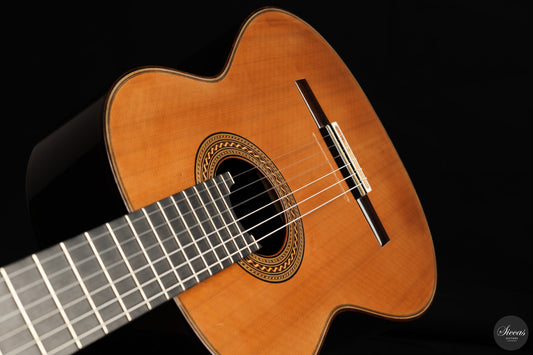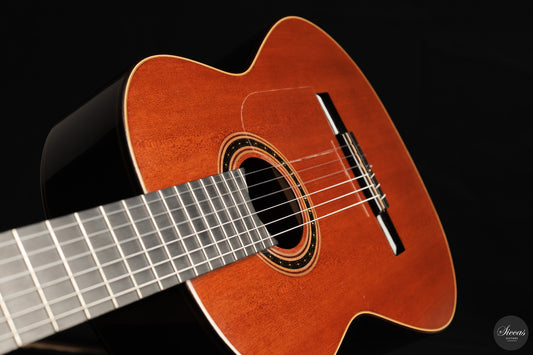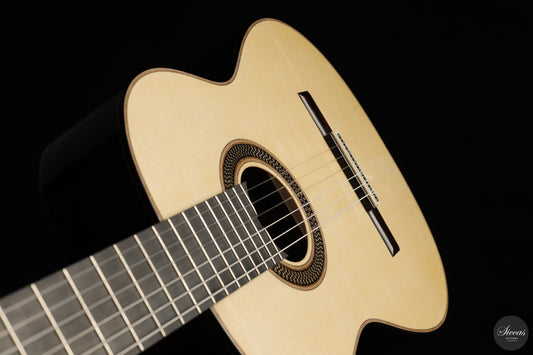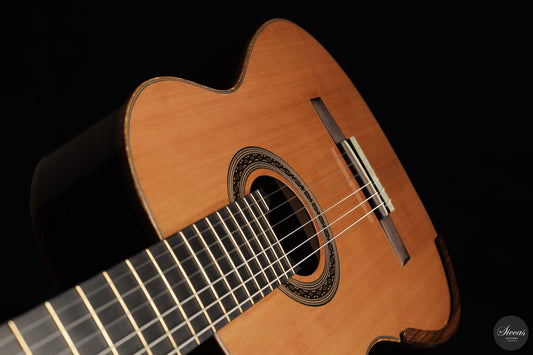

Two guitars can look almost identical and yet feel completely different to play — and one of the biggest reasons is scale length. It is one of the most important specifications on any classical guitar, yet many players never think about it until a guitar feels "just right" or strangely awkward. Here is what scale length is, what the common measurements mean, and how to choose the one that suits you.
What scale length is
The scale length is the vibrating length of the string — measured from the nut (at the top of the fingerboard) to the saddle (on the bridge). In practice, it determines how far apart the frets are and therefore how much your left hand has to stretch. A longer scale spreads the frets further apart; a shorter scale brings them closer together. It is, quite literally, the size of the playing field for your fingers.
The common measurements
- 650 mm — the traditional "standard," used by countless makers since the time of Torres. It is the reference point against which everything else is compared.
- 640 mm — a slightly shorter scale that has become very popular. The reduction is small but noticeable: the frets are a touch closer, the string tension a little lower, making the guitar feel a bit easier under the hand while keeping a full sound.
- Short scales (e.g. 630 mm and below) — chosen by players with smaller hands or those who want the easiest possible reach. They make wide stretches far more comfortable.
How scale length affects feel and sound
Scale length changes two things at once. The first is reach: a shorter scale means less stretching, which can be a real help in pieces with big left-hand spans. The second is string tension: for the same tuning and strings, a shorter scale lowers the tension, so the strings feel a little softer and easier to press, while a longer scale feels firmer and more resistant. Many players also feel that a longer scale gives a touch more clarity, projection and "tightness" of tone, while a shorter scale can feel warmer and more relaxed — though strings, build and the individual guitar matter just as much.
Which should you choose?
This is where personal fit matters more than any rule. If you have smaller hands, or you struggle with stretches and tension, a 640 mm or short scale can be transformative — suddenly difficult passages become manageable, and playing is less tiring. If you have larger hands and like a firm, responsive feel, the traditional 650 mm may suit you perfectly. The only reliable test is to play guitars of different scales and notice which lets your hand relax. Comfort is not a luxury; it directly affects how well, and how long, you can play.
A note for smaller players and children
For children, fractional-size guitars (3/4, 1/2) reduce both scale and body. For adults with smaller hands, a short-scale full-size guitar is often the ideal answer — full tone, easier reach. Never assume you simply have to "manage" with a standard scale; the right scale length can remove obstacles you didn't even realise were holding you back.
FAQ
What is the standard classical guitar scale length?
650 mm is the traditional standard, though 640 mm is now very common.
Is a shorter scale easier to play?
Often yes — it reduces both the stretch between frets and the string tension, which can make playing more comfortable.
Does scale length change the sound?
It can affect tension and tone somewhat, but strings, construction and the individual guitar influence the sound just as much.
How to choose a classical guitar, or browse our classical guitars →