Antonio de Torres — The Father of the Modern Classical Guitar

Antonio de Torres — The Father of the Modern Classical Guitar

If Francisco Tárrega is the father of modern guitar playing, then Antonio de Torres Jurado (1817–1892) is the father of the modern guitar itself. Before Torres, the guitar was a smaller, quieter, more variable instrument; after him, it had the body, the proportions and above all the sound we recognise today. Almost every classical guitar built in the last 150 years — including the finest concert instruments — is, in essence, a descendant of his design.

A maker from Almería

Torres was born in Almería, in southern Spain, and came to guitar making after working as a carpenter. He built in two main periods — first in Seville, where his great innovations took shape, and later back in Almería, after a break from the trade. He was never a wealthy man, and many of his instruments were modestly made on the outside; what mattered to Torres was not decoration but sound.

The revolution

Torres's genius lay in understanding what actually makes a guitar sing. He enlarged the body, settled on the proportions and the roughly 650 mm string length that remain standard, and — most importantly — perfected the system of fan bracing: a pattern of thin wooden struts spread like a fan beneath the soundboard. This let him use a larger, thinner, more responsive top that produced far more volume, warmth and projection than earlier guitars. In a single conception he gave the instrument the power to fill a hall.

"It's all in the top"

Torres held a conviction that still guides luthiers today: that the soundboard, more than any other part, makes the guitar's voice. He is famous for having built a guitar — known as the "papier-mâché guitar" — with back and sides of papier-mâché rather than fine wood, precisely to prove that a great-sounding top could carry the instrument. The demonstration became legendary, and the principle behind it underlies modern guitar making.

His legacy

Tárrega played a Torres, and the new music he and his pupils wrote was conceived for the Torres sound. The great twentieth-century makers — Hermann Hauser among them — studied and refined his model rather than replacing it. Even today's boldest innovations, from lattice to double-top construction, are answers to the question Torres first framed: how to get the most beautiful, powerful sound from a vibrating wooden top.

FAQ

Why is Torres so important?

He standardised the size, proportions and fan-braced construction of the classical guitar, creating the template still used today.

What is fan bracing?

A fan-shaped pattern of thin struts under the soundboard that lets the top vibrate freely for more volume and warmth.

Did famous players use his guitars?

Yes — Tárrega played a Torres, and the modern repertoire was shaped around the Torres sound.

Browse our classical guitars →

The Library
  • Classical Guitars

    The classical guitar, with its soft nylon strings and characteristic timbre, has become a symbol of chamber music, Spanish tradition, and concert repertoire. Its modern form was shaped by Antonio de Torres in the 19th century, setting the standard for the body, fan bracing, and the 65-centimeter scale length that are still used today. Instruments in this category open up a rich palette from the refined Romantic miniatures of Tárrega to the majestic concertos of Rodrigo. Here you will find guitars that preserve historical continuity and at the same time inspire new interpretations.
    Explore all classical guitars
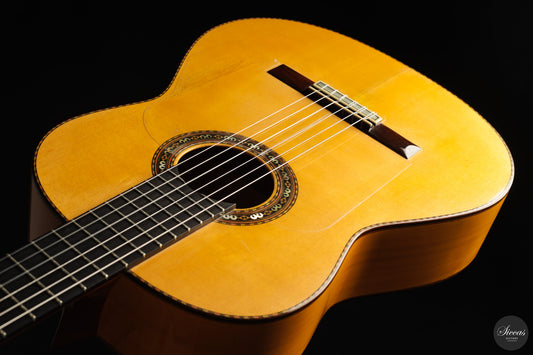
  • Luthier: Zbigniew Gnatek
    Construction Year: 2023
    Construction Type: Lattice
    Top: Cedar
    Back and Sides: Madagascar rosewood
    Soundboard Finish: Nitrocellulose
    Body Finish: Polyurethane
    Air Body Frequency: G
    Weight (g): 1760
    Tuner: Pagos
    Condition: Excellent
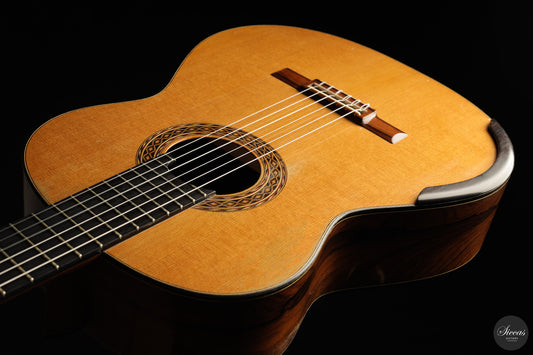
  • Construction Year: 2025
    Construction Type: Double-Top Guitars
    Top: Spruce
    Back and Sides: Indian rosewood
    Soundboard Finish: Lacquer
    Body Finish: Lacquer
    Air Body Frequency: F
    Weight (g): 1500
    Tuner: Kris Barnett
    Condition: Mint
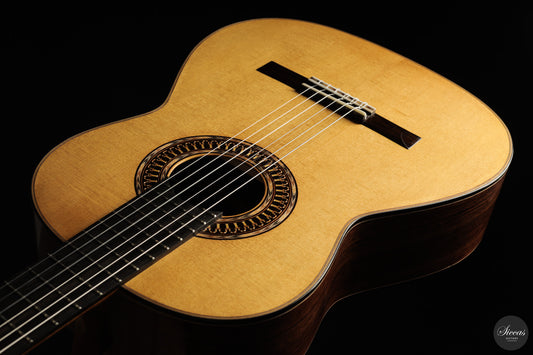
  • Construction Year: 2025
    Construction Type: Traditional
    Top: Spruce
    Back and Sides: Flamed Maple
    Soundboard Finish: French polish
    Body Finish: French polish
    Air Body Frequency: G sharp / A
    Weight (g): 1550
    Tuner: Fustero
    Condition: New
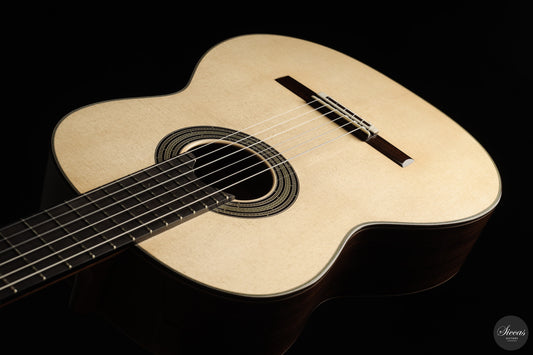
  • Construction Year: 2026
    Construction Type: Traditional
    Top: Spruce
    Back and Sides: Indian rosewood
    Soundboard Finish: French polish
    Body Finish: French polish
    Air Body Frequency: G
    Weight (g): 1710
    Tuner: Rubner
    Condition: New
  • Luthier: José Salinas
    Construction Year: 2026
    Construction Type: Traditional
    Top: Spruce
    Back and Sides: Indian rosewood
    Soundboard Finish: Lacquer
    Body Finish: Lacquer
    Air Body Frequency: F sharp / G
    Weight (g): 1550
    Tuner: Aparicio
    Condition: New
  • Construction Year: 2015
    Construction Type: Lattice
    Top: Cedar
    Back and Sides: Indian rosewood
    Soundboard Finish: Nitrocellulose
    Body Finish: Polyurethane
    Air Body Frequency: G / G sharp
    Weight (g): 2460
    Tuner: Alessi
    Condition: Excellent

Exclusive Offers and Insights

Stay in tune with exclusive updates and offers from Siccas Guitars! Subscribe to our weekly newsletter and be the first to hear about new arrivals, special promotions, and expert insights into guitar craftsmanship. Enter your email below to join our community.