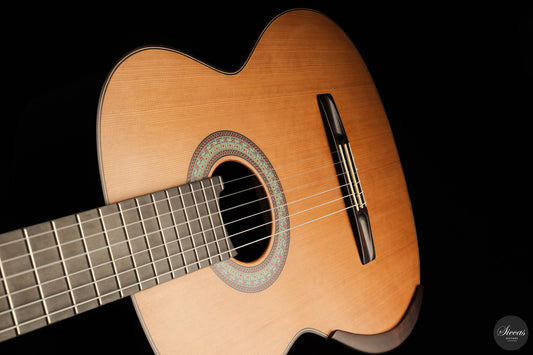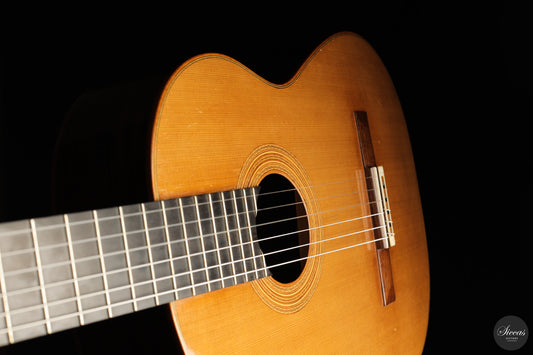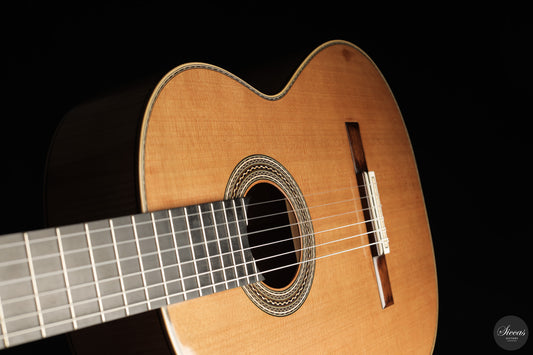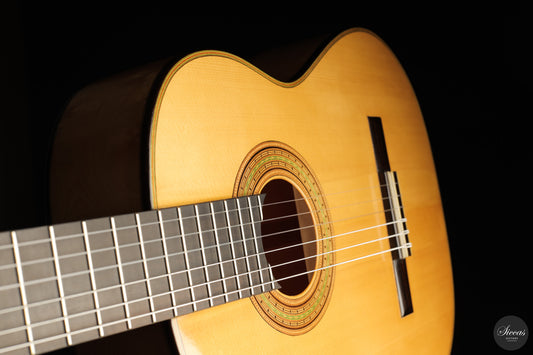

Ed Sheeran is one of the most successful singer-songwriters of his generation — and one of the few global pop stars whose approach to the guitar has genuine roots in fingerstyle technique. His story with the guitar begins with a nylon-string instrument, and the fingerpicking vocabulary he developed as a teenager has shaped every performance he has given since.
A Nylon-String Beginning
Sheeran's very first guitar was a nylon-string instrument. The softer string tension of nylon makes fingerpicking easier for a beginner, and it is credited with developing the sensitivity and touch that defines his playing to this day. Many classical guitarists begin on the same type of instrument for exactly the same reason: nylon rewards delicacy in a way that steel strings do not.
As an adult, Sheeran has been photographed during songwriting sessions with a Cordoba GK Studio Negra — a Spanish-style nylon-string electro-classical guitar. No commercial recordings are known to have been made on this instrument; it appears to serve primarily as a private compositional tool. His performance and studio guitars are steel-string acoustics — primarily Sheeran by Lowden and earlier Martin models.
The Fingerpicking Foundation
At thirteen, Sheeran attended a week-long summer workshop in Girvan, Scotland run by percussive fingerstyle guitarist Preston Reed — the pioneer of integrated percussive guitar, in which the player simultaneously provides bass lines, melody, inner harmony, and rhythmic percussion on the guitar body. Reed later recalled that Sheeran "was intelligent and quick" and picked up the techniques rapidly. This workshop gave Sheeran the core of his adult performing method: building a full band sound alone, with a loop pedal and a single guitar.
The technique itself — thumb handling bass strings, fingers carrying melody, no plectrum — follows the same principle that underpins classical guitar playing: the instrument as a complete, self-sufficient voice capable of multiple simultaneous lines. The difference is the tradition: Sheeran's method is rooted in folk and percussive fingerstyle, not in the classical curriculum. But the parallel is real.
Songs That Show the Connection
Several of Sheeran's most celebrated recordings showcase fingerpicking patterns that have been widely arranged for classical guitar and that feel natural on a nylon-string instrument: The A Team, with its alternating bass-treble picking; Photograph, whose arpeggiated pattern carries the melody; Thinking Out Loud; and Perfect, which has been arranged for classical guitar by performers worldwide. The melody-over-accompaniment texture of these songs maps directly onto how classical guitarists separate voices on the fretboard.
The Wider Picture
Sheeran is part of a long line of major artists whose guitar playing has crossover connections to the classical world: George Harrison of The Beatles played a José Ramírez classical guitar on "And I Love Her"; Joni Mitchell's open-tuning fingerstyle influenced generations of acoustic players; Rodrigo y Gabriela bring flamenco technique to rock compositions. What connects them all is the acoustic fingerstyle tradition — the guitar as a complete instrument, played with the fingers, carrying multiple simultaneous musical voices.
See more classical guitarists at Siccas and explore our guitar collection.