
Taylor Swift is one of the most-searched names in music — and when millions of her fans pick up a guitar, they want to know exactly what she plays. The burning question: does Taylor Swift play classical nylon string guitar? The short answer surprises most people. Let's go through exactly what guitars she uses, where nylon strings fit into her story, and what that means if you're exploring the world of classical guitar yourself.
Taylor Swift's Primary Guitar Choices
Taylor Swift built her career on the steel-string acoustic guitar. The Taylor 814ce — a dreadnought-style steel-string acoustic — became closely associated with her early country years, and the brand name Taylor (coinciding with her first name) made for memorable marketing. She has used a wide range of steel-string acoustics throughout her career, from smaller parlor-style guitars to full dreadnoughts, often custom-built or signature models.
On stage and in the studio she also plays electric guitars extensively — including vintage Fender Telecasters, a guitar style particularly associated with country and indie rock. The electric guitar became central to her "1989" era (2014) and the rock-influenced "Reputation" era (2017). If you watch her stadium tours, you'll see an elaborate guitar collection that spans steel-string acoustics, electrics, and the occasional surprise.
Does Taylor Swift Actually Play Nylon String Guitar?
Here is where it gets genuinely interesting. Taylor Swift has used nylon-string guitars in select contexts — and it is not just a one-off moment. Nylon strings produce a warmer, rounder tone that steel strings simply cannot replicate. For certain intimate arrangements and specific recording sessions, that softer, more classical sound is exactly what a producer or artist reaches for.
However, it is important to be precise: Taylor Swift is not a classical guitarist in the trained, academic sense. She does not perform repertoire from the classical guitar tradition — no Tárrega, no Sor, no Bach transcriptions. When she picks up a nylon-string guitar it is as a singer-songwriter using it as a tonal color, not as a practitioner of the classical guitar technique (right-hand fingerstyle with nails, formal left-hand positioning, sitting posture with footstool, etc.).
That distinction matters — and it actually opens a fascinating door. The nylon-string guitar world she occasionally touches belongs to the same instrument family as centuries of serious classical repertoire. The same instrument that Swift might strum for a mellow acoustic moment is the instrument on which Andrés Segovia built an entire concert tradition, and on which players like Ana Vidovic and David Russell deliver performances of extraordinary complexity.
Classical Guitar vs. Taylor Swift's Guitar Style — Key Differences
Understanding the distinction between what Taylor Swift does with a guitar and what classical guitarists do helps appreciate both worlds more deeply.
Technique and Posture
Classical guitar technique is highly codified. Players typically sit with the guitar resting on the left leg (or using a support), adopt a precisely angled left-hand position, and use the right-hand fingers (not a pick) to produce differentiated tonal qualities from different parts of the string and soundboard. Taylor Swift, like most singer-songwriters, uses a plectrum or strumming technique and holds the guitar in a standard folk/pop position.
String Material and Tension
Classical guitars use nylon strings (or carbon/composite variants) which sit at lower tension than steel strings. This produces the characteristic warm, rounded tone — and also means the guitar body, bracing, and neck are designed differently. You cannot simply put nylon strings on a steel-string guitar and expect proper results; the instruments are built for different string tensions. Classical guitars also typically have a wider nut width (around 52mm) compared to most steel-string acoustics, making fingerstyle technique easier but strumming with a pick feel different.
Repertoire and Context
Classical guitar has a deep repertoire stretching from Renaissance lute transcriptions through Baroque (Bach), Classical era (Fernando Sor, Mauro Giuliani), Romantic (Francisco Tárrega, Agustín Barrios) to 20th-century works (Villa-Lobos, Rodrigo's Concierto de Aranjuez). You can read about some of the most celebrated pieces in our guide to famous classical guitar pieces. Taylor Swift's songwriting sits in a completely different tradition — American country, folk, and pop.
Why Nylon Strings Appeal to Singer-Songwriters
Even artists who are not classical guitarists are drawn to nylon-string instruments for specific moments. The reasons are practical and sonic:
- Softer on fingers: Nylon strings are gentler on fingertips, making them more comfortable for long playing or recording sessions, especially for players who have not built up the calluses steel strings require.
- Mellow, intimate tone: For quiet, stripped-back arrangements, the warmth of nylon is hard to match. It reads differently in a mix — rounder, more breath-like.
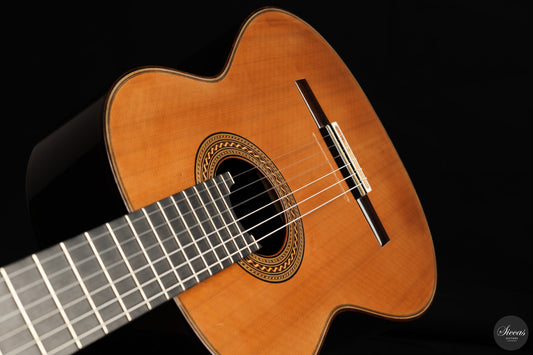
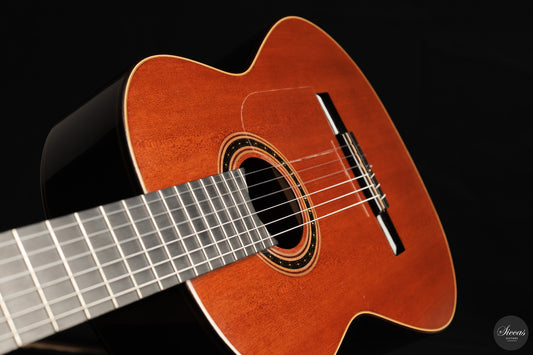
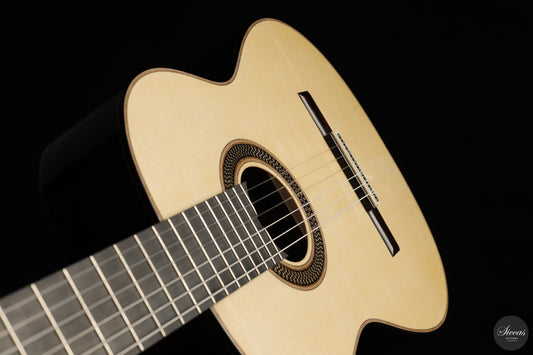
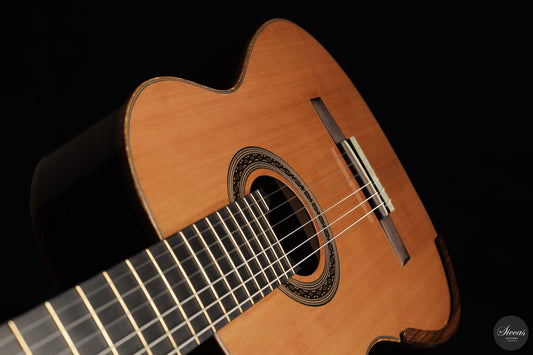
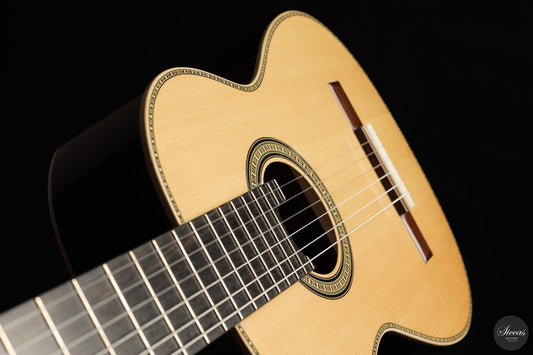
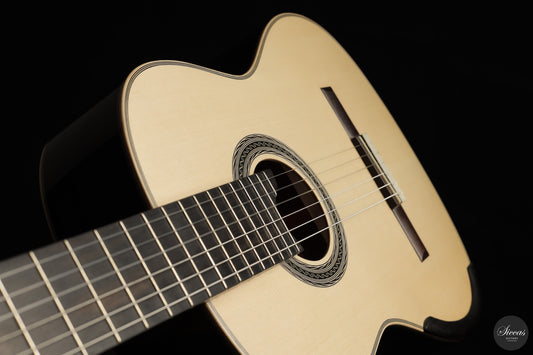
- Aesthetic and visual: Nylon-string guitars often have a visually distinctive character — cedar or spruce tops, fan-braced bodies, slotted headstocks — that communicates a different mood in a music video or on stage.
- Recording versatility: In the studio, producers frequently reach for a nylon-string guitar to add textural contrast to a track dominated by steel-string or electric tones.
If you are curious about how the tonal character of nylon-string guitars differs depending on the top wood, our comparison of spruce vs. cedar classical guitars breaks it down in detail.
The Classical Guitar World Taylor Swift's Fans Discover
One of the most common paths into classical guitar starts with a mainstream artist — the curiosity about a sound, a YouTube video, a mellow acoustic performance that sounds different from everything else. If Taylor Swift's occasional use of nylon-string instruments sent you down this path, you are in excellent company, and the destination is extraordinary.
The classical guitar tradition is one of the richest in all of acoustic music. Composers like Francisco Tárrega — who gave us Recuerdos de la Alhambra and Capricho Árabe — essentially defined the modern classical guitar language in the 19th century. Agustín Barrios took it to emotional and technical heights that still astonish listeners today. And Bach's lute works transcribed for guitar represent some of the most intellectually satisfying music ever written for any instrument.
If you are wondering how long it takes to get started, our article on how long it takes to learn classical guitar gives an honest, encouraging overview. The short version: you can play genuinely beautiful pieces within months, even as a complete beginner.
Choosing Your First Classical Guitar
If Taylor Swift's aesthetic — intimate, warm, acoustic — resonates with you, and you want to explore the instrument properly, a classical or nylon-string guitar is the right starting point. Here is what to consider:
Budget and Build Quality
Entry-level classical guitars start from a few hundred euros/dollars and scale up to hand-made concert instruments worth tens of thousands. For a beginner, a solid top instrument in the mid-range offers excellent tone and playability. Our classical guitar collection covers a range of levels and makers.
Top Wood: Spruce or Cedar?
The soundboard (top) wood is the single most important tonal choice. Cedar tops respond quickly and warm immediately — great for fingerstyle and more intimate playing. Spruce tops are brighter and more dynamic, rewarding players who develop technique and projection over time. Browse our spruce top guitars and cedar top guitars to compare.
Standard vs. Double-Top
For players who want exceptional volume and tonal complexity at lower weight, double-top guitars (featuring a sandwich of two thin wood layers with a Nomex honeycomb core) are increasingly popular among concert players and serious amateurs. See our double-top guitar collection for options.
The Surprising Truth About Taylor Swift and Classical Guitar
So: does Taylor Swift play classical guitar? Not in the formal, trained sense. She is a singer-songwriter who uses guitars — primarily steel-string acoustics and electrics — as tools for her songwriting, and occasionally reaches for a nylon-string instrument when the sound calls for it. She is not performing Tárrega études or Bach chaconne transcriptions, and she would not claim to be a classical guitarist.
But the more interesting truth is this: the same family of instruments she occasionally uses is the entry point to one of music's deepest and most rewarding traditions. The nylon-string guitar bridges pop and folk songwriting on one side and centuries of serious concert repertoire on the other. That bridge is worth crossing.
Whether you arrived here as a Taylor Swift fan or a curious guitar enthusiast, the classical guitar world has something remarkable waiting. Explore our collection of classical guitars, read about the history and evolution of the classical guitar, and discover why players around the world are drawn to this instrument for life.