Sergei Gudelev and Vasiliy Romanov playing Night Club 1960 by Astor Piazzolla

Gudelev and Romanov Play Piazzolla’s Night Club 1960

← All Works

Sergei Gudelev and the flautist Vasiliy Romanov play Night Club 1960, the third movement of Astor Piazzolla's Histoire du Tango. The recording was made for our Siccas Media programme.

About Histoire du Tango

Piazzolla wrote Histoire du Tango in 1986 for flute and guitar, and built it as a history lesson in four movements. Bordel 1900 opens in the brothels where the tango began. Café 1930 moves it into the cafés, where people had started listening rather than dancing. Night Club 1960 arrives at the moment the tango met bossa nova and jazz, and Concert d'aujourd'hui ends in the concert hall.

Night Club 1960 is the movement most often taken out of the set, and it is easy to hear why. The rhythm has the drive of a dance, the harmony has the colour of a jazz standard, and the writing gives the flute long singing lines over a guitar part that has to be accompaniment, bass and percussion at once. The piece sounds free; it is not. Every rubato has to be agreed between two players who cannot see the same page.

For the guitarist the movement poses a problem of role. In a duo with a wind instrument the guitar is always at a disadvantage in sustain, and the writing does nothing to protect it: the flute can hold a note indefinitely while the guitar has to suggest that it is doing the same. The answer is not more volume but better timing — placing the bass so that the harmony arrives exactly when the line needs it.

About Astor Piazzolla

Piazzolla spent his life being told that what he wrote was not tango. He had studied with Nadia Boulanger in Paris, played bandoneón in Buenos Aires dance orchestras, and built from both a music that borrowed counterpoint from one world and rhythm from the other. Guitarists came to his work late, and now play it constantly. Our portrait of Astor Piazzolla follows that career, and our Piazzolla repertoire guide collects the pieces most often played on guitar.

The Guitar

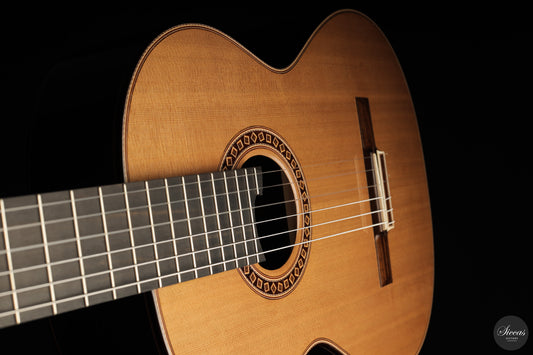
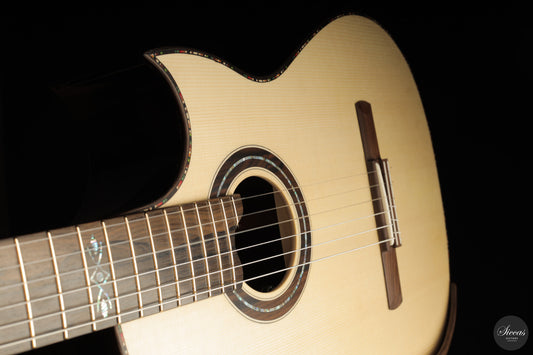
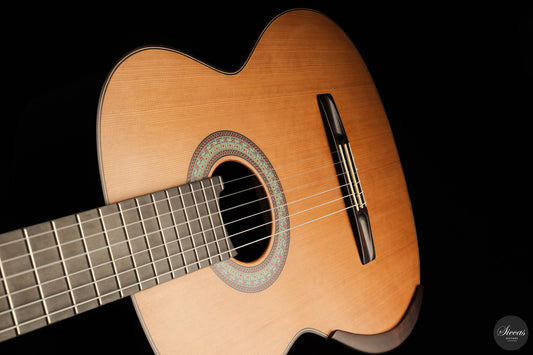
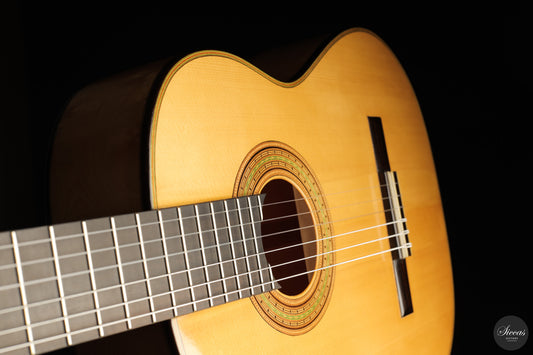
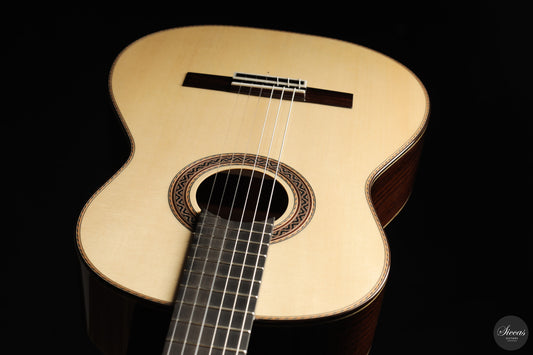
Gudelev plays an instrument by Vladimir Druzhinin, a maker whose guitars are built for exactly this kind of chamber music: enough projection to hold its own against a flute, and enough definition in the bass to carry a rhythmic figure without turning muddy. Our portrait of Vladimir Druzhinin introduces his work, and you can see the available instruments in our Druzhinin collection.

Watch the Performance


Browse the repertoire in our overview of famous classical guitar pieces, or meet more players in our list of great classical guitarists.

The Library
  • Classical Guitars

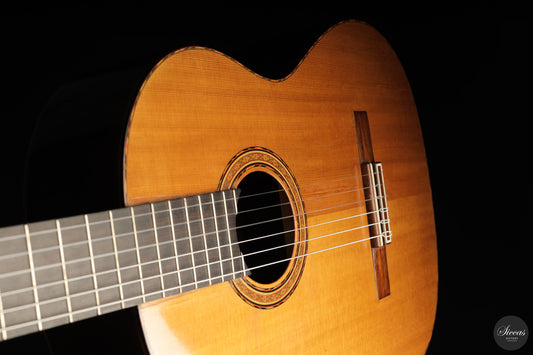
    The classical guitar, with its soft nylon strings and characteristic timbre, has become a symbol of chamber music, Spanish tradition, and concert repertoire. Its modern form was shaped by Antonio de Torres in the 19th century, setting the standard for the body, fan bracing, and the 65-centimeter scale length that are still used today. Instruments in this category open up a rich palette from the refined Romantic miniatures of Tárrega to the majestic concertos of Rodrigo. Here you will find guitars that preserve historical continuity and at the same time inspire new interpretations.
    Explore all classical guitars
  • Construction Year: 1964
    Construction Type: Traditional
    Top: Spruce
    Back and Sides: Brazilian rosewood (CITES certified)
    Soundboard Finish: French polish
    Body Finish: French polish
    Air Body Frequency: G sharp / A
    Weight (g): 1490
    Tuner: Fustero
    Condition: Very good
  • Luthier: Friederike Linscheid
    Construction Year: 2026
    Construction Type: Double-Top Guitars
    Top: Cedar
    Back and Sides: Indian rosewood
    Soundboard Finish: French polish
    Body Finish: French polish
    Air Body Frequency: F sharp
    Weight (g): 1640
    Tuner: Klaus Scheller
    Condition: New
  • Luthier: Martin Bretscher
    Construction Year: 2026
    Top: Spruce
    Back and Sides: Ziricote
    Soundboard Finish: Uv-cured finish
    Body Finish: Uv-cured finish
    Air Body Frequency: A
    Weight (g): 1860
    Tuner: Rubner
    Condition: New
  • Luthier: Simon Marty
    Construction Year: 2026
    Top: Cedar
    Back and Sides: Madagascar rosewood
    Soundboard Finish: Lacquer
    Body Finish: Lacquer
    Air Body Frequency: G / G sharp
    Weight (g): 2185
    Tuner: Gilbert
    Condition: New
  • Luthier: Davide Scacchi
    Construction Year: 2026
    Construction Type: Traditional
    Top: Spruce
    Back and Sides: Birdseye Maple
    Soundboard Finish: French polish
    Body Finish: French polish
    Air Body Frequency: F sharp
    Weight (g): 1240
    Tuner: Perona
    Condition: New
  • Manufacturer: Siccas Luthiers
    Manufacturer: Siccas Luthiers
    Construction Type: Traditional
    Construction Type: Traditional
    Top: Spruce
    Back and Sides: Indian rosewood
    Soundboard Finish: Polyurethane
    Body Finish: Polyurethane
    Air Body Frequency: F / F sharp
    Weight (g): 1500
    Tuner: Der Jung
    Condition: New

Exclusive Offers and Insights

Stay in tune with exclusive updates and offers from Siccas Guitars! Subscribe to our weekly newsletter and be the first to hear about new arrivals, special promotions, and expert insights into guitar craftsmanship. Enter your email below to join our community.