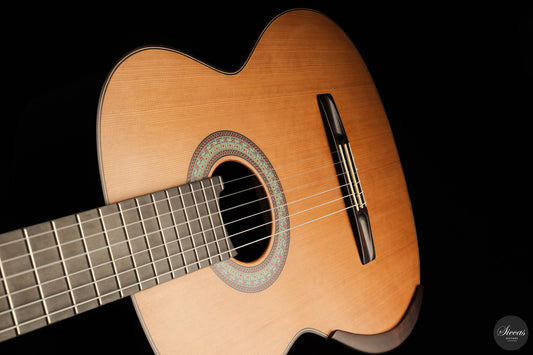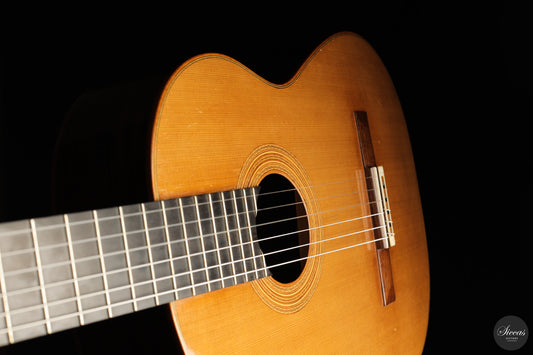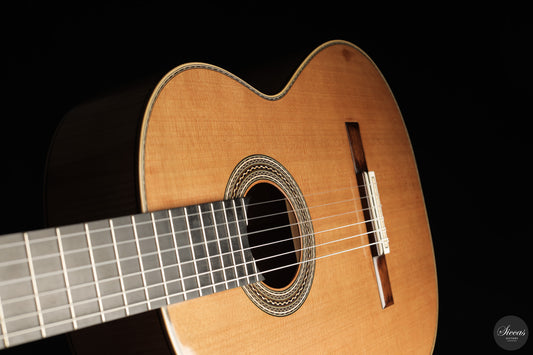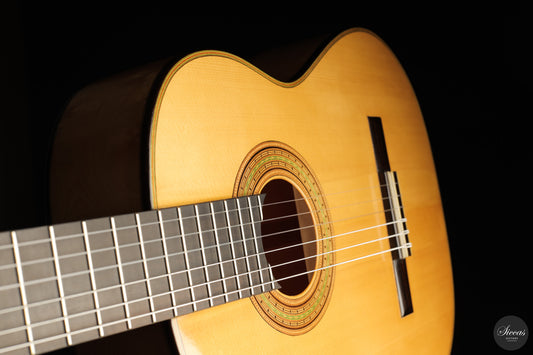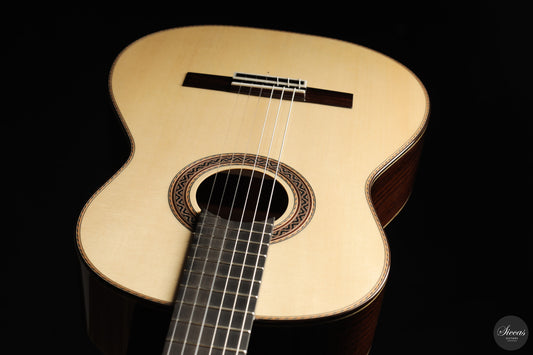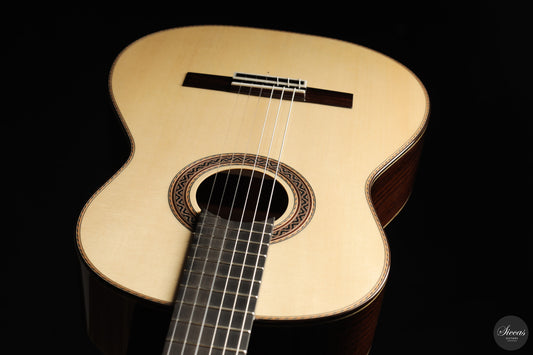

Hernandez y Aguado, 1973, Nr. 448 — A Great Guitar and Its Extraordinary History
For more than two decades, two friends built classical guitars of exceptional quality in a small workshop in the heart of Madrid. Manuel Hernandez (1895–1975) and Victoriano Aguado (1905–1985) worked side by side in the Torres tradition, producing instruments that were played by leading performers of the twentieth century and are now sought after by collectors and serious players around the world. Guitar No. 448, completed in 1973, represents the late period of their collaboration — an instrument made when both men had reached the height of their craft, shortly before the partnership would be dissolved by age and infirmity.
The story of Hernandez y Aguado is inseparable from the story of Madrid guitar-making in the twentieth century, and from the larger tradition of Spanish lutherie that stretches back through Manuel Ramírez and Santos Hernandez to Antonio de Torres himself. Understanding the guitar means understanding the men who made it and the tradition they worked within. Browse the classical guitar collection at Siccas Guitars to see fine instruments from the great Spanish and international makers.
Two Friends and a Workshop in Madrid
Manuel Hernandez was born in 1895 and Victoriano Aguado in 1905. The two men met while working together in a piano factory and formed a friendship that would eventually lead to one of the great partnerships in twentieth-century lutherie. They established themselves initially as furniture restorers before turning, in the mid-1950s, to guitar making — a late beginning for a craft that typically demands decades of apprenticeship, and one that makes their subsequent achievement all the more remarkable.
Their workshop was located in the Rastro district of Madrid, at Ribera de Curtidores 9 — a street in one of the most characterful quarters of the old city. The Rastro is Madrid's famous flea market district, a place of artisans and dealers and restorers, and it was entirely fitting that two craftsmen of their temperament should work there. The location placed them at the heart of a city and a culture that had been central to classical guitar development since the nineteenth century.
The Torres Tradition in Madrid
Against the prevailing fashion in Madrid — where, by the early 1960s, heavier cedar-top guitars had become predominant — Hernandez and Aguado chose to follow the older tradition of instruments as built by Manuel Ramírez (1866–1916) and Santos Hernandez (1874–1943). This was a deliberate artistic statement. The cedar-top guitar, associated with a warmer and more immediately gratifying sound, had become commercially dominant. But Hernandez and Aguado held to the lighter, more transparent construction methods of the Torres school — spruce tops, careful bracing, a sound that required patience to develop but rewarded that patience with exceptional tonal depth and projection.
Their guidance came from distinguished sources. The great virtuoso Regino Sainz de la Maza — one of the most celebrated Spanish guitarists of the twentieth century, for whom Manuel de Falla's Homenaje was premiered by Miguel Llobet in 1921 — was among those who provided information and direction to the workshop. Modesto Borreguero, who had been the youngest member of the Ramírez workshop, brought direct continuity with the Ramírez tradition. Through these connections, Hernandez and Aguado were linked to the most important lineage in twentieth-century Spanish lutherie.
Division of Labour and Artistic Integrity
Within the partnership, the two men divided their responsibilities clearly. Manuel Hernandez handled the structural construction of the instruments — the joinery, the bracing, the assembly. Victoriano Aguado was responsible for the varnishing, the decorative inlay work, and the finishing of the instruments. This division of labour reflected their individual skills and temperaments, and it produced guitars that were cohesive artistic objects: structurally sound and acoustically refined, finished with the decorative care that distinguishes the finest Spanish luthiery.
The quality of their output was recognised quickly by the performing world. Their instruments were played by top performers of the mid-twentieth century, and the workshop received orders from across the world — a remarkable achievement for two men who had come to lutherie late and worked in a small workshop without institutional support or industrial methods.
The End of the Partnership
Around 1970, Victoriano Aguado was forced to give up his work. Diabetes had caused problems with his eyes and legs that made the precise, detailed work of varnishing and decorating guitars impossible to continue. His departure removed the finishing half of the partnership at a stroke. Manuel Hernandez, faced with a full order book and the absence of his essential collaborator, needed to find a new working arrangement.
Hernandez's son-in-law, Jesús Belezar, had been working with both men since the late 1960s. After Aguado's departure, Belezar took a different direction and went independent. Hernandez continued working, taking on a new collaborator, and it was in this late period — after 1970, when the original partnership had effectively ended — that Guitar No. 448 was made, in 1973.
Guitar No. 448: A Late Masterwork
The number 448 tells us something important: this was a guitar made at the end of a long productive run, by a maker who had spent nearly two decades developing and refining his craft. The late-period instruments of Hernandez y Aguado are among the most treasured because they represent the fullest development of the workshop's artistic and technical approach. By 1973, Manuel Hernandez was seventy-eight years old — in the final years of his working life. The guitar he produced that year embodies a lifetime of accumulated skill and artistic judgement.
The construction follows the Torres tradition that defined the workshop's approach: a light, responsive instrument built for tonal depth and projection rather than the immediate warmth of the cedar-top guitars that dominated the market. More than fifty years after its completion, Guitar No. 448 has passed through the critical window of acoustic development described above, and its tonewoods have reached the crystallised, matured state that only decades of good playing can produce.
Historical Significance and Collecting
Hernandez y Aguado guitars occupy a distinctive position in the collecting world. They are not as widely known outside specialist circles as the great names of the Granada school — Hauser, Fleta, Romanillos — but among players and collectors who have played them, they command deep respect. Their rarity relative to their quality makes them genuinely sought after. Manuel Hernandez died in 1975, only two years after Guitar No. 448 was completed; Victoriano Aguado died in 1985. The workshop's entire output spans roughly two decades, limiting the total number of instruments in existence.
For a player seeking a genuine masterwork of twentieth-century Madrid lutherie — an instrument built in the direct tradition of Torres and Ramírez, by craftsmen of verified skill and artistic integrity — a Hernandez y Aguado guitar represents one of the finest options available. The instruments carry their history in the wood: the tradition they embody, the performers who played them, the city where they were made.
Frequently Asked Questions
Who were Hernandez y Aguado?
Manuel Hernandez (1895–1975) and Victoriano Aguado (1905–1985) were Madrid guitar makers who built classical guitars in the Torres tradition from the mid-1950s until around 1973, when age and illness ended their collaboration.
What makes their guitars distinctive?
They followed the older Torres/Ramírez school of construction rather than the heavier cedar-top fashion of the 1960s, producing instruments valued for tonal depth, projection, and refinement of finish.
Why is Guitar No. 448 significant?
It dates from 1973, the late period of the collaboration, made when Manuel Hernandez had nearly two decades of lutherie experience behind him. It represents the workshop at full maturity and is now acoustically fully developed after more than five decades of age.