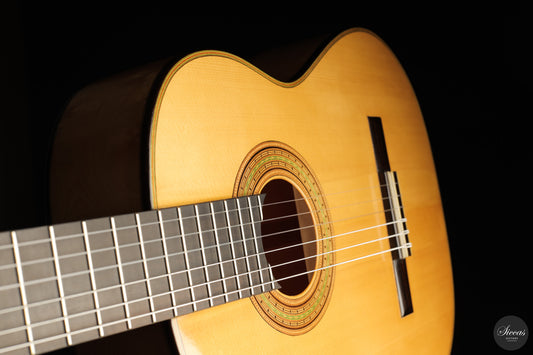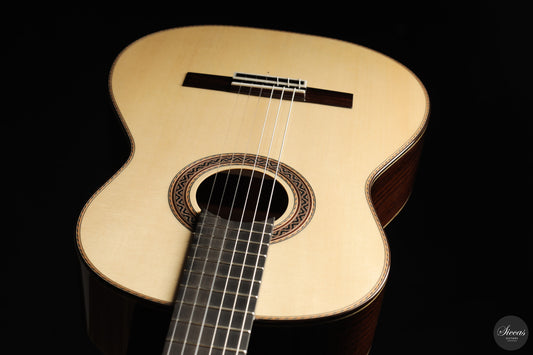

Justin Chen plays Capricho de Goya No. 18 by Mario Castelnuovo-Tedesco on a new 2026 Adrian Heinzelmann concert guitar.
About the Caprichos de Goya
Castelnuovo-Tedesco wrote his 24 Caprichos de Goya for Andrés Segovia, taking Francisco de Goya's series of etchings as his starting point. Each piece responds to one image — and Goya's Caprichos are not decorative. They are satirical, often grotesque, and occasionally frightening, and the music follows them there rather than smoothing them over.
That is what makes the cycle difficult beyond its notes. A player has to commit to a character that may be unpleasant, and hold it. Phrases break off; textures turn harsh where a guitarist's instinct is to make them beautiful. The pieces work when that instinct is resisted.
The complete cycle is rarely performed in one evening, so most listeners meet it through individual numbers. You can hear a different reading of this one in our article on Vasilina Shashkova playing Capricho de Goya No. 18 — the same text, two temperaments.
No. 18 belongs to the darker half of the set. The writing keeps returning to the same gesture from slightly different angles, so the effect accumulates rather than develops, and the ending offers no resolution of the kind the cycle's lighter numbers allow.
About Mario Castelnuovo-Tedesco
Castelnuovo-Tedesco met Segovia in 1932 and wrote for the guitar for the rest of his life, eventually producing more music for the instrument than almost any other composer of his generation. Forced to leave Italy in 1939, he settled in Los Angeles, worked in film and taught a generation of composers there. Our portrait of Mario Castelnuovo-Tedesco follows that life, and our repertoire guide collects the guitar works.
The Guitar
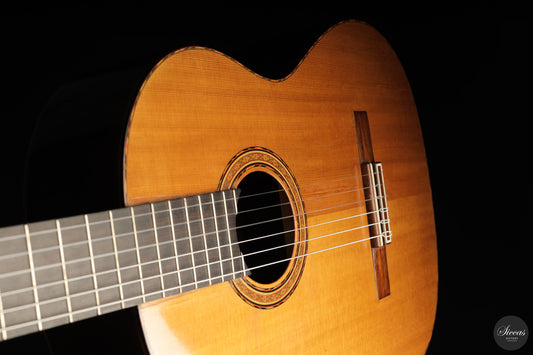
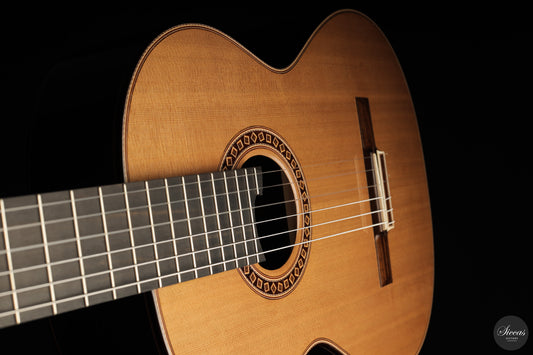
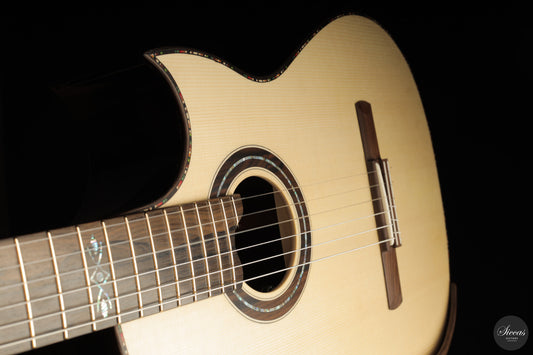
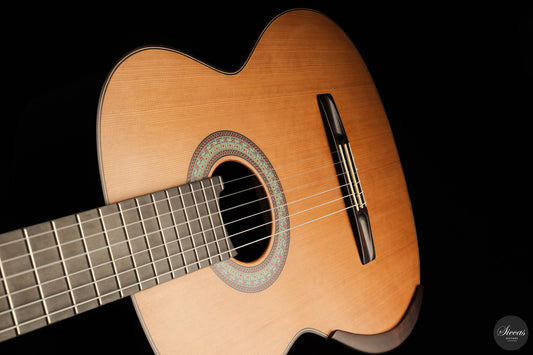
The Adrian Heinzelmann 2026 has a cedar top in French polish over Indian rosewood, a 650 mm scale, a 52 mm nut and tuners by Kris Barnett. What defines it is the soundboard: Heinzelmann's Groove Bracing cuts narrow parallel channels inside the cedar top to control weight and flexibility, and combines them with a lightweight lattice structure. The result is a sensitive instrument with strong volume that stays clear under pressure — useful in music that asks for sudden changes of colour and attack. Our portrait of Adrian Heinzelmann describes his work.
Watch the Performance
You can hear Justin Chen in different repertoire in our article on his performance of Brouwer and a Toby Rzepka sonata, and browse more works in our overview of famous classical guitar pieces.