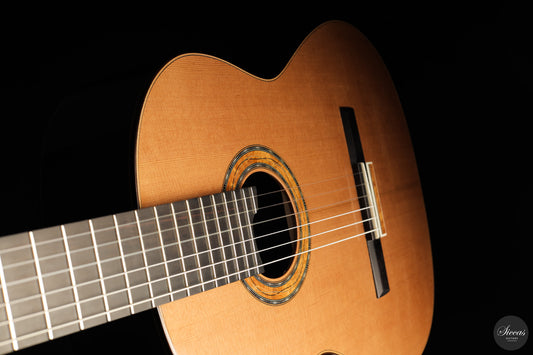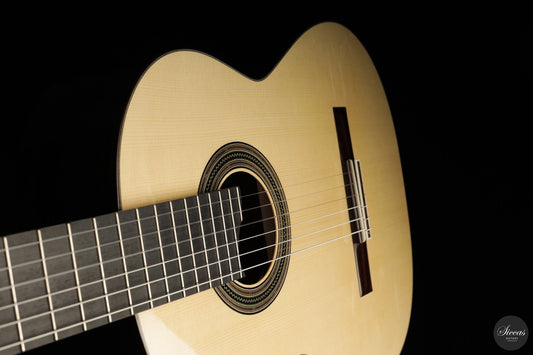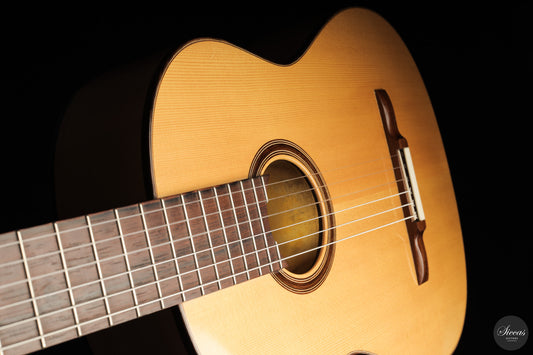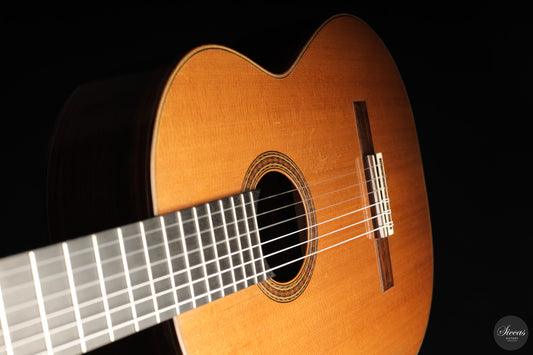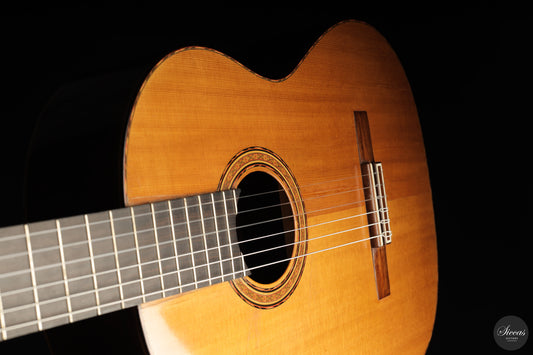

Marcin Dylla plays Capricho Árabe by Francisco Tárrega, and he plays it on six different classical guitars. The idea is as simple as it is revealing: the same player, the same piece, the same room, and only the instrument changes.
The Six Guitars
Marcin Dylla plays the piece on these six instruments, in this order.
- 1964 Manuel de la Chica (guitars by Manuel de la Chica)
- 1996 Ignacio Fleta e hijos (about Ignacio Fleta)
- 2014 Roy Fankhänel (about Roy Fankhänel)
- 2014 Bernd Holzgruber, double top
- 2014 Keijo Korelin, double top (about Keijo Korelin)
- 1999 Ignacio Fleta e hijos
The selection spans half a century. There is a Spanish guitar from the 1960s, two instruments from the Fleta workshop in Barcelona built three years apart, and three guitars from 2014, two of them double tops. The two Fletas are a comparison of their own, the same workshop and almost the same years, and still two individual voices.
Why Compare Guitars This Way
Descriptions of guitar sound quickly run out of words. Warm, bright, focused, round: every maker and every dealer uses the same handful of adjectives. A direct comparison does what words cannot. When one player moves from guitar to guitar within a single piece, the differences in colour, sustain, balance between bass and treble and speed of response become audible in a way that no list of woods or measurements can convey.
It also shows something less obvious. A great player adapts to each instrument within seconds, and part of what you hear is that adaptation: a slightly different touch, a different weight in the right hand, phrasing that follows what the guitar offers. The comparison is never only about the guitars.
What to Listen For
Listen first to the bass. In the introduction the low strings carry long notes, and some guitars let them ring with a deep, round body while others give a drier, more defined attack. Then follow the melody in the upper register: how long does a note sustain before it fades, and does the treble stay sweet or turn thin when the playing gets louder? Finally, notice how quickly each guitar responds to small changes of touch. Those three things, bass, sustain and response, tell you more about an instrument than any description.
About Capricho Árabe
Capricho Árabe is one of Tárrega's best-known works and one of the most direct evocations of Moorish Spain in the guitar repertoire. A free, almost improvised introduction leads into a melody in D minor with an unmistakably Arabic colour, carried over a gently moving accompaniment. It is a piece about atmosphere and line, which makes it an ideal test of how a guitar sings. Our article on Capricho Árabe explores the work in depth, and our portrait of Francisco Tárrega introduces the composer.
About Marcin Dylla
The Polish guitarist has won nineteen first prizes at international competitions, among them the Gold Medal at the 2007 Guitar Foundation of America International Competition in Los Angeles, one of the most important contests for classical guitarists. Since then he has performed widely in Europe and North America. Our portrait of Marcin Dylla tells more about his career.
Watch the Comparison
If you want to understand why guitars sound so different, our guides to spruce versus cedar and to fan-braced, double-top and lattice construction explain the main factors. Browse our current range of classical guitars.