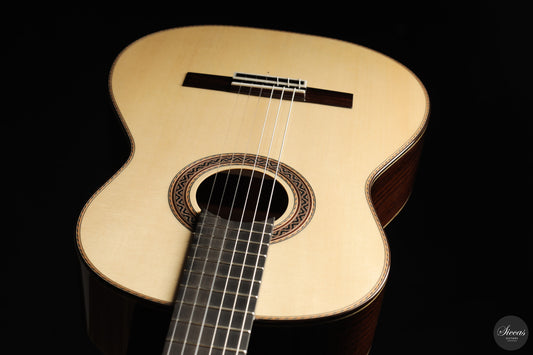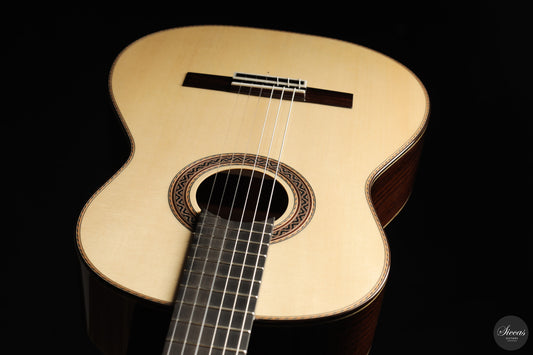

Philip Woodfield — A British Master of the Classical Guitar
From a workshop in East Sussex, Philip Woodfield has spent more than three decades quietly building some of Britain's most admired classical guitars — instruments that combine meticulous handcraft with a thoughtful approach to both traditional and modern construction. His work represents a significant strand in the history of English lutherie, part of a tradition that includes José Romanillos and a small number of other makers who brought serious classical guitar craftsmanship to Britain in the late 20th century.
A Lifetime in Wood
Woodfield has loved fine woodworking since childhood, and his career as a luthier has been built on that deep, sustained engagement with material. Over more than thirty years he has built more than 350 instruments. His method is deliberately hands-on: he works mainly with traditional hand tools and finishes in French polish, seeking a personal connection with each guitar rather than a production-line approach. His eye for tonewood is famously exacting — only a small fraction of the wood he examines ever meets his standard for a guitar top or back.
This unhurried, attentive approach to making is what distinguishes his instruments. A guitar built this way carries the maker's judgement in every decision — not just in the visible dimensions but in the thickness of the soundboard, the weight of the bracing, the height of the bridge, the density and figure of each piece of wood selected.
Traditional and Modern Construction
Woodfield builds both fan-braced and lattice-braced instruments. His Torres-influenced fan-braced models carry the classical warmth and responsiveness of the Spanish tradition; his lattice-braced guitars offer the greater power and clarity that modern lattice construction brings, while retaining what Woodfield has described as a traditional look, feel, and voice.
The lattice-braced guitar — a construction developed and refined primarily by Australian luthiers from the 1970s onward — replaces the traditional wooden fan struts under the soundboard with a grid of carbon fibre or spruce, allowing the top to be made thinner and therefore more responsive. The result is typically more volume and a brighter, more focused tone. Woodfield's interest in this design while maintaining the visual and tactile qualities of a traditional instrument is a distinctly British balance: innovation in service of continuity.
Part of English Lutherie Tradition
The English classical guitar making tradition has a small but distinguished history. José Romanillos — the Spanish-born luthier who settled in England and became one of the most celebrated makers of the 20th century, building instruments for Julian Bream — is its most famous figure. But around Romanillos and following him, a number of English-trained and English-based makers developed their own voices within the classical guitar tradition. Woodfield is among the most significant of his generation.
Building fine concert guitars in England presents particular challenges: the climate differs significantly from Spain, requiring careful attention to humidity control both during construction and in the finished instrument's care. Woodfield's long experience addresses these practical realities, producing instruments that are stable and durable as well as beautiful in tone.
Instruments at Siccas Guitars
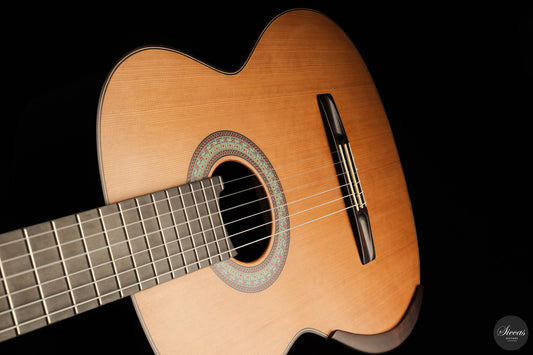
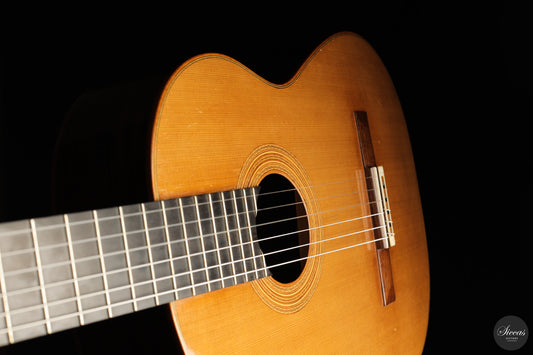
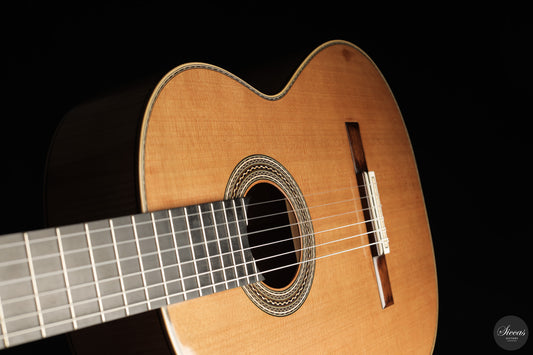
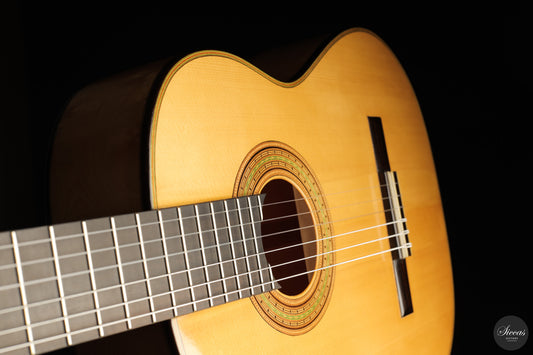
Siccas Guitars includes instruments by Philip Woodfield in its collection of concert-quality classical guitars. Each instrument represents Woodfield's careful, individualistic approach to making — no two are identical. For a player looking for a guitar built with the standards of the English handcraft tradition, his instruments offer a distinctive alternative to Spanish-school instruments.
Both his fan-braced and lattice models appear in the collection. Players comparing the two should attend to the tonal character each brings: the fan-braced guitar will feel and sound more traditional; the lattice will project with more force and clarity. Both are built to concert standard.
The Case for English-Made Concert Guitars
The classical guitar is so deeply associated with Spain that instruments made elsewhere sometimes attract less attention than they deserve. The great French makers of the 20th century — Robert Bouchet and Daniel Friedrich among them — established that exceptional concert guitars could be built outside the Spanish tradition. English makers working in the same tradition have built on this understanding.
A Woodfield guitar is not trying to be a Granada guitar. It draws on the same Torres inheritance, applies it with the same seriousness of purpose, but brings the particular sensibility of an English craftsman — an attention to subtlety and restraint that complements rather than competes with the more extrovert character sometimes associated with Spanish instruments. For players whose repertoire includes music calling for those qualities, Woodfield's instruments can be a very good match.
Careful Construction
The process of building a Woodfield guitar begins with wood selection. He works with traditional tonewoods — spruce and cedar for soundboards, rosewood and similar for back and sides — selecting each piece by hand for figure, density, stiffness, and tap tone. The top is graduated by hand to the right thickness in each zone, tested repeatedly by touch and ear as the graduation proceeds. The bracing is fitted and shaped, then voiced further after the box is assembled.
French polishing — the application of many thin layers of shellac-dissolved resin by hand — is among the most demanding of the finishing crafts. Woodfield's commitment to this method rather than faster modern lacquers is both an aesthetic choice and a practical one: French polish is thinner and harder than most modern finishes, allowing the wood to vibrate more freely and age more naturally. The resulting instruments improve with playing over the years, a quality well-established in fine handmade guitars.
FAQ
Who is Philip Woodfield?
A British luthier based in East Sussex, England, known for finely handcrafted classical guitars built primarily by hand using traditional methods. He has built over 350 instruments in more than three decades.
What kind of guitars does he build?
Both traditional fan-braced instruments and modern lattice-braced classical guitars, all finished in French polish. His work is available through Siccas Guitars.
How does English lutherie differ from the Spanish tradition?
English makers work within the same Torres-derived tradition but bring different sensibilities and must address a different climate. The results are often characterised by particular attention to subtlety and craftsmanship detail.
Are lattice-braced guitars better than fan-braced?
Neither is universally better. Lattice construction offers more volume and projection; fan bracing provides a warmer, more traditional response. The best choice depends on the player's repertoire, technique, and venue.
Famous classical guitar pieces → · Browse our classical guitars · Great classical guitarists