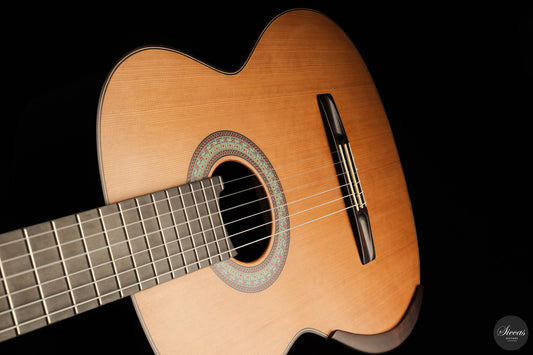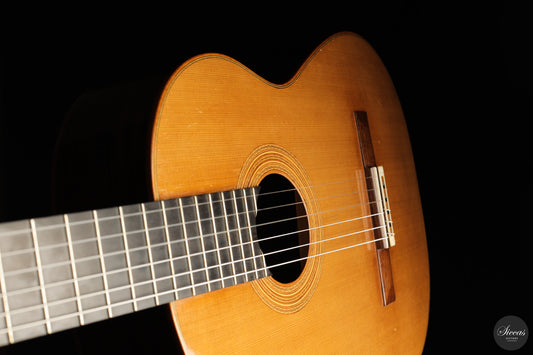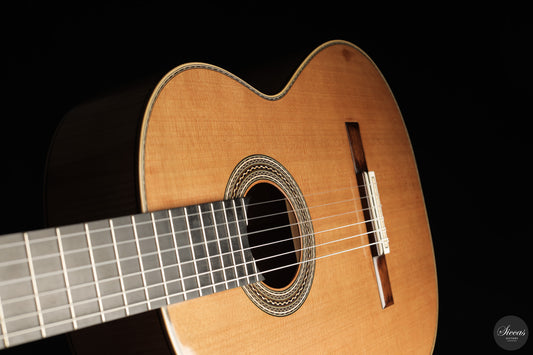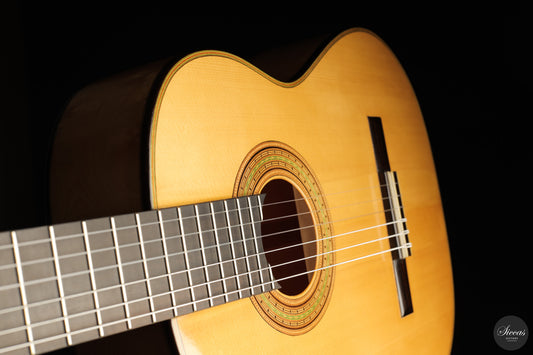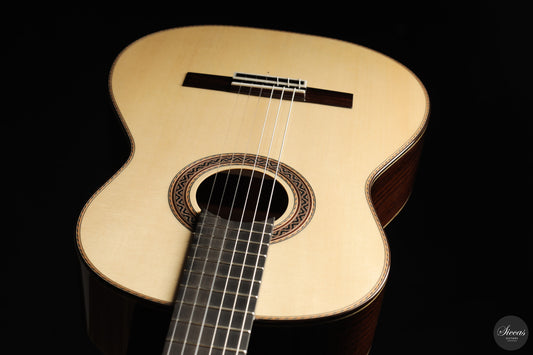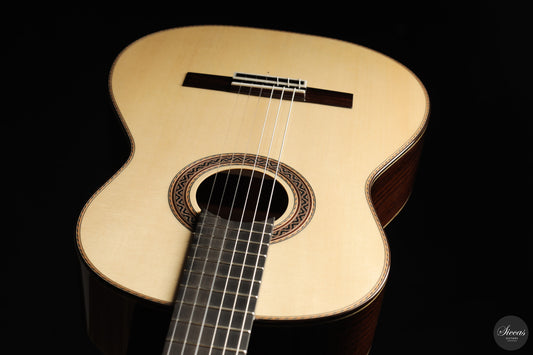

Germany's great contribution to the classical guitar is usually told through Hermann Hauser. But there is a second German name every collector should know: Richard Jacob, who signed his instruments with the old family trade-name Weißgerber. He was, by common consent, the most inventive and eclectic German maker of the twentieth century.
Born into the trade in Markneukirchen
Jacob was born on 11 February 1877 in Markneukirchen, the Saxon town that has been a centre of German instrument making for centuries. He was the son of guitar maker Karl August Jacob and grew up surrounded by finely decorated instruments. He first learned zither making, then served his guitar apprenticeship from 1899 to 1905 under Wilhelm Voigt, and in 1905 opened his own workshop. In 1921 he registered the trademark "Weißgerber" — the name by which his guitars have been known ever since.
The Spanish turn
Early Weißgerber guitars followed the popular Viennese style of the day. Then came two visits that changed everything: in 1921 the great Catalan virtuoso Miguel Llobet came to his workshop, and in 1924 Llobet returned with Andrés Segovia. Seeing their Spanish instruments — a Torres and a Manuel Ramírez — up close reoriented Jacob's work toward the Spanish ideal, and his finest guitars from then on blend that influence with his own restless imagination.
The most eclectic maker of his century
Over fifty-five years Jacob was astonishingly productive, building more than 3,700 instruments — not only concert guitars but vihuelas, baroque guitars, historical lutes and even an experimental double-soundboard guitar. He constantly varied his models, shapes and decoration, so that hardly any two Weißgerber guitars are exactly alike. That endless invention is precisely what makes his work so collectible.
His legacy
Weißgerber guitars were played by leading German players such as Heinz Teuchert, Karl Scheit and Siegfried Behrend. Jacob worked to the very end, completing three guitars in his final year at the age of 83. He died in Markneukirchen on 17 July 1960; his son Martin carried the workshop on until 1990.
FAQ
Who was Richard Jacob "Weißgerber"?
A German master (1877–1960) from Markneukirchen who signed his guitars "Weißgerber" and is considered the most inventive German maker of the twentieth century.
Why is the name "Weißgerber" on the guitars?
It was the family trade-name, which he registered as a trademark in 1921.
What influenced his style?
Visits from Miguel Llobet (1921) and Llobet with Segovia (1924) turned his work toward the Spanish Torres ideal.
More great Gitarrenbauer → · Browse our classical guitars
A short overview with the key questions answered. The full portrait is in Richard Jacob Weissgerber: The Most Versatile Guitar Maker of the 20th.