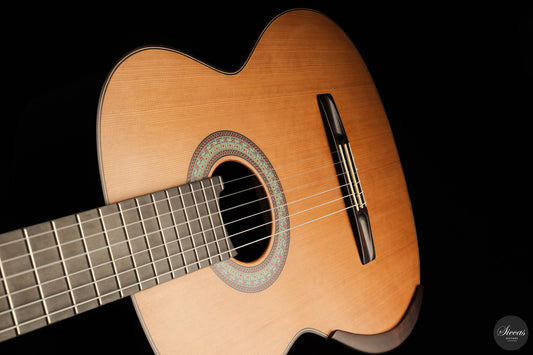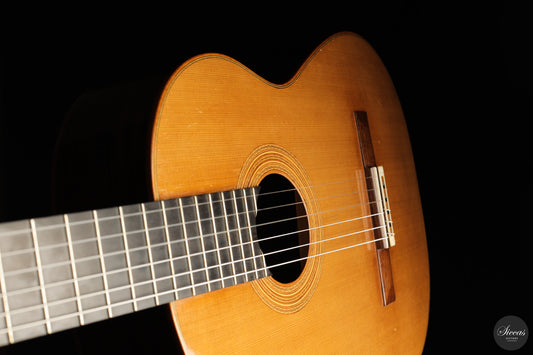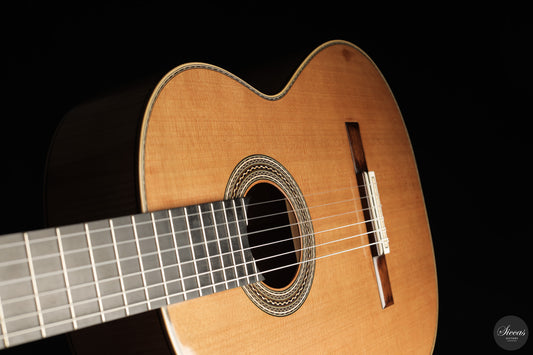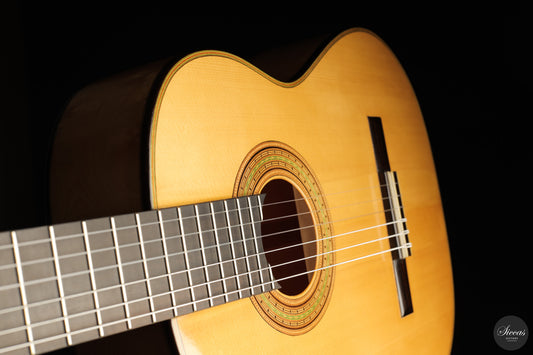

Few stories in lutherie are as unlikely as that of Robert Bouchet. He was a respected Paris painter who did not build his first guitar until he was forty-eight — and yet he became one of the greatest makers of the twentieth century and the founding father of the French school of guitar making.
A painter first
Bouchet was born in Paris on 10 April 1898. For the first half of his life his art was the brush, not the plane: he exhibited at the Salon des Tuileries and the Salon d'Automne and was a genuine figure in the Paris art world. In the mid-1930s he grew fascinated by the guitar's construction while visiting the workshop of the Spanish maker Julián Gómez Ramírez. When his own guitar was stolen during the war, he resolved to build a replacement, and in 1946 he completed the instrument that would remain his personal guitar for life.
Quality over quantity
Bouchet built only around 154 instruments in total — a tiny output by any standard — yet each was finished with a painter's eye for proportion and detail. That scarcity, paired with their beautiful, refined voice, is exactly why a genuine Bouchet is among the most treasured of all classical guitars today.
The Bouchet bar
His most lasting technical legacy is a small but influential idea: in the mid-1950s he added a transverse brace beneath the bridge, now known the world over as the Bouchet bar. It improved projection and steadied the soundboard's vibration, and makers have borrowed the idea ever since.
His influence
Bouchet's guitars were played by some of the finest musicians of the era — the celebrated duo Ida Presti and Alexandre Lagoya, the scholar-guitarist Emilio Pujol, Oscar Ghiglia, Turibio Santos and Julian Bream among them. His approach also shaped makers far beyond France; the great Granada master Antonio Marín Montero drew directly on Bouchet's templates and techniques. Robert Bouchet died in August 1986, aged 88, having changed his craft more than most makers who built ten times as many guitars.
FAQ
Who was Robert Bouchet?
A French painter turned luthier (1898–1986), regarded as the founding father of the French school of classical guitar making.
What is the Bouchet bar?
A transverse brace under the bridge he introduced in the 1950s to improve projection and stabilise the top — still used by makers today.
Why are his guitars so rare?
He built only about 154 instruments in his lifetime, which, with their refined sound, makes a genuine Bouchet highly prized.
More great Gitarrenbauer → · Browse our classical guitars
A short overview with the key questions answered. The full portrait is in Robert Bouchet: The Life and Legacy of a Master Luthier.