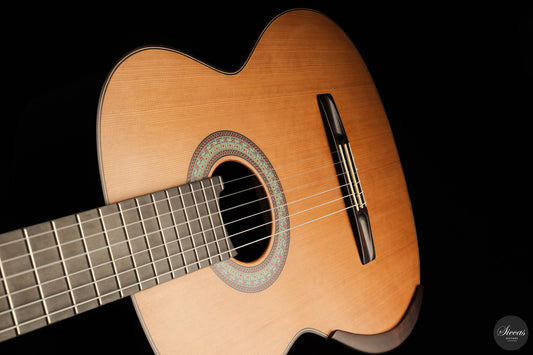
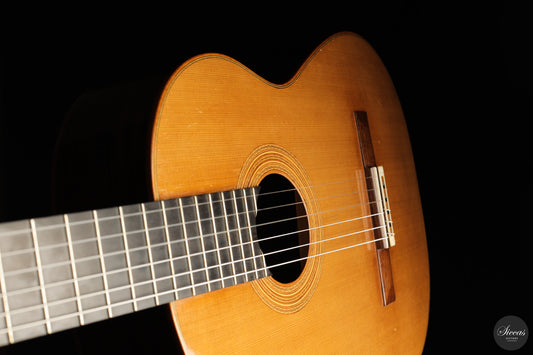
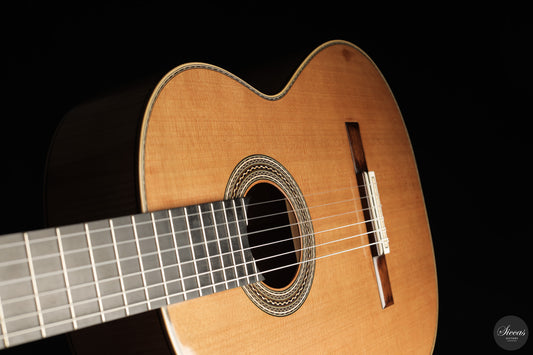
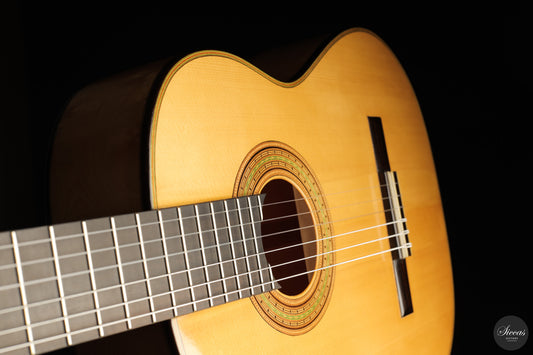
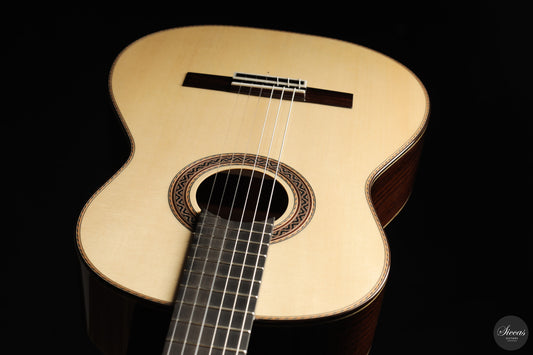
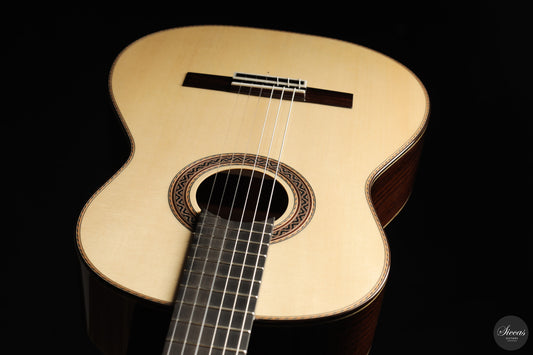
Few acoustic devices in the history of the classical guitar are as mysterious, misunderstood, and quietly compelling as the tornavoz. A small cylindrical or conical tube fitted inside the body beneath the soundhole, the tornavoz darkens the voice of the guitar, deepens its resonance, and lends an almost cavernous quality to the sound that has fascinated players and luthiers for over 170 years. Once a common sight on the finest concert instruments of the 19th century, the tornavoz fell out of use in the mid-20th century — only to experience a quiet but meaningful revival among historically minded luthiers and adventurous performers today.
What Is a Tornavoz?
The word tornavoz comes from Spanish and translates roughly as "turned voice" or "voice redirector." In practice, it is a tube — traditionally made from brass or bronze, though wood, paper-mâché, and modern carbon fibre have all been used — fitted to the underside of the guitar's soundhole and extending into the body of the instrument. The tube shares the same diameter as the soundhole and projects inward, functioning something like an inverted megaphone.
Rather than simply allowing sound to radiate freely outward through the soundhole, the tornavoz shapes and directs the internal air column. The result is a tonal character distinctly its own: a darker, more focused timbre with an extended sustain and a sense of depth that players often describe as the sound seeming to emerge from somewhere deep inside the instrument. The bass register in particular gains body and warmth, while the overall tone takes on a rounder, more intimate quality. Critics of the device sometimes note that it can add a slight metallic ring — a characteristic closely linked to the material used — but skilled luthiers have long known how to minimise this through careful fitting and material choice.
The material from which the tornavoz is made has a measurable effect on the result. Brass produces a bright, slightly metallic resonance; wood yields a warmer, more neutral contribution to the overall tone; and carbon fibre, favoured by some contemporary makers, offers rigidity with minimal colouration. The device must be secured firmly to the underside of the soundboard to provide the necessary damping and added stiffness, while still being free to contribute its own sympathetic vibration.
History and Origins
The tornavoz is almost inseparable from the name of Antonio de Torres Jurado (1817–1892), the Almería-born luthier widely regarded as the architect of the modern classical guitar. Torres established the proportions, bracing principles, and structural logic that virtually every classical guitar maker since has inherited. Among his many contributions, the tornavoz stands out as one of the most intriguing.
Of the 39 known instruments from Torres' first epoch of guitar making, 17 are fitted with a tornavoz. His earliest surviving example with the device is the guitar known as "La Leona" (FE 04), built around 1856 and now considered a landmark instrument in guitar history. Whether Torres invented the tornavoz outright or refined a pre-existing idea remains a matter of some discussion, but there is no doubt that he was its most influential early proponent. By his second epoch, however, Torres used the device far less frequently — only two of his 49 known second-epoch instruments include one — suggesting that his views on its acoustic merit shifted over time, or that changing player preferences played a role.
The great guitarists associated with Torres and his immediate successors did use tornavoz-equipped instruments. Julián Arcas, Francisco Tárrega, and Miguel Llobet — three of the most significant concert guitarists of the late 19th and early 20th centuries — are all known to have played on guitars fitted with the device. Their endorsement reflects how central the tornavoz was to the concert guitar world of that era.
As the 20th century progressed, the tornavoz gradually disappeared from mainstream guitar making. The shift to nylon strings in the late 1940s, changes in concert hall acoustics, and evolving tonal ideals all contributed to its decline. By mid-century it had all but vanished, surviving only in museum instruments and the memories of scholars. For a deeper look at the broader sweep of guitar-making tradition, the history of the Romantic guitar provides essential context for understanding why certain features thrived and others fell away.
How the Tornavoz Shapes the Sound
Understanding why the tornavoz produces the sonic effects it does requires thinking about how sound moves inside a guitar body. Normally, air vibrations generated by the moving soundboard radiate outward through the soundhole in a relatively undirected way. The tornavoz interrupts this process by channelling the internal air column through a defined tube before it exits the body. This focusing effect lengthens the acoustic path, increasing sustain and adding a sense of depth and projection.
The darker timbre that results is not simply a loss of treble energy — it is a genuine tonal shift, a quality that many players describe as a more "vocal" or "resonant" character. The impression, as one 19th-century observer noted, is that the sound seems to originate inside a hollow or cavernous chamber. For music that prizes depth of tone and expressive sustain over brilliance and attack, this quality can be extremely attractive.
It is worth noting that the tornavoz is not a volume amplifier in the modern sense. It does not make the guitar louder in any straightforward acoustic measurement. Its effect is primarily one of tonal character — shaping how the sound feels and how it projects in the room, rather than simply increasing its decibel output. This distinction matters when considering whether a tornavoz guitar is the right choice for a particular player or context.
Modern Revival and Today's Luthiers
The tornavoz never disappeared entirely; it simply retreated to the margins. In recent decades it has re-emerged on two distinct fronts: historically informed replicas of Torres-era instruments, and experimental additions to modern performance guitars.
Among contemporary luthiers, Wolfgang Jellinghaus stands out as one of the most committed advocates for the tornavoz in the present day. Working through his Milestones of Music project, Jellinghaus has built meticulous replicas of Torres instruments — including the FE 17 and the iconic La Leona FE 04 — fitted with tornavoz devices, making this historic sound accessible to today's players. Several of these instruments are available through Siccas Guitars, offering a rare opportunity to experience the tornavoz in a new, carefully crafted instrument rather than only in the archives.
On the performance side, the British guitarist Paul Galbraith has brought the tornavoz to wider attention through his use of a modified version on his eight-string guitar. Galbraith, who plays in an unusual upright cello-like position, found that the tornavoz helped enhance the bass response of his extended-range instrument. His collaboration with luthiers to develop and refine the device for his specific instrument sparked renewed discussion in the lutherie community about the tornavoz's acoustic potential.
The question of construction materials has also evolved. Where Torres used brass and later makers experimented with wood, today's luthiers work with carbon fibre and other modern materials that allow for greater consistency and reduced risk of unwanted resonance artefacts. The underlying principle, however, remains exactly what Torres explored in the 1850s.
Choosing a Guitar with a Tornavoz
If you are considering a tornavoz guitar, there are several practical questions worth thinking through. First, consider your repertoire and tonal ideals. The tornavoz suits players who value depth, warmth, and sustain over a bright or projecting modern sound. It tends to complement early repertoire — Renaissance, Baroque, and 19th-century music — particularly well, though its qualities are by no means limited to historical styles.
Second, consider the instrument's overall construction. A tornavoz is one element within a complex acoustic system. The bracing pattern, soundboard thickness, back and sides material, and scale length all interact with the device. Instruments built specifically around the tornavoz — as Torres-replica instruments by makers such as Jellinghaus are — will generally deliver a more coherent result than a standard guitar to which the device has been added as an afterthought. For a broader understanding of how bracing and construction choices shape tone, the guide to fan-braced, double-top, and lattice guitars is an excellent reference point.
Third, listen carefully. The tornavoz's effect is subtle enough that it can be missed in a brief trial, and striking enough that it divides opinion. Some players find it transformative; others find the darkening of tone too pronounced for their taste. If possible, play the same maker's instrument with and without the device to calibrate your own response.
For those drawn to the historical dimension of guitar making, a tornavoz instrument represents a living connection to the founding tradition of the modern guitar. The broader history of classical guitar makers shows how Torres' influence shaped every subsequent generation — and the tornavoz is one of the most tangible ways to hear that influence directly.
Frequently Asked Questions
Does a tornavoz make a guitar louder?
Not necessarily. Its primary effect is on tone colour rather than volume. It focuses and deepens the sound, producing a darker timbre and extended sustain, but it does not function as a simple amplifier.
Are tornavoz guitars harder to play?
No. The tornavoz affects the acoustic properties of the instrument but has no bearing on playability, string tension, or action. Playing a tornavoz guitar feels identical to playing a standard classical guitar of the same scale and setup.
Can a tornavoz be added to any classical guitar?
In principle, yes — the device can be fitted to many instruments. However, the results are most coherent when the guitar has been designed and voiced with the tornavoz in mind from the outset. Retrofitting can produce variable outcomes depending on the instrument's existing acoustic characteristics.
Who makes tornavoz guitars today?
Wolfgang Jellinghaus is among the most prominent contemporary makers offering tornavoz instruments. A number of historically oriented luthiers also build them on commission. Siccas Guitars carries a selection of tornavoz instruments, providing one of the most reliable ways to find and compare available examples.
Is the tornavoz associated with any particular playing tradition?
It is most closely associated with the Spanish guitar tradition of the 19th century, particularly the instruments and players connected to Antonio de Torres. However, modern players from a variety of traditions have found value in its tonal qualities, and it is not restricted to any single repertoire or style.
The tornavoz may be one of the quieter chapters in classical guitar history, but it is far from a minor one. In the hands of Torres, it helped define the sound of an era. In the hands of today's most thoughtful luthiers and performers, it continues to offer something genuinely distinctive — a reminder that the quest for the perfect guitar voice is as alive now as it was in 19th-century Almería. Explore the thinking of master luthiers to understand how this tradition of acoustic exploration has continued into the present day.