

Bertrand Ligier
-
Luthier: Bertrand Ligier
-
Luthier: Bertrand Ligier
-
Luthier: Bertrand Ligier
-
Luthier: Bertrand Ligier




Ask us - right here.
Enrico, our AI team member, replies around the clock.
Instant reply · free · no obligation Rather use WhatsApp
Frequently Asked Questions About Classical Guitars
How do I choose the right classical guitar for my level?
Choosing the right classical guitar depends on your playing level, musical goals, and budget. Beginners benefit from studio-model guitars from renowned workshops, while advanced players and professionals often choose a handmade master guitar. We are happy to advise you personally and can send detailed sound samples and videos on request.
What is the difference between a master guitar and a studio guitar?
Master guitars are built entirely by hand in the workshop of a single luthier, using only high-quality, well-aged tonewoods. Studio guitars are made in small series, often under the supervision of the master luthier, and offer excellent value for students and ambitious amateur players.
Can I try a classical guitar at home for 14 days?
Yes — every guitar you purchase from us comes with a 14-day home approval period. This complimentary trial applies worldwide to all orders, whether you are in Germany, Europe, the USA, Asia or anywhere else. We ship your instrument fully insured in a high-quality case so you can play it under your own acoustic conditions. If the guitar is not the right one for you, simply send it back and receive a full refund of the purchase price.
Can I try a classical guitar before purchasing?
Absolutely. You are warmly invited to visit our showroom in Karlsruhe, Germany, and test the instruments at your leisure. We are happy to schedule a personal appointment. If a visit is not possible, we send detailed videos and sound samples, and offer extensive consultation by phone or video call.
What payment methods and financing options do you offer?
We accept bank transfer, PayPal, major credit cards, and Klarna. For high-value instruments, we offer individual installment plans on request. Please contact us directly — we will find a suitable solution for every budget.
How do I properly care for my classical guitar?
A classical guitar requires constant humidity between 45 and 55 percent. Store the instrument in its case with a humidifier, avoid direct sunlight and large temperature fluctuations. Change the strings regularly and clean the guitar with a soft microfiber cloth.
You may also be interested Bertrand Ligier
About the Guitar Maker
Bertrand Ligier is a French luthier whose work represents a harmonious balance between art, craftsmanship, and acoustic science. After studying Art History at the University of Montpellier and Furniture Making at the École des Beaux-Arts Georges Guynemer in Uzès, southern France, he dedicated himself to the art of building classical guitars.
Academic Background and Craft Training
During his university years, he explored the history of painting, architecture, and archaeology from antiquity to the 20th century, with a special interest in the Renaissance and the French Impressionist era. He then trained extensively in woodworking and furniture craftsmanship in Uzès, completing internships with the Compagnons du Devoir and working on various historical furniture projects. This period refined his attention to structural detail, aesthetics, and fine handcrafting.
Early Steps into Guitar Making
Having played the classical guitar for ten years, Bertrand built his first instrument in his student room. While working in a carpentry and restoration workshop in Montpellier, he continued developing his skills through manuals and studying photos of master guitars. A pivotal moment came when he met Dominique Field, introduced by guitarist Bernard Piris. This encounter deeply influenced his artistic direction, merging the pursuit of tonal beauty and aesthetic refinement into the core of his philosophy.
Influences and Style Development
Ligier studied the history of the classical guitar from the 19th century to the present, allowing him to understand the evolution of styles and sound philosophies across Europe. His work draws inspiration from both historical masters and modern innovators, blending traditional Spanish and French lutherie with a distinctly personal touch. The result is a guitar that reflects both heritage and originality.
Philosophy and Technical Approach
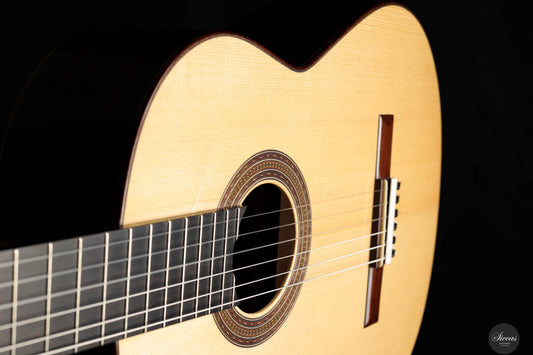
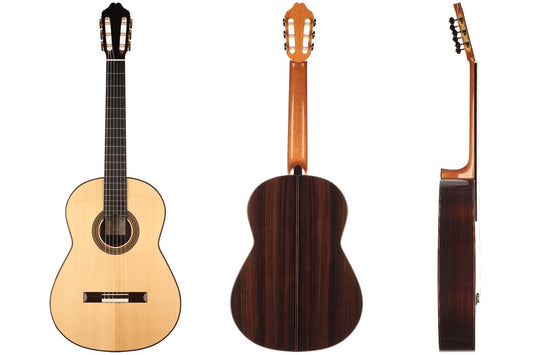
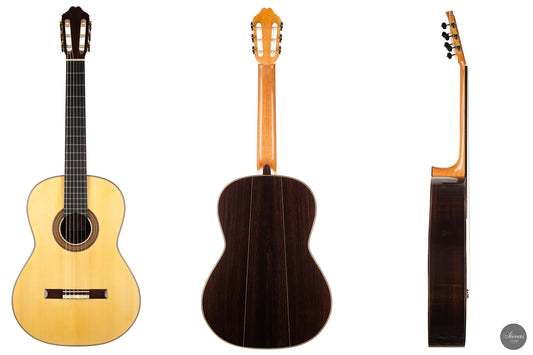
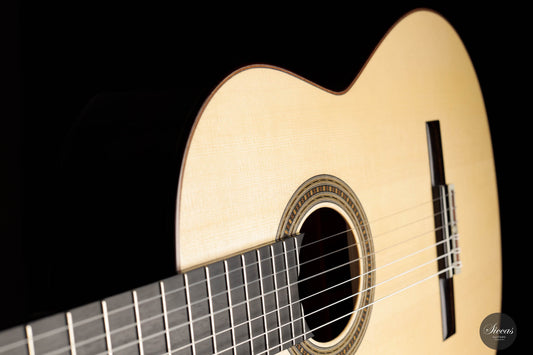
Each of his guitars is built using a traditional approach informed by detailed acoustic research. Ligier produces around eight guitars per year, typically featuring a spruce soundboard with a fan bracing system. The back is reinforced for enhanced projection and complemented by a double-sided construction. His intricate rosette designs—continuously evolving—have become a signature element of his artistic identity, symbolizing the precision and sensitivity that define his craft.