

Simon Marty
-

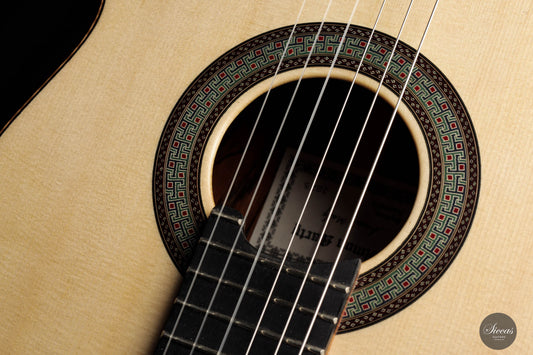 SoldSoldLuthier: Simon Marty
 -
Luthier: Simon MartyConstruction Type: LatticeConstruction Type: Short Scale
-

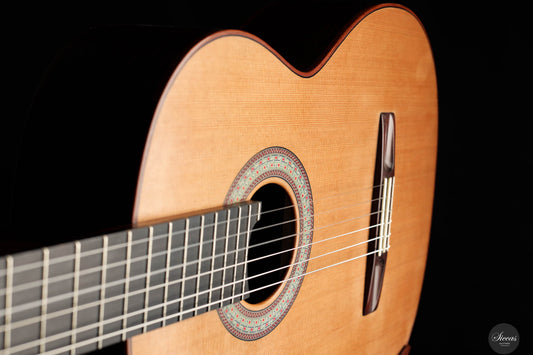 SoldSoldLuthier: Simon Marty
 -
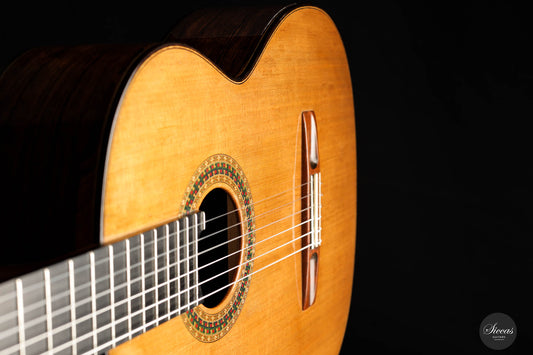
Luthier: Simon Marty




Frequently Asked Questions About Classical Guitars
How do I choose the right classical guitar for my level?
Choosing the right classical guitar depends on your playing level, musical goals, and budget. Beginners benefit from studio-model guitars from renowned workshops, while advanced players and professionals often choose a handmade master guitar. We are happy to advise you personally and can send detailed sound samples and videos on request.
What is the difference between a master guitar and a studio guitar?
Master guitars are built entirely by hand in the workshop of a single luthier, using only high-quality, well-aged tonewoods. Studio guitars are made in small series, often under the supervision of the master luthier, and offer excellent value for students and ambitious amateur players.
Can I try a classical guitar at home for 14 days?
Yes — every guitar you purchase from us comes with a 14-day home approval period. This complimentary trial applies worldwide to all orders, whether you are in Germany, Europe, the USA, Asia or anywhere else. We ship your instrument fully insured in a high-quality case so you can play it under your own acoustic conditions. If the guitar is not the right one for you, simply send it back and receive a full refund of the purchase price.
Can I try a classical guitar before purchasing?
Absolutely. You are warmly invited to visit our showroom in Karlsruhe, Germany, and test the instruments at your leisure. We are happy to schedule a personal appointment. If a visit is not possible, we send detailed videos and sound samples, and offer extensive consultation by phone or video call.
What payment methods and financing options do you offer?
We accept bank transfer, PayPal, major credit cards, and Klarna. For high-value instruments, we offer individual installment plans on request. Please contact us directly — we will find a suitable solution for every budget.
How do I properly care for my classical guitar?
A classical guitar requires constant humidity between 45 and 55 percent. Store the instrument in its case with a humidifier, avoid direct sunlight and large temperature fluctuations. Change the strings regularly and clean the guitar with a soft microfiber cloth.
You may also be interested Simon Marty
Simon Marty Guitars
The classical guitars crafted by Simon Marty need no introduction. After Greg Smallman & Sons, they are the second most popular Australian guitars among concert performers worldwide. We are fortunate to occasionally have a Simon Marty guitar in our collection. His waiting list is long, and acquiring one of his guitars is quite a wonder. We are lucky to have one from time to time.
His classical guitars are played by many concert artists, including Marco Tamayo, Annabel Montesinos, and Irina Kulikova, who particularly appreciate the definition and overall sound quality of his instruments.
Biographical Elements about Guitar Maker Simon Marty
Simon Marty is a trained engineer with a doctorate in engineering sciences and applies his research to develop innovative guitars featuring a “radial” bracing system that radiates in a star-shaped pattern from the bridge. The soundboard is not thin like in lattice guitars but rather thick, more in line with traditional guitars. This thickness contributes to a woody, full sound. Sustain is one of the strengths of this construction.
Simon has two passions: guitar making and surfing, which he enjoys for much of the year on the beaches of Indonesia. Another guitar maker, Jesse Moore, also occasionally builds guitars for us. Only three luthiers worldwide share the expertise in radial bracing guitars: Simon Marty, Jesse Moore, and Robin Moyes.
The Classical Guitars by Simon Marty
They are bright yet possess a certain velvetiness and a beautiful midrange. This brilliance allows for perfect polyphony that fills even the largest spaces. The playing feel is very similar to that of a traditional concert guitar, as the thicker soundboard allows the guitarist to “grip” the strings more naturally.