







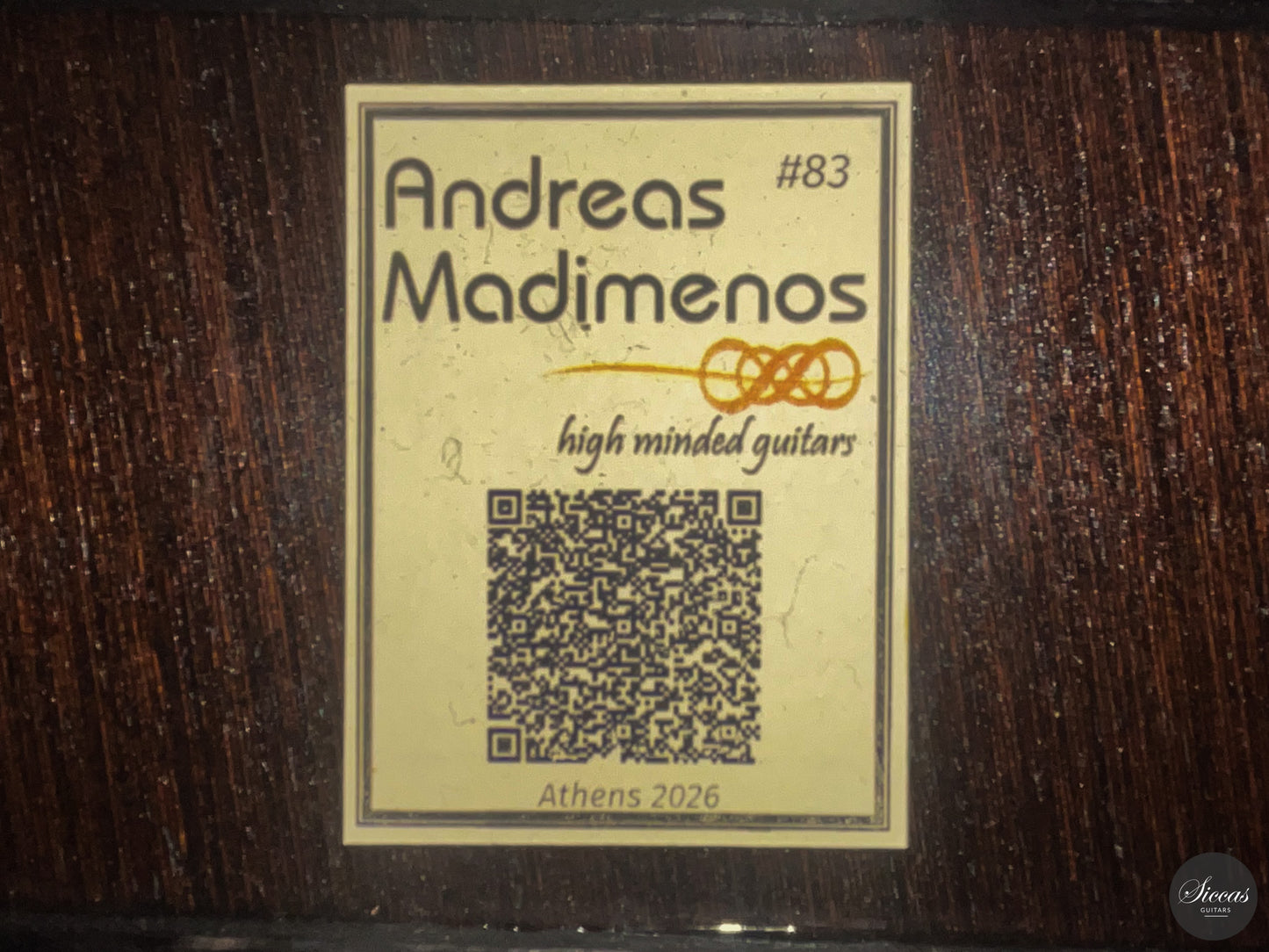
Andreas Madimenos - 2026 No. 83


Details
Details
Overview
Overview
Shipping important note
Shipping important note
Important: Additional costs such as import taxes and custom duties may occur when importing goods from the EU into your country.
Delivery times are typically reliable and most instruments arrive within the estimated timeframe.
Should any unexpected delay occur, our team will keep you informed and provide support at every step. For all shipping details and exceptions, please see our Shipping Policy.
Details about GPSR
Details about GPSR
Ask us - right here.
Enrico, our AI team member, replies around the clock.
Instant reply · free · no obligation Rather use WhatsApp


Video overview


More details about the guitar
About the luthier
Andreas Madimenos was born in Athens in 1984. After completing his musical studies, he studied Management and Financial Investments at the Athens University of Economics and Business before beginning his training in guitar making with Greek luthier Pavlos Gypas in 2014. Today he works from his own workshop, developing instruments that draw on both historical and modern ideas. His points of reference range from Vicente Arias and Johann Georg Stauffer to Thomas Humphrey, Greg Smallman and Zbigniew Gnatek, reflecting a broad interest in the evolution of guitar construction and in the relationship between structure, projection and responsiveness. Rather than following one established school, Madimenos continues to explore different construction concepts in search of a personal sound, always with musical control and expressive range at the centre of his work. Among the concert players using his instruments is Rafael Aguirre, who performs on one of Madimenos’s lattice guitars.
About the guitar
Power, immediacy and a dark, rounded tonal core define this 2026 Andreas Madimenos Doubletop No. 83. The guitar responds with striking ease: very little energy is required to bring the sound fully into motion, and notes seem to emerge almost at the instant the string is touched. This quick response gives the instrument a strong sense of presence, yet its power is not accompanied by a hard or aggressive attack. Instead, the sound remains soft around the edges, with a smoothness that allows incidental nail noise to recede naturally into the broader resonance.
One of its most distinctive qualities is the abundance of overtones. They rise easily around the fundamental and give sustained notes a broad, resonant halo without dissolving the tonal core. Harmonics respond with particular freedom, making the guitar especially rewarding in repertoire where upper partials, resonance and lingering sonorities form part of the musical texture. The lower register is deep and substantial, while the overall sound retains a rounded quality even when played with considerable energy. There is considerable volume available, but the guitar does not need to be pushed to reveal it; the response is already alive at a light touch, allowing dynamics to develop from a very responsive foundation.
The construction behind this behaviour represents a new direction in Madimenos’s work. The cedar–Nomex–cedar double top uses his “springs” bracing system, conceived to create an exceptionally lightweight soundboard while reinforcing selected areas with wood. A carbon frame beneath the top forms part of this system, while a second carbon structure reinforces the back. Developed in collaboration with Koumridis, this approach allows Madimenos to control stiffness and stability while keeping the vibrating structure comparatively light. The laminated Indian rosewood back and sides follow the same idea, helping to keep the overall construction lighter than his lattice guitars.
Although certain elements grow out of Madimenos’s experience with lattice construction, the way the soundboard works is fundamentally different. His intention with this Doubletop concept is to combine power, depth, sustain and overtone richness with a more natural and rounded tonal response. In No. 83, these qualities come together convincingly: the guitar has the immediacy and projection associated with modern construction, but its voice remains broad, soft-edged and resonant rather than overtly brilliant. The matched colours of the rosette, bindings and tie block complete the design with a coherent visual identity, while the elevated fingerboard and armrest underline the instrument’s contemporary concert-guitar concept.
Regular care extends the life of the instrument
Even with careful use, a classical guitar may gradually change in appearance or respond to unstable storage conditions. Have a close look at your guitar regularly and be attentif to changes. If your instrument is suffering from its environement, it will let you know.
Protect Your Guitar: Handle with Care
Be mindful when touching your instrument with greasy or unwashed hands: any skin contact is a small attack on the varnish. Of course, a guitar is made to be played, but taking a few precautions helps preserve its beauty: wash your hands before playing, wear long sleeves, and avoid unnecessary direct skin contact with the body of the instrument.
Pro tip: Avoid playing with a button-up shirt, heavy jewelry, or a belt, as these can scratch the guitar. Also, make sure your guitar case is free of any objects that could damage the instrument during storage.
String care
A good habit to adopt is wiping down your strings briefly after each playing session. This small action significantly extends their lifespan and helps maintain a consistent, comfortable feel under your fingers.
Most importantly, clean strings are essential for keeping your instrument in tune. Corrosion, sweat, and dust can affect the uniformity of the strings and interfere with accurate tuning across the entire fingerboard.
Pro tip: If you're having trouble getting your guitar in tune, it might be time to change the strings. A useful test is to compare the pitch of the 12th fret harmonic with the fretted note at the 12th fret; if there's an unusually large gap between them, your strings may have lost their integrity and should be replaced.
Keep Your Shellac Finish Shining!
Got a guitar with a shellac (French polish) finish? Here's a simple trick: Take a clean microfiber cloth and gently breathe on the surface to create a light mist. Then, softly rub to remove fingerprints, sweat, and grease. That’s usually all it takes to keep it looking great, no products needed!
Pro tip: Every few years, treat your guitar to a check-up with a luthier to keep it in top shape.
Storing Your Guitar: Climate Matters
Your guitar can safely stay outside its case, as long as the surrounding environment maintains 42–55% humidity and a temperature between 18–25°C.
Keep in mind that humidity levels can still fluctuate inside the case, especially during seasonal changes.
- Too much humidity may cause overtightened strings and a dull tone.
- Too little humidity can lead to a bulging top, string buzz, or even cracks.
Avoid placing your guitar near radiators, air conditioners, or windows with direct sunlight.
Pro tip: Always close your guitar case while playing. This helps preserve a stable microclimate inside the case, so your instrument is protected the moment you put it back in.
Related guitars
Frequently Asked Questions About Classical Guitars
How do I choose the right classical guitar for my level?
Choosing the right classical guitar depends on your playing level, musical goals, and budget. Beginners benefit from studio-model guitars from renowned workshops, while advanced players and professionals often choose a handmade master guitar. We are happy to advise you personally and can send detailed sound samples and videos on request.
What is the difference between a master guitar and a studio guitar?
Master guitars are built entirely by hand in the workshop of a single luthier, using only high-quality, well-aged tonewoods. Studio guitars are made in small series, often under the supervision of the master luthier, and offer excellent value for students and ambitious amateur players.
Can I try a classical guitar at home for 14 days?
Yes — every guitar you purchase from us comes with a 14-day home approval period. This complimentary trial applies worldwide to all orders, whether you are in Germany, Europe, the USA, Asia or anywhere else. We ship your instrument fully insured in a high-quality case so you can play it under your own acoustic conditions. If the guitar is not the right one for you, simply send it back and receive a full refund of the purchase price.
Can I try a classical guitar before purchasing?
Absolutely. You are warmly invited to visit our showroom in Karlsruhe, Germany, and test the instruments at your leisure. We are happy to schedule a personal appointment. If a visit is not possible, we send detailed videos and sound samples, and offer extensive consultation by phone or video call.
What payment methods and financing options do you offer?
We accept bank transfer, PayPal, major credit cards, and Klarna. For high-value instruments, we offer individual installment plans on request. Please contact us directly — we will find a suitable solution for every budget.
How do I properly care for my classical guitar?
A classical guitar requires constant humidity between 45 and 55 percent. Store the instrument in its case with a humidifier, avoid direct sunlight and large temperature fluctuations. Change the strings regularly and clean the guitar with a soft microfiber cloth.