





This guitar is sold – but we may have something similar.
Our experts know every guitar in the house and are happy to advise you personally.
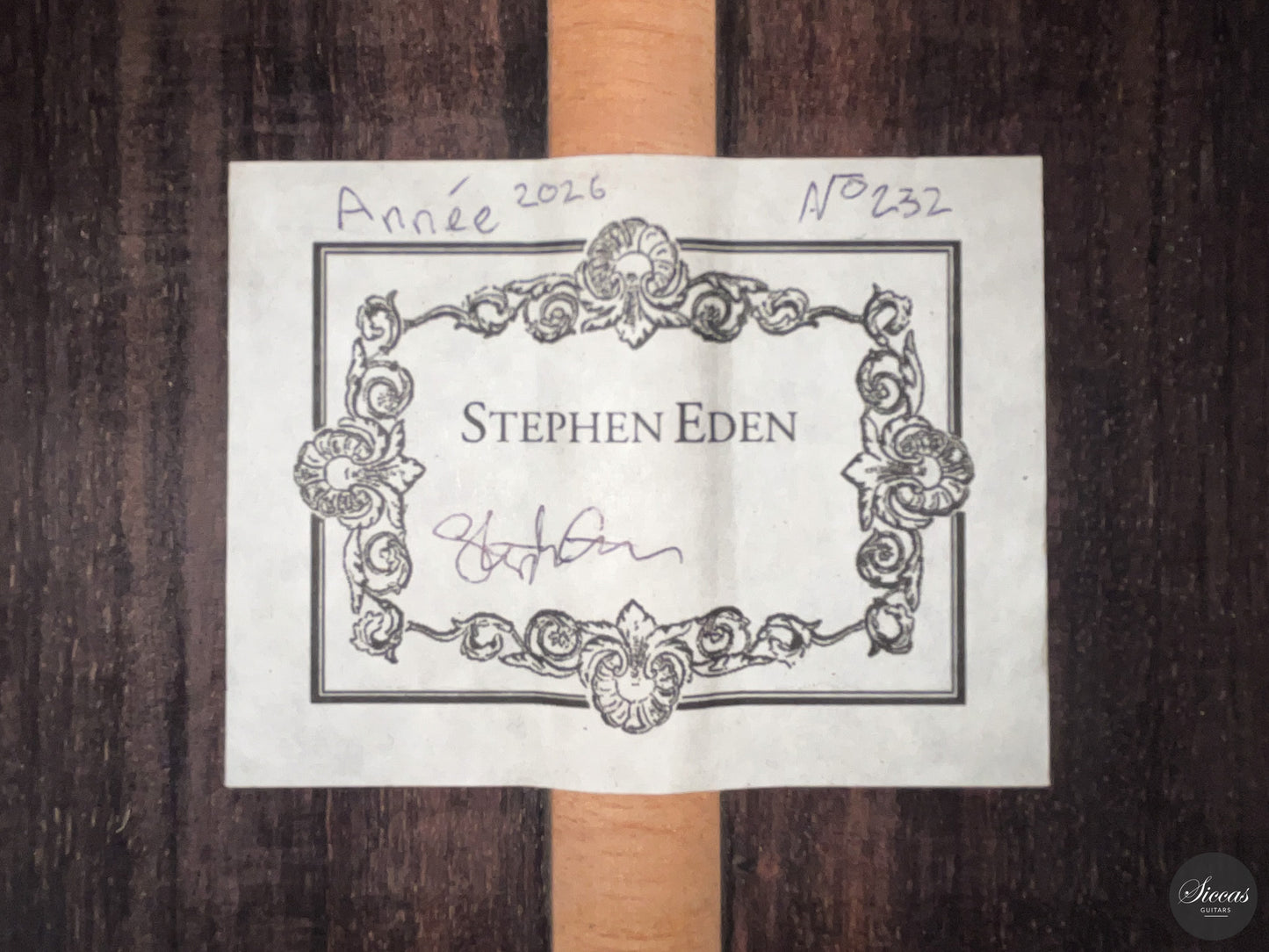
Ask about similar guitarsStephen Eden - 2026 "Daniel Friederich 1980" No. 232
Details
Details
Overview
Overview


Video overview


More details about the guitar
About the luthier
Stephen Eden is a British luthier based in Bexhill-on-Sea, where he has developed a refined and versatile approach to classical guitar making. His path began in 2004 with evening classes under Stephen Hill, followed by a traditional two-year apprenticeship with Pablo Requena, which gave him a strong foundation in handcraft, structure, and sound. Since establishing his own workshop in 2008, Eden has built instruments inspired by some of the great traditions of the classical guitar, including the work of Torres, Santos Hernández, Hermann Hauser, and Daniel Friederich. His guitars have reached players internationally and have been used by distinguished musicians such as Paul Gregory, Juan Martin, Sean Shibe, Ian Watt, Andrew Gough, Gaëlle Solal, Pavel Ralev, Bridget Mermikides, and Raphaella Smits.
About the guitar
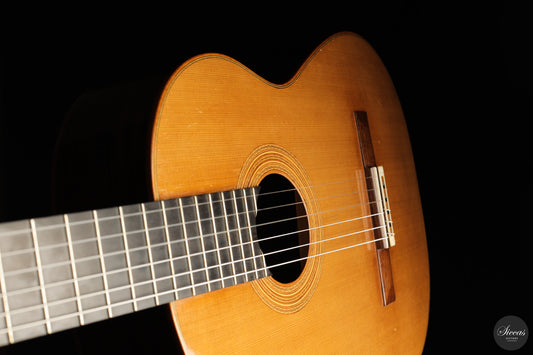
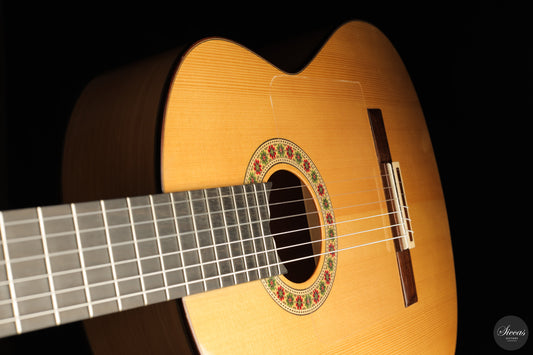
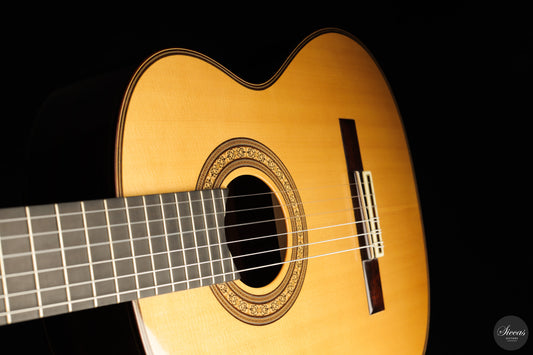
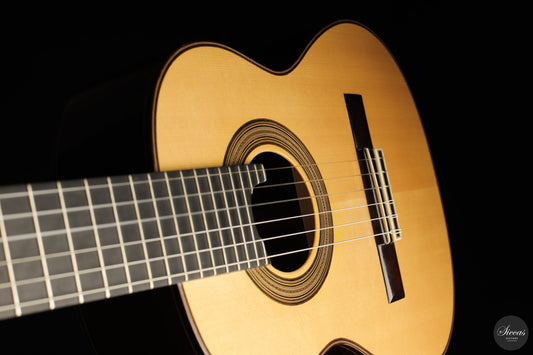
This 2026 Stephen Eden is a traditional concert guitar conceived as an homage to Daniel Friederich, drawing on the character of the French master’s concert instruments while remaining a contemporary work by Eden. Built with a cedar top, Indian rosewood back and sides, and double sides, it aims for the breadth, sustain, and concentrated tonal core associated with Friederich’s mature concert guitars. The result is an instrument with a deep centre to the sound: notes do not merely speak and disappear, but continue with remarkable length and a singing quality that gives melodic lines a strong sense of direction.
Its musical strength lies in the combination of density and balance. The sound has a full, rounded core, yet the registers remain even and clearly proportioned, allowing scales, chords, and contrapuntal textures to carry with consistent intensity across the fingerboard. The sustain is especially striking, giving the player time to shape the decay of each note and to connect phrases with an almost vocal continuity. There is a sense of orchestral control in the way the guitar responds: basses provide depth and gravity, trebles retain focus and persistence, and the overall voice invites nuanced shaping rather than forcing the player into one fixed colour.
The Daniel Friederich reference is present not as imitation alone, but as an acoustic ideal: long resonance, strong inner substance, excellent balance, and a refined concert personality. For players drawn to the Friederich sound world but looking for a new instrument by a contemporary British maker, this Stephen Eden offers a compelling combination of structural clarity, musical seriousness, and expressive range.

While this one is sold, these are ready for you
-
Classical Guitars
The classical guitar, with its soft nylon strings and characteristic timbre, has become a symbol of chamber music, Spanish tradition, and concert repertoire. Its modern form was shaped by Antonio de Torres in the 19th century, setting the standard for the body, fan bracing, and the 65-centimeter scale length that are still used today. Instruments in this category open up a rich palette from the refined Romantic miniatures of Tárrega to the majestic concertos of Rodrigo. Here you will find guitars that preserve historical continuity and at the same time inspire new interpretations.Look all products of the collection -

 Reserved
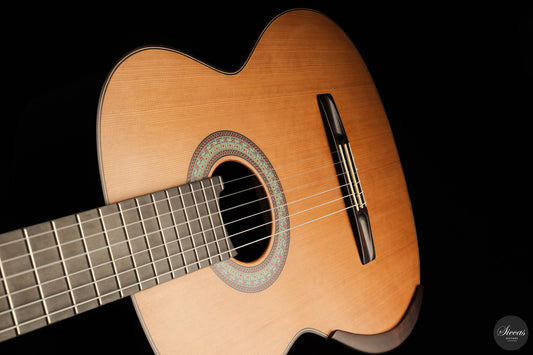
Simon Marty - 2026 Classical Guitar
Price on requestReservedLuthier: Simon Marty -
Gerhard Oldiges - 1993
Price: 4.990 €Unit price per Tax free (0% DE)Luthier: Gerhard OldigesConstruction Type: Traditional -

 Reserved
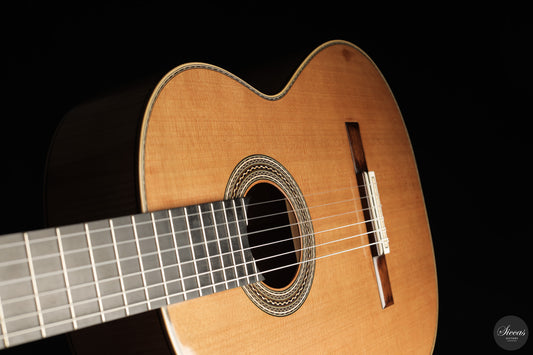
Karel Dedain - 2026 Concert No. 06
Price: 10.990 €Unit price per Tax free (0% DE)ReservedLuthier: Karel DedainConstruction Type: Traditional -
Siccas Luthiers - Halo Traditional Spruce 63 cm
Sale price 1.790 € Price:Unit price per Tax free (0% DE)1.990 €Save: 200 €Pre-OrderManufacturer: Siccas LuthiersManufacturer: Siccas LuthiersConstruction Type: TraditionalConstruction Type: Traditional -
Siccas Luthiers - Halo Traditional Spruce
Sale price 1.790 € Price:Unit price per Tax free (0% DE)1.990 €Save: 200 €Pre-OrderManufacturer: Siccas LuthiersManufacturer: Siccas LuthiersConstruction Type: TraditionalConstruction Type: Traditional -
Siccas Luthiers - Halo Traditional Cedar 63 cm
Sale price 1.790 € Price:Unit price per Tax free (0% DE)1.990 €Save: 200 €Pre-OrderManufacturer: Siccas LuthiersManufacturer: Siccas LuthiersConstruction Type: TraditionalConstruction Type: Traditional -

 Pre-Order
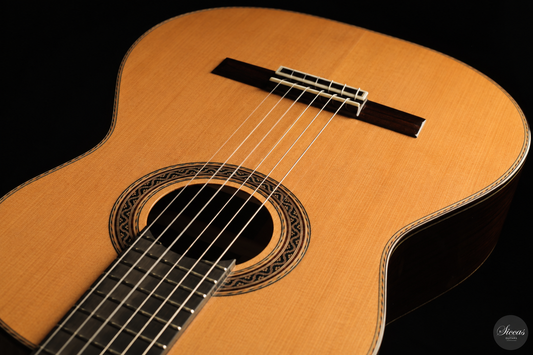
Siccas Luthiers - Halo Traditional Cedar
Sale price 1.790 € Price:Unit price per Tax free (0% DE)1.990 €Save: 200 €Pre-OrderManufacturer: Siccas LuthiersManufacturer: Siccas LuthiersConstruction Type: TraditionalConstruction Type: Traditional -
Fernando Moreno - 2019 "Rastrojo"
Price: 3.490 €Unit price per Tax free (0% DE)Construction Type: Flamenco -
Dieter Hense - 1989 "Terz" 82/109 57 cm
Price: 4.190 €Unit price per Tax free (0% DE)Construction Type: Traditional -
Dieter Hense - 1989 "Oktav " 81/109 39 cm
Price: 2.990 €Unit price per Tax free (0% DE)Construction Type: Traditional












Related guitars
Frequently Asked Questions About Classical Guitars
How do I choose the right classical guitar for my level?
Choosing the right classical guitar depends on your playing level, musical goals, and budget. Beginners benefit from studio-model guitars from renowned workshops, while advanced players and professionals often choose a handmade master guitar. We are happy to advise you personally and can send detailed sound samples and videos on request.
What is the difference between a master guitar and a studio guitar?
Master guitars are built entirely by hand in the workshop of a single luthier, using only high-quality, well-aged tonewoods. Studio guitars are made in small series, often under the supervision of the master luthier, and offer excellent value for students and ambitious amateur players.
Can I try a classical guitar at home for 14 days?
Yes — every guitar you purchase from us comes with a 14-day home approval period. This complimentary trial applies worldwide to all orders, whether you are in Germany, Europe, the USA, Asia or anywhere else. We ship your instrument fully insured in a high-quality case so you can play it under your own acoustic conditions. If the guitar is not the right one for you, simply send it back and receive a full refund of the purchase price.
Can I try a classical guitar before purchasing?
Absolutely. You are warmly invited to visit our showroom in Karlsruhe, Germany, and test the instruments at your leisure. We are happy to schedule a personal appointment. If a visit is not possible, we send detailed videos and sound samples, and offer extensive consultation by phone or video call.
What payment methods and financing options do you offer?
We accept bank transfer, PayPal, major credit cards, and Klarna. For high-value instruments, we offer individual installment plans on request. Please contact us directly — we will find a suitable solution for every budget.
How do I properly care for my classical guitar?
A classical guitar requires constant humidity between 45 and 55 percent. Store the instrument in its case with a humidifier, avoid direct sunlight and large temperature fluctuations. Change the strings regularly and clean the guitar with a soft microfiber cloth.