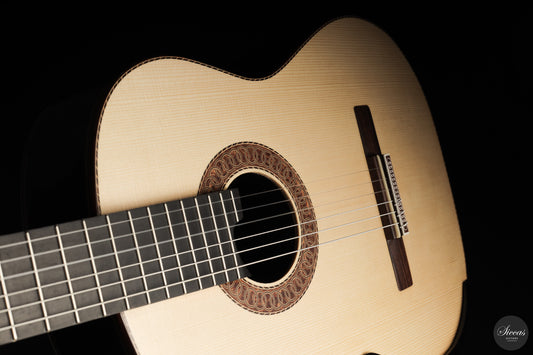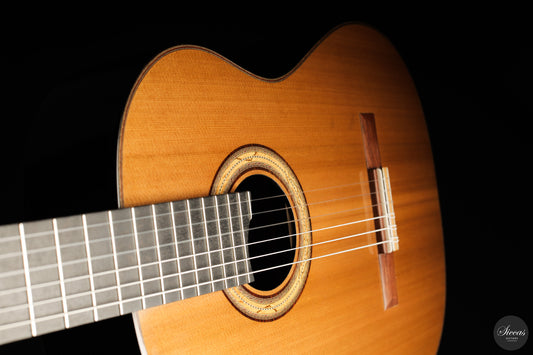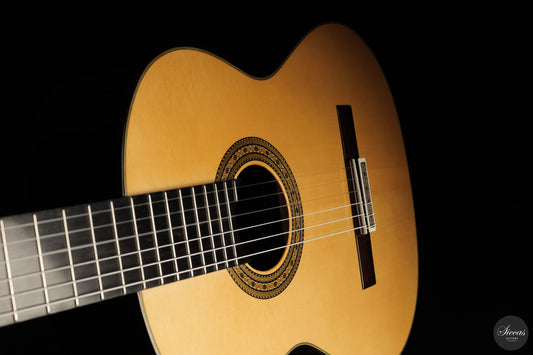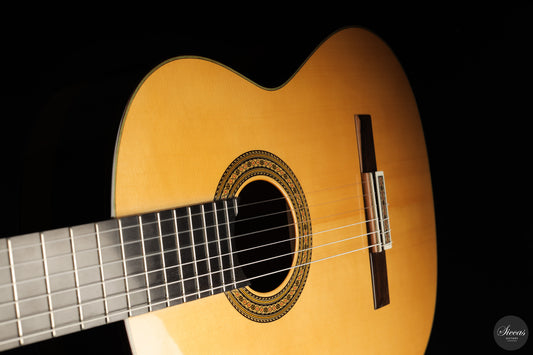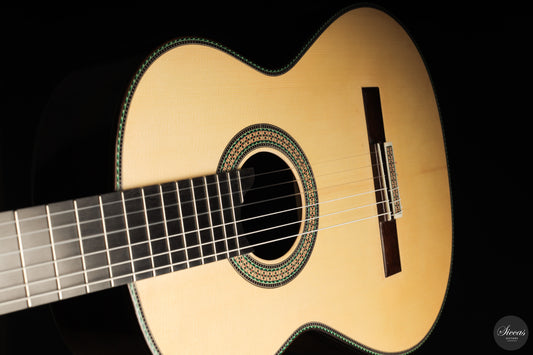

Adrian Neher builds classical guitars in Pernes-les-Fontaines in the south of France. His workshop at 40 Place Reboul is open to visitors by appointment, and he belongs to Les Ateliers de Pernes, the town's association of art craftspeople. He trained in Germany, at the instrument-making schools of Mittenwald and Markneukirchen, and his model Circé takes the Spanish guitar as its starting point while relying entirely on European woods.
Training
Neher began his apprenticeship in 2015 at the state vocational school for musical instrument making in Mittenwald. After completing it, he went on to a bachelor's degree at the Westsächsische Hochschule Zwickau (WHZ), which he finished with the master craftsman's title and with the best instrument of his year. He then completed a master's degree in the acoustics and technology of musical instrument making, also at the WHZ, before setting up on his own.
During his training he worked with Michael Batell, Adrian Heinzelmann, Simon Burgun and Christopher Schuetz. His first internship was with Schuetz in Villes-sur-Auzon, and the experience confirmed his choice of profession. Neher also names Gabriel Seitner, Manuel Arango, Lisa Duchêne, Jakob Biehler, Christina Müller and Johanna Vogl as strong influences. He has a particular interest in how soundboards vibrate and has refined his techniques in further courses. When he assembles the structure of a top, he says, he is looking for the best possible vibration, aware that the sound changes with every wood he uses.
The Circé model
Neher describes Circé as a guitar with a classical design language. Its direct models are Spanish, above all Antonio de Torres and the workshop of Hernández y Aguado. In construction he combines traditional Spanish guitar making with a more modern approach. The sound he looks for is intimate, with a full bass and a bright treble.
Wood with short journeys
Where Neher departs most clearly from the Spanish tradition is in his materials. Many of the woods used in classic Spanish guitars have become scarce, and he also wants to avoid the ethical dilemmas attached to them. He therefore works only with European timber that has travelled as short a distance as possible, and most of it is followed from the tree to the finished tonewood.
The top is almost always spruce. For back and sides he uses maple, cherry, ash, apple or pear and smoked oak. Maple and cherry also serve for necks, and smoked oak appears in decorative details. As a result, the body wood can change from one guitar to the next, while the top is almost always spruce.
Repairs and setups
Besides building new instruments, the workshop takes on repairs. Lifting bridges, cracked tops and broken headstocks are typical jobs, along with setups and adjustments to a player's individual needs. This work is not limited to classical guitars: electric guitarists, bass players and steel-string players are welcome as well. Neher is a bass player himself and has performed in concerts with the Atelier jazz pernois, a local jazz group.
Instruments at Siccas Guitars
Siccas Guitars has two of Adrian Neher's guitars from 2026, No. 19 and No. 20. On his own website he presents exactly these two instruments as examples of the Circé model, and No. 19 carries the model name.