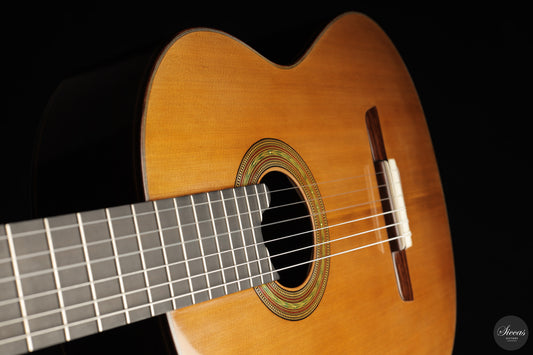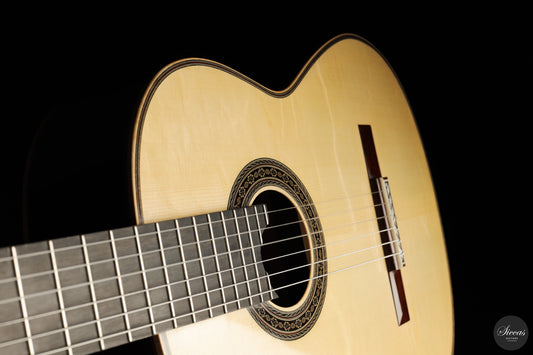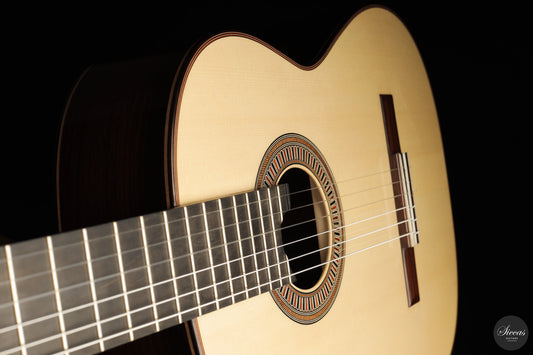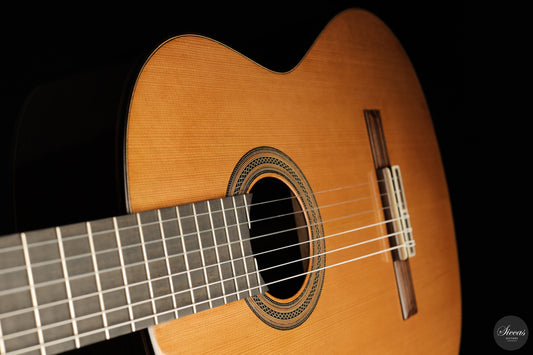

Andrea Stanzione is one of Italy's most compelling contemporary classical guitar makers — a craftsman whose instruments combine the warmth of the Spanish tradition with a distinctly personal aesthetic rooted in northern Italy's long history of fine woodworking. Based in Milan, Stanzione operates his workshop, Manifatture Sonore, from the quiet Villapizzone neighbourhood on the city's northwestern edge, where each guitar is built entirely by hand to concert standards. His work has earned him recognition among dealers and players across Europe, and his instruments are increasingly sought after by discerning musicians who value both tonal depth and visual refinement.
Biography & Training
Andrea Stanzione was born and raised in Lissone, a small town north of Milan in the Brianza region — an area historically renowned for the production of high-quality artisanal furniture. It was by frequenting the local workshops of furniture makers and carpenters that Stanzione first developed a feel for wood and an appreciation for traditional hand craftsmanship. Yet his formal education initially took a different path: he trained as an electrical technician before deciding, around 2001, to follow his deeper vocation.
That year he enrolled in the Civic School of Luthiery in Milan, one of Italy's most respected institutions for instrument making. He graduated with honours in 2005, already demonstrating the attention to detail and technical command that would define his mature work. The years immediately following graduation were ones of consolidation: Stanzione combined guitar building with carpentry work, building up his practical skills and beginning to develop his own approach to the instrument.
The decisive turning point came around 2009, when he met master luthier Enrico Bottelli. Their collaboration, which extended over several years, proved formative. Bottelli deepened Stanzione's understanding of the traditional Spanish classical guitar — its construction logic, its structural principles, and the aesthetic values that underpin the finest instruments of that lineage. This period gave Stanzione both a rigorous technical foundation and a confident point of departure for his own voice as a maker. Among the broader community of classical guitar makers, the influence of the Spanish school remains central, and Stanzione's work is firmly grounded in that tradition.
Construction Philosophy
Stanzione builds his instruments with an unwavering commitment to quality at every stage: wood selection, structural geometry, finish, and decoration are all treated as integral to the final result. His guitars are not mass-produced, and each instrument is understood as a singular object shaped by the particular properties of the wood in hand. He works with tonewoods that have been well seasoned, choosing materials not only for their acoustic potential but for the character they bring to the finished instrument.
His REG model — arguably the centrepiece of his output — features a spruce soundboard braced with a symmetrical nine-radius bamboo fan, complemented by a cedar lower bridge plate and spruce struts. The combination produces an instrument with notable tonal clarity and quick dynamic response. Back and sides are kept exceptionally thin to allow free vibration and maximise the contribution of the body to the guitar's overall resonance. The neck, typically in well-seasoned mahogany, is joined to an ebony fingerboard with a carefully considered crossover radius that supports both left-hand comfort and intonation across the full range of the instrument.
Aesthetically, Stanzione's guitars are immediately recognisable for their refined decorative sensibility. Walnut-body models, for instance, incorporate ebony bindings and centre-back strips, flamed walnut top borders, and a rosette of double flamed walnut rings — details that reflect the maker's background in a region where decorative woodwork is a living tradition. This integration of visual craft and tonal purpose sets his instruments apart from builders who treat decoration as an afterthought. His approach shares something of the philosophical depth discussed in an overview of fan-braced, double-top and lattice guitar construction, though Stanzione remains committed to the fan-braced Spanish form.
Signature Models
Stanzione's catalogue centres on a small number of models that he refines iteratively across annual production cycles. The REG Limited Edition series — produced in very limited numbers each year — represents the summit of his output and has become the model most associated with his name in the international market. Each year's REG edition is distinguished by specific material choices and decorative treatments, meaning that no two years' instruments are identical even within the same model designation. This approach keeps the work alive and responsive rather than locked into repetition.
Beyond the REG, Stanzione builds instruments in spruce and walnut, cedar-topped variants, and occasional special commissions. The consistent throughline across all his models is the quality of execution: joinery, graduation, and finishing are carried out to the standard expected of top-tier concert instruments. His guitars have been stocked and reviewed by leading European dealers and have appeared in specialist guitar auctions, a reliable indicator of market confidence in an instrument's long-term value.
Notable Players and Collaborations
Stanzione's reputation extends beyond his individual workshop through his participation in collaborative projects that bring together Italy's finest instrument builders. Most notably, he was among the twenty Italian master luthiers selected to contribute to Italica — a singular concert guitar assembled from parts built by makers from across the country, each contributing their specific expertise to a different section of the instrument. The Italica project, documented at Siccas Guitars, stands as both a playable concert instrument and a statement about the depth and continuity of Italian lutherie as a living tradition. Being included among those twenty makers is itself a mark of standing within the community.
While specific concert artists who play Stanzione's guitars are not always publicly documented — as is common with many contemporary Italian makers — his instruments have found their way into the hands of professional players through European dealers and competitions. The calibre of craftsmanship he brings to each guitar speaks to a musician's market, and the consistent demand for his limited annual editions suggests a loyal and growing player base.
Legacy and Place in Italian Lutherie
Andrea Stanzione represents a generation of Italian luthiers who have absorbed the lessons of the great Spanish tradition — the lineage running from the nineteenth-century masters through figures like Ignacio Fleta and José Luis Romanillos — and are now producing instruments that reflect both that inheritance and a distinctly Italian sensibility. Italy has its own rich history of instrument making, and the Brianza region's craft traditions give makers like Stanzione a particular advantage: a deep, practical familiarity with wood and joinery that extends well beyond the guitar workshop.
His decision to work within the Spanish tradition while bringing his own decorative and tonal sensibility to it positions him as a maker who respects the canon without being constrained by it. Each year's limited editions show a luthier still actively developing, still curious, and still committed to the proposition that a handmade concert guitar is among the finest objects a craftsman can produce. For players seeking an instrument with strong tonal character, visual distinction, and the quiet assurance that comes from genuine artisanship, Stanzione's guitars merit serious consideration alongside the most respected names in contemporary European lutherie. His contribution to the broader conversation about what Italian guitar making can achieve in the twenty-first century is already substantial — and, given the trajectory of his career, very much ongoing.
Browse available Andrea Stanzione guitars → in the Siccas Guitars collection.